Why “More Data” Doesn’t Mean a Better Cricket Betting Model
It’s tempting to assume that a cricket betting model gets better the more data you throw at it, every batting average, every ground statistic, every weather reading going back a decade. In practice, the opposite often happens. Models drown in irrelevant variables, overfit to historical quirks, and end up chasing noise instead of signal.
A genuinely useful cricket betting model isn’t judged by data volume, it’s judged by data relevance. The best systems, whether built by professional quants or by AI-driven cricket apps, tend to converge on the same handful of high-impact categories: recent form, conditions, matchups, and match situation. Everything else is either supporting context or statistical filler.
This is the core idea worth internalizing before going further: a cricket match outcome is a function of current conditions interacting with current form, not a static comparison of two teams’ all-time numbers.
Pitch and Venue Data: The Foundation of Any Cricket Betting Model
If there’s one dataset that separates a serious cricket betting model from a casual guess, it’s pitch and venue history. Cricket, unlike most global sports, is played on surfaces that vary dramatically from ground to ground and even session to session on the same pitch.
Key venue-level data points that matter:
- Average first-innings and second-innings scores at that venue over the last 2–3 seasons
- Chase success rate — some grounds are notoriously good venues to bat second, others heavily favor the team batting first
- Pace vs. spin split — how many wickets fall to seamers versus spinners at that venue
- Boundary dimensions and outfield speed, which affect scoring rates independent of batting quality
- Historical toss-decision trends at that specific venue
A pitch that has produced low, two-paced totals in its last five matches tells a very different story than raw team strength numbers would suggest. This is why serious models weigh recent venue data more heavily than data from years ago, pitches get relaid, drainage improves, and groundstaff behavior changes over time.
Player Form vs. Career Averages
One of the most common mistakes in cricket prediction is leaning too hard on career statistics. A batter’s lifetime average tells you about their career, not about how they’re playing right now. A cricket betting model built well will always prioritize a rolling window of recent form over static lifetime numbers.
What “form” data actually looks like in a good model:
- Runs and strike rate across the last 8–10 innings, not the full career
- Recent performance broken down by bowling type faced (pace vs. spin, left-arm vs. right-arm)
- Current tournament form vs. historical form in that format
- Bowlers’ recent economy rate and wicket-taking frequency in the powerplay, middle overs, and death oversseparately, since a bowler’s overall economy can hide big situational weaknesses
The reason recency matters so much in cricket specifically is that technique, fitness, and confidence shift quickly, a player returning from injury or a slump behaves statistically differently than their five-year average suggests.
Head-to-Head Records: Useful Signal or Overrated Stat?
Head-to-head (H2H) statistics are among the most publicized numbers in cricket previews, and also among the most misused. A team’s 8-2 win record against an opponent over the last decade sounds meaningful, but most of that data is often outdated: different players, different conditions, sometimes even a different format era.
Where H2H data genuinely helps:
- Player vs. player matchups — a specific batter’s record against a specific bowler type (e.g., a left-hander’s record against left-arm wrist-spin) carries real predictive value
- Recent head-to-head only — the last 3–5 meetings, ideally in similar conditions, are far more useful than a 15-match historical record
- Format-specific H2H — Test match history has almost no bearing on a T20I head-to-head
Where it doesn’t help: using overall win-loss records as a standalone predictor. Team compositions change too much year to year for old H2H data to carry much weight on its own.
Weather and Toss Data
Weather is an underrated input in most casual predictions but a heavily weighted variable in professional cricket betting models. Cloud cover, humidity, and dew all directly affect ball behavior, swing bowlers thrive under overcast skies, while dew in evening matches makes the ball skid onto the bat and historically favors the chasing team in day-night fixtures.
Relevant weather and toss inputs:
- Cloud cover and humidity forecasts for the match window, not just the day
- Historical dew impact at that specific venue for day-night matches
- Toss decision patterns, captains at grounds with strong dew factors will almost always choose to bowl first
- Rain probability and DLS (Duckworth-Lewis-Stern) implications, which change the shape of a run chase entirely
Because weather data is time-sensitive, it’s one of the few inputs that needs to be refreshed close to match time rather than sourced days in advance.
Team News, Squad Depth, and Injuries
A prediction model is only as good as its most current inputs, and nothing goes stale faster than team news. . A single injury to a strike bowler or an opener can shift a match’s probability more than months of historical data.
What to track here:
- Confirmed playing XI, since predicted XIs can differ significantly from the final lineup
- Injury replacements and how the replacement player’s stats compare to the player they’re replacing
- Rest and rotation policies, especially in bilateral series where teams rotate fast bowlers
- Batting order changes, which affect powerplay and death-over data more than people expect
This is also where automated, real-time data feeds outperform manually updated models, team news breaks fast, often within an hour of the toss, and a model relying on yesterday’s lineup news is already behind.
Ball-by-Ball and In-Match Situational Data
Pre-match modeling gets you a starting probability. But cricket is a game that changes shape over, sometimes even ball, so any credible in-play cricket betting model depends on ball-by-ball data rather than end-of-innings summaries.
Situational data that matters once the match is underway:
- Run rate required vs. resources remaining (wickets in hand, overs left)
- Partnership context — a well-set batting pair changes win probability more than raw required run rate alone suggests
- Powerplay and death-over splits, since a team’s ability to score in the final five overs is a distinct skill from their overall strike rate
- Momentum indicators like recent boundary frequency and dot-ball percentage
This is the layer where academic research has been most active. Studies using ball-by-ball datasets, including context-aware performance metrics that factor in opponent strength and match situation, have shown meaningfully better alignment with actual match outcomes than simple aggregate statistics, and have outperformed older situational tools like the standard Duckworth-Lewis-Stern method for judging player impact.
How Machine Learning Models Combine These Data Points
Modern cricket prediction systems rarely rely on a single statistic in isolation, they use machine learning techniques to weigh and combine dozens of variables simultaneously. A few approaches commonly used:
- Logistic regression for straightforward win/loss probability, since match outcomes are binary
- Random forests and gradient boosting for handling dozens of interacting variables (form, pitch, weather, matchups) without needing to manually specify how they interact
- Decision trees and neural networks, which have been applied specifically to cricket outcome prediction in academic research, particularly for capturing non-linear relationships between conditions and results
- Feature engineering — turning raw stats into derived indicators, such as combining a venue’s historical scoring data with a batting lineup’s average to produce a “ground-adjusted” expected score, or converting rest days into a fatigue-adjustment factor
The common thread across all of these approaches is validation discipline: splitting historical data into training and testing sets, and checking model output against a calibration measure (like the Brier score) rather than just raw accuracy. A model that’s right 60% of the time but wildly overconfident is less useful than one that’s honestly calibrated, because calibrated probabilities are what let you compare a model’s output against bookmaker odds and spot value.
Common Data Traps That Weaken a Cricket Betting Model
Even data-rich models fail when they fall into a few recurring traps:
- Overweighting sample sizes that are too small: three matches of “good form” can be noise, not signal
- Ignoring format context: mixing Test, ODI, and T20 data together distorts strike rate and average comparisons
- Stale venue data: pitches get relaid and drainage improves; five-year-old ground stats can mislead
- Survivorship bias in H2H stats: old head-to-head records reflect squads that no longer exist
- Treating weather as static: forecasts change right up to the toss, and models using day-old weather data lose accuracy fast
Recognizing these traps is often what separates a model that merely looks sophisticated from one that’s actually predictive.
How AllCric Turns This Data Into Usable Match Insights
Everything above explains why certain data matters, AllCric is built around actually applying it. As an AI-first cricket intelligence platform, AllCric pulls together the exact categories of data covered in this guide, pitch behavior, player form, head-to-head trends, and weather conditions, into a single, continuously updated view instead of forcing users to piece it together from multiple sources.
Its AI Markets feature reflects the in-play data layer discussed above, updating win probability, predicted score ranges, and session predictions as a match evolves, using live match data alongside historical patterns and situational context. The Ask AI tool lets users query pitch behavior, player matchups, and venue trends directly, while AllCric’s fantasy team builder applies form, matchup, and venue data to suggest risk-aware, rule-compliant Head-to-Head, Small League, and Grand League team combinations. For anyone who wants the analytical rigor described in this article without manually tracking a dozen data sources, this is effectively that framework packaged into a live, match-day tool.
Conclusion
A strong cricket betting model isn’t built on the sheer quantity of statistics fed into it, it’s built on choosing the right data and weighting it correctly. Pitch and venue history set the baseline; recent player form and matchup-specific stats refine it; weather and team news adjust it right up to the toss; and ball-by-ball situational data keeps it accurate as the match unfolds. Head-to-head records and career averages, despite being the most commonly cited numbers in match previews, actually carry the least predictive weight unless narrowed down to recent, format-specific, and matchup-specific samples.
Whether you’re building your own prediction framework or relying on an AI-driven platform to do the heavy lifting, understanding which inputs matter, and why, is what separates informed match analysis from guesswork.


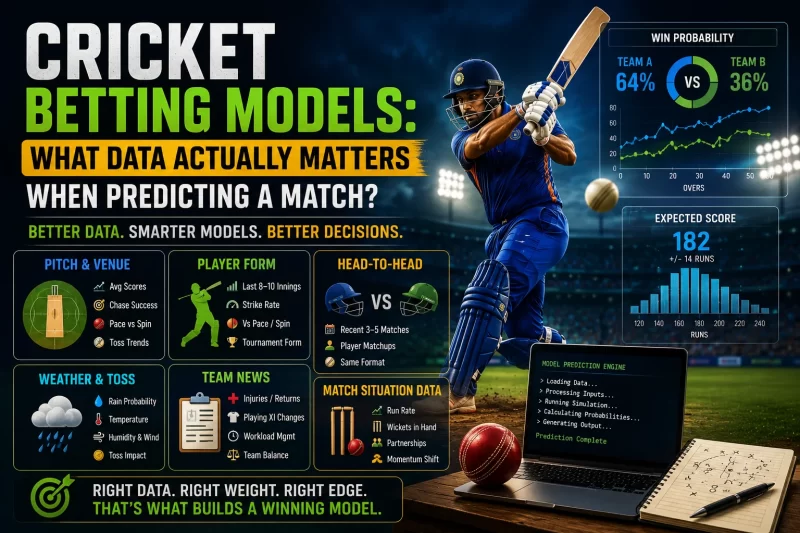 The most useful cricket betting models combine recent form, pitch conditions, weather, team news and live match data instead of relying on raw historical stats alone.
 Get expert Today cricket match predictions 100 sure, top picks & fantasy tips – Download AllCric App or visit AllCric Website