What Is Implied Probability in Cricket Betting?
Implied probability is the percentage chance of an outcome happening, as suggested by the odds a bookmaker offers. When you see India priced at 1.80 to beat Australia, that number isn’t arbitrary, it’s a coded probability estimate. Implied probability cricket betting is simply the skill of decoding that number.
The key word is “implied.” The percentage isn’t a guaranteed truth about the future; it’s the bookmaker’s estimate, adjusted to include their profit margin. Once you know how to read it, implied probability becomes a lens for interpreting every cricket market, match winner, top run-scorer, method of dismissal, or session totals, as a probability statement rather than just a price.
Why Odds Are Really Just Probabilities in Disguise
Bookmakers don’t set odds by guessing randomly, they build them from statistical models, market demand, and risk management, then express the result as a price. The odds format (decimal, fractional, or moneyline) is just a different way of writing the same underlying number: how likely the bookmaker thinks that outcome is.
This matters for cricket specifically because odds shift constantly, after the toss, after an early wicket, after a rain delay. Every shift in the odds is really a shift in implied probability, reflecting new information the market has priced in. Learning to read implied probability means you’re reading the market’s real-time assessment of a match, not just a static number on a screen.
How to Calculate Implied Probability from Decimal Odds
Decimal odds are the standard format across most cricket betting markets, including exchanges and international sportsbooks. They’re also the easiest format to convert.
Formula: Implied Probability = (1 ÷ Decimal Odds) × 100
Example: If a team is priced at 2.50 to win, the calculation is: 1 ÷ 2.50 = 0.40 → 40% implied probability
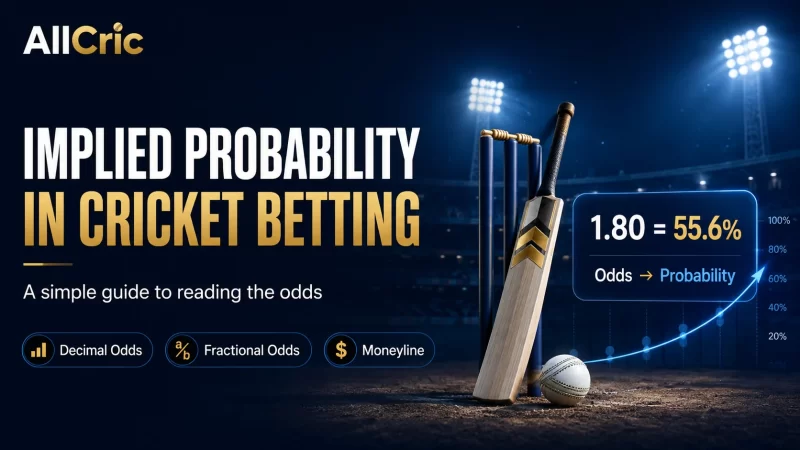
If the odds shorten to 1.80 (a bigger favorite), the calculation becomes: 1 ÷ 1.80 = 0.556 → 55.6% implied probability
The rule to remember: lower decimal odds mean a higher implied probability, because the bookmaker is paying out less relative to the stake for an outcome they consider more likely.
How to Calculate Implied Probability from Fractional Odds
Fractional odds (like 5/1 or 4/6) are still common in UK-facing cricket betting markets. Converting them requires a slightly different formula.
Formula: Implied Probability = Denominator ÷ (Numerator + Denominator) × 100
Example: For odds of 5/1: 1 ÷ (5 + 1) = 0.1667 → 16.7% implied probability
Example: For odds of 4/6 (a favorite): 6 ÷ (4 + 6) = 0.60 → 60% implied probability
Fractional odds can feel less intuitive at first glance, but once converted, they follow the exact same logic as decimal odds, shorter odds mean a higher implied chance of that outcome occurring.
How to Calculate Implied Probability from Moneyline (American) Odds
Moneyline odds are used less often in cricket than in US sports betting, but they occasionally appear on international platforms, so it’s worth knowing the conversion.
For positive odds (underdogs): Implied Probability = 100 ÷ (Odds + 100) × 100 For negative odds (favorites): Implied Probability = |Odds| ÷ (|Odds| + 100) × 100
Example: +200 odds → 100 ÷ (200 + 100) = 33.3% implied probability Example: −150 odds → 150 ÷ (150 + 100) = 60% implied probability
Regardless of format, the underlying math always answers the same question: what break-even win rate would this price need to hit for a bet to be profitable long-term?
Why Implied Probabilities Add Up to More Than 100%
Here’s where implied probability gets interesting. In a genuinely fair two-outcome market, the probabilities of both sides should add up to exactly 100%. In real cricket betting markets, they almost never do, they typically add up to somewhere between 103% and 108%.
That extra percentage is the bookmaker’s built-in profit margin, commonly called the overround, vig, or juice. It’s how bookmakers guarantee a profit margin regardless of the outcome, by pricing both sides of a market slightly higher than their true statistical chance.
Example: In a two-team cricket match, if Team A is priced at 1.90 (52.6% implied) and Team B is also at 1.90 (52.6% implied), the total comes to 105.2%. That extra 5.2% is the bookmaker’s margin.
Removing the Vig: Finding “True” Probability
Because implied probability includes the bookmaker’s margin, it’s not the same as the true statistical probability of an outcome. To estimate the “fair” probability with the margin stripped out, you can normalize the numbers.
Method: Divide each outcome’s implied probability by the total implied probability of the market.
Example: If Team A’s implied probability is 52.6% and Team B’s is 52.6% (adding to 105.2% total):
- Team A fair probability = 52.6 ÷ 105.2 = 50%
- Team B fair probability = 52.6 ÷ 105.2 = 50%
This “no-vig” number is closer to what the market actually believes about the match, and it’s the number worth comparing against your own analysis, not the raw, margin-inflated implied probability shown on the betting slip.
Implied Probability in Real Cricket Betting Markets
Cricket’s structure creates some unique implied probability scenarios worth understanding:
- Match winner markets shift implied probability constantly with the state of play, a required run rate climbing above the historical par score for that ground will move implied probability toward the fielding side in real time.
- Toss and conditions cause pre-match implied probability to adjust the moment the toss result is known, since venues with strong chasing records or heavy dew factor shift the market immediately.
- Session and over-based markets (like runs in a specific over range) carry their own implied probabilities independent of the match-winner market, and can diverge sharply from it, a team can be a big match-winner favorite while still being an underdog to win a specific session.
- In-play markets update implied probability ball by ball, meaning the “story” implied probability tells changes far faster in cricket’s live betting markets than in most other sports, given how quickly momentum swings.
Understanding this helps explain why odds that look “wrong” at first glance often aren’t, they’re reflecting information (conditions, momentum, required rate) that a simple team-strength comparison wouldn’t capture.
Using Implied Probability to Spot Value Bets
The entire point of learning to calculate implied probability is to compare it against your own independent estimate of an outcome’s real chance. This comparison is where the concept of a “value bet“ comes from.
The logic:
- Convert the bookmaker’s odds into implied probability (and ideally, remove the vig).
- Form your own probability estimate using match analysis, recent form, pitch history, weather, matchups.
- If your estimated probability is higher than the bookmaker’s implied probability, that price may represent value.
Example: If a bookmaker’s odds imply a 40% chance for a team to win, but your own analysis of recent form, conditions, and matchups suggests a 48% chance, the gap between those two numbers (48% vs. 40%) is where a potential edge lies.
This is also the same logic used by more advanced statistical models, comparing a model’s output probability to the market’s implied probability is a standard way analysts and quants assess whether a price is fairly set.
Common Mistakes When Reading Implied Probability
- Treating implied probability as the “true” probability: it always includes the bookmaker’s margin unless you’ve explicitly removed the vig
- Comparing odds across formats without converting first: 5/1 fractional and 5.00 decimal are very different prices, and mixing them up leads to real miscalculations
- Ignoring market movement, implied probability is only a snapshot; odds (and the probability behind them) shift constantly as new information comes in, especially after the toss
- Assuming a big favorite always represents low value: a heavily favored team can still be underpriced if the model or analysis behind it is wrong, and a big underdog can be overpriced for the same reason
- Forgetting session and prop markets have separate implied probabilities from the match-winner market, treating them as if they move together can lead to misreading the actual market sentiment
How AllCric Helps You Read Cricket Odds and Probabilities:
Manually converting odds and stripping out bookmaker margins for every market takes time, and cricket’s constantly shifting live odds make that even harder to track match after match. This is where a platform like AllCric fits directly into the implied probability conversation.
AllCric’s AI Markets feature generates a continuously updated AI Win Probability for matches as they unfold, drawing on live match data, historical patterns, and situational context, effectively giving users a probability-based read on a match without needing to manually calculate implied probability from raw odds. Alongside this, features like AI Predicted Score Range, AI Over Prediction, and AI Session Prediction apply the same probability-driven thinking to specific match segments, echoing the session and prop-market dynamics discussed above. For fans who want to understand what the numbers behind a match actually mean, rather than just watching prices move, AllCric’s Ask AI tool also allows direct queries about pitch behavior, matchups, and venue trends that shape those probabilities in the first place.
Conclusion
Implied probability is the bridge between the odds you see and what a bookmaker actually believes about a match. Once you know how to convert decimal, fractional, or moneyline odds into a percentage, and understand that the total always exceeds 100% because of the built-in margin, you can start reading cricket betting markets the way professionals do: as probability statements rather than arbitrary numbers. The real skill isn’t just calculating implied probability, though; it’s comparing it against your own well-researched estimate of a match, which is exactly where identifying value begins.


 Get expert Today cricket match predictions 100 sure, top picks & fantasy tips – Download AllCric App or visit AllCric Website