
Cricket Odds and Probability Explained: A Complete Data-Driven Guide to Smarter Predictions
Summary
Every cricket match comes with a number attached to it, whether fans notice it or not, a probability of each team winning, baked into the odds a bookmaker publishes or the win-percentage a prediction app displays. Understanding cricket odds and probability is the single biggest skill gap between fans who guess and fans who actually understand what the market, or the data, is telling them. This pillar guide breaks down how odds convert into probability, why the “favorite” isn’t always the smart pick, how live win-probability models recalculate mid-match, and what data actually drives a reliable cricket prediction. It also acts as the hub for a wider content series, covering implied probability, expected value, value betting, AI-based predictions, and live in-play analysis, with each section below pointing to the dedicated deep-dive guide on that specific topic.
Why Cricket Odds and Probability Matter More Than “Who’s Better”
Ask any two cricket fans who’s going to win tonight’s match, and you’ll get two confident, entirely opinion-based answers. That’s the problem with most casual cricket analysis, it treats prediction as a debate rather than a probability exercise. Cricket odds and probability aren’t about declaring a certain winner; they’re about quantifying how likely each outcome is, given everything currently known about the two teams, the pitch, the toss, and recent form.
A team that wins 6 out of 10 matches at a venue isn’t a “lock”, it’s a 60% probability, which still means it loses 4 times out of 10. Understanding that distinction is the first step toward reading cricket matches the way data analysts, bookmakers, and AI prediction engines already do. Across a full T20 league season, a team with a “true” 60% win probability per match will still lose roughly 5–6 games out of 14 in the league stage; variance is built into the sport, not a flaw in the model.
Odds vs. Probability: The Basic Conversion Fans Get Wrong
Odds and probability describe the same underlying idea in different formats, and converting between them is simpler than most fans assume.
Decimal odds – implied probability: Implied Probability (%) = (1 ÷ Decimal Odds) × 100
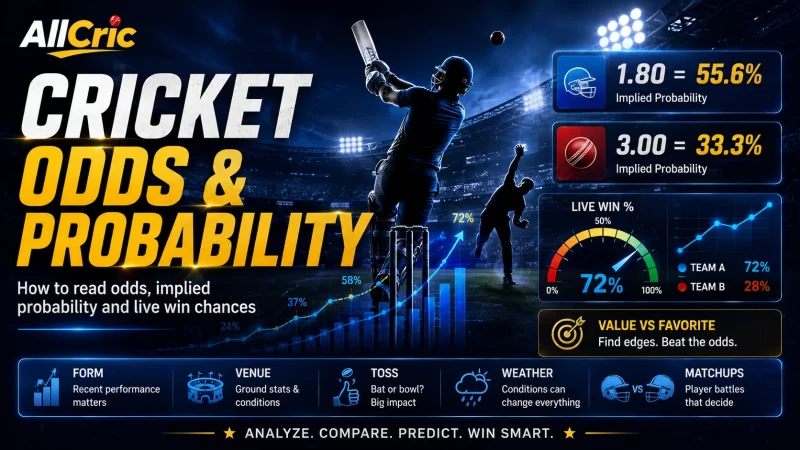
For example, decimal odds of 1.80 imply a probability of roughly 55.6% (1 ÷ 1.80 = 0.556). Odds of 3.00 imply exactly 33.3%.
Fractional odds – implied probability: Implied Probability (%) = Denominator ÷ (Denominator + Numerator) × 100
Fractional odds of 5/2 imply 2 ÷ (2+5) = 28.6%.
This conversion is the backbone of reading any cricket market, whether it’s a full-match winner, top run-scorer, or session total. Once you can convert odds to probability in your head, you stop reacting to the number on the screen and start evaluating whether it actually reflects reality.
What Is Implied Probability in Cricket Betting? A Simple Guide to Reading the Odds
If you convert every outcome’s odds in a two-team match into implied probability, they should theoretically sum to 100%. In practice, they almost always add up to more, commonly 105–110% in cricket markets. That extra percentage is the bookmaker’s built-in margin, often called the “overround” or “vig.”
This matters enormously for anyone trying to interpret cricket odds and probability correctly: the odds you see aren’t a pure, unbiased probability estimate, they include a commercial buffer. Recognizing and mentally stripping out that margin is essential before comparing market odds to your own (or an AI model’s) probability estimate.
Read the full breakdown in the dedicated guide: What Is Implied Probability in Cricket Betting? A Simple Guide to Reading the Odds
Cricket Betting Odds Explained
It helps to think of published odds less as a prediction and more as a live consensus. Every price reflects a mix of statistical modeling, team news, and the flow of money from bettors reacting to it. When odds shorten sharply on one side without any obvious news trigger, it usually signals that informed money is backing that outcome, a phenomenon often called “steam.”
Reading the market this way turns odds into a second data source, alongside your own analysis, not something to blindly follow, but not something to ignore either.
Read the full breakdown in the dedicated guide: Cricket Betting Odds Explained: What Is the Market Really Telling You?
How Bookmakers Actually Set Cricket Odds
Cricket odds aren’t set by a single analyst’s gut feeling, they’re generated from statistical models built on historical results, adjusted for team news, and then shaped further by market money as bettors respond. Key inputs typically include:
- Historical head-to-head results between the two sides
- Recent form, usually the last 5–10 matches
- Venue-specific scoring and toss trends
- Player availability, including injuries and rotation
- Toss outcome and conditions (overcast skies, dew factor, pitch wear)
Once odds go live, they continue to move based on where money is being placed, not necessarily because the underlying probability changed, but because the market is self-correcting toward balance. This is why odds can shift 20–30 minutes before a toss even without new team news.
Why Betting on the Most Likely Cricket Winner Can Still Be a Bad Bet
Here’s where most casual fans get tripped up. Backing the favorite feels intuitive, but the favorite being likely to winand the favorite being good value are two completely different things. If a team has a genuine 65% chance to win but the odds only imply 55%, that’s a mismatch worth noticing. Conversely, a team priced as if it has a 70% chance when your own analysis says 55% is a red flag, even if that team is still statistically more likely to win the match outright.
This is the essential difference between probability and value, and it’s the single most important mental shift separating recreational fans from data-driven ones. A team can be the “right” pick in terms of raw win chance and still be the “wrong” pick in terms of value, and vice versa.
Read the full breakdown in the dedicated guide: Why Betting on the Most Likely Cricket Winner Can Still Be a Bad Bet: Understanding Value vs Probability
Cricket Betting Models: What Data Actually Matters When Predicting a Match?
Serious probability models don’t rely on one or two stats, they weigh a combination of factors, typically 10–15+ variables per match, including:
Factor | Why It Matters |
Team form (last 5–10 matches) | Captures current momentum, not just career stats |
Head-to-head record | Reflects matchup-specific tendencies |
Venue scoring history | Batting-friendly vs. bowling-friendly conditions |
Toss trends at the venue | Some grounds show a strong bat-first or chase-first bias |
Weather and dew factor | Heavily influences T20 chase success rates, especially in day-night games |
Player-level matchups | Certain batters/bowlers historically dominate specific opponents |
Squad news and injuries | Missing a strike bowler or top-order batter shifts probability meaningfully |
Cricket also has format-specific quirks that data models must account for. In T20 cricket, dew factor alone can swing the chasing team’s win probability by several percentage points in evening matches, which is why models built purely on daytime data can misfire under lights. Average first-innings totals at a venue (often in the 165–180 range for a “typical” T20 pitch) are also a critical baseline, a model that doesn’t adjust for venue-specific scoring averages will consistently misjudge chase probability.
Read the full breakdown in the dedicated guide: Cricket Betting Models: What Data Actually Matters When Predicting a Match?
Can AI Find Its Place in Cricket Betting? What AI Cricket Predictions Can and Can’t Do
Traditional statistical models are useful, but they’re often static, built once and reused. Modern AI-based prediction systems, by contrast, are trained on large historical datasets (often 1,000+ matches across a decade or more) using machine-learning techniques like Random Forests, Neural Networks, and Support Vector Machines. These models don’t just apply fixed weightings, they learn which combinations of factors have historically predicted outcomes most reliably, and they update continuously as new match data comes in.
That said, AI isn’t magic. It’s still working with historical patterns applied to a chaotic, low-sample-size sport where a single dropped catch or rain interruption can flip a game. AI-based cricket models tend to land in the 55–65% pre-match accuracy range for T20 cricket, meaningfully better than a coin flip, but far from certainty. The honest framing is that AI narrows the gap between guesswork and informed probability; it doesn’t eliminate uncertainty.
Read the full breakdown in the dedicated guide: Can AI Find an Edge in Cricket Betting? What AI Cricket Predictions Can and Can’t Do
Live Cricket Betting Explained: How Wickets, Runs and Momentum Change Win Probability
Pre-match probability is only the starting point. Once the game begins, cricket odds and probability become dynamic, recalculating after nearly every delivery based on:
- Current run rate vs. required run rate
- Wickets in hand
- Momentum shifts (e.g., two wickets in an over)
- Dew factor increasing as the match progresses under lights
- Historical chase success rates at that specific venue and score
A team chasing 180 at 8 overs with 6 wickets in hand might sit around 55–60% win probability, but lose two quick wickets, and that number can swing below 40% within a single over. This is why live win-probability trackers are so valuable: they reflect the actual state of the game, not just the pre-match assumptions.
Read the full breakdown in the dedicated guide: Live Cricket Betting Explained: How Wickets, Runs and Momentum Change Win Probability
What Is Positive EV (+EV) in Cricket Betting?
Once you understand implied probability and market margin, the next concept worth learning is Expected Value (EV), a way of measuring whether a bet is mathematically favorable over the long run, independent of whether it wins or loses on any single occasion.
At its simplest: EV = (Probability of Winning × Potential Profit) − (Probability of Losing × Stake)
A bet is considered “+EV” (positive expected value) when your estimated true probability of an outcome is higher than the probability implied by the odds. Identifying +EV situations consistently, not winning every individual bet, is what separates a data-driven approach from pure guesswork.
Read the full breakdown in the dedicated guide: What Is Positive EV (+EV) in Cricket Betting? A Beginner’s Guide to Expected Value and Smarter Odds
Steps to Find Value Bets in Cricket Using Data
Finding value isn’t about intuition, it’s a repeatable process: build or source a probability estimate, convert market odds into implied probability, strip out the bookmaker’s margin, and compare the two numbers directly. A gap of just a few percentage points, applied consistently across a large sample of matches, is what a data-driven approach is actually chasing, not one big win, but a statistically sound edge repeated over time.
This is also where using a reliable cricket AI prediction app or a transparent statistical model becomes useful, it gives you a consistent, unemotional probability baseline to compare against the market, rather than relying on match-day gut feeling.
Read the full breakdown in the dedicated guide: How to Find Value Bets in Cricket Using Data: A Step-by-Step Approach
How to Compare Cricket Betting Odds With Win Probability
In practice, comparing odds to probability means lining up three numbers side by side for any given match outcome: the market’s implied probability, your own (or a model’s) estimated true probability, and the gap between them. Doing this consistently, ideally logged over time, reveals patterns: certain leagues, formats, or bet types where the market tends to be less efficient, and others where it’s tightly priced and harder to beat.
Read the full breakdown in the dedicated guide: How to Compare Cricket Betting Odds With Win Probability: A Practical Walkthrough
How to Make Smarter Cricket Betting Decisions
Bringing all of this together, a data-driven approach to cricket predictions generally follows this sequence:
- Convert market odds to implied probability and account for the bookmaker’s margin.
- Build or reference your own probability estimate using form, venue, toss, and weather data.
- Compare the two — look for meaningful gaps, not marginal ones.
- Track live match data to see how in-game events shift the probability in real time.
- Evaluate results over a large sample, not match-by-match, since variance is inherent to a low-scoring-event sport like cricket.
This structured framework transforms cricket prediction from a hobby built on hunches into a repeatable, evidence-based process, the same underlying logic professional analysts and modern AI prediction engines are built on.
Read the full breakdown in the dedicated guide: How to Make Smarter Cricket Betting Decisions: A Complete Data-Driven Framework
👉 Get expert Today cricket match predictions 100 sure, top picks & fantasy tips – Download AllCric App or visit AllCric Website
FAQS❓
Odds are the market’s pricing format (decimal, fractional, or moneyline), while probability is the actual likelihood of an outcome. Odds can be mathematically converted into implied probability, but that figure includes the bookmaker’s margin, so it’s not a pure probability estimate.
For decimal odds, divide 1 by the odds and multiply by 100. For example, odds of 2.00 imply a 50% probability. For fractional odds, divide the denominator by the sum of the denominator and numerator.
The excess percentage reflects the bookmaker’s built-in margin (overround), which ensures profitability regardless of the actual outcome.
Not necessarily. A favorite can still be poor value if the odds overstate its true winning chances. Smart predictions focus on the gap between estimated probability and market-implied probability, not just who’s more likely to win.
Well-built AI models trained on large historical datasets typically reach around 55–65% accuracy for pre-match T20 predictions — a meaningful edge over guesswork, but not a guarantee, given cricket’s inherent unpredictability.
Yes, particularly in T20 cricket, where toss-winning teams often gain a meaningful advantage due to dew, pitch deterioration, or venue-specific batting/bowling bias.
Live probability can update after nearly every ball, since factors like run rate, wickets in hand, and momentum shifts are constantly evolving.
Team form, head-to-head record, venue scoring history, toss trends, weather/dew factor, and confirmed lineups are typically the highest-weighted variables in reliable prediction models.
A value bet exists when your estimated true probability of an outcome is higher than the probability implied by the market’s odds — meaning the odds are, in theory, priced too generously relative to the real chances of that outcome occurring.
Absolutely. Fans use these same concepts to evaluate fantasy team selections, gauge how “safe” a captain pick really is, and better understand commentary around match-ups, without ever placing a wager.
