
AI Cricket Match Prediction: How Does AI Predict Cricket Match Winners?

Quick AI Terms Explained Before We Start
A few words you’ll see throughout this guide, explained simply first so nothing gets confusing later.
Term | What It Means |
Training | Showing the model thousands of old matches where the result is already known, so it can learn patterns |
Testing | Checking the trained model against matches it has never seen, to see how well it predicts new results |
Features | Features | The pieces of information fed into the model, toss result, venue, team form, pitch report, and so on |
Classifier | A model that sorts something into categories, here, “Team A wins” or “Team B wins” |
Overfitting | When a model memorizes its training matches too closely instead of learning something that works on new matches |
Where Does the Data for These Models Actually Come From?
AI cricket models are trained on real ball-by-ball match records, usually pulled from a handful of well-known free and commercial data sources, not some mysterious black box of secret information.
Common data sources used in published research:
- Cricsheet, a free, publicly available ball-by-ball dataset covering thousands of international and league matches, widely used by researchers and hobbyist developers alike
- ESPNcricinfo’s match records, used as a data source in several published academic studies
- Kaggle datasets, community-uploaded cricket data, often compiled from public match records
Most serious studies combine data from thousands of matches spanning several years, and generally, the more matches available, the more reliable the model tends to be, since it has more real situations to learn from.
How Much Data Does a Model Actually Need to Be Reliable?
There’s no single magic number, but published research consistently shows models trained on a few thousand matches or more tend to perform far more reliably than those trained on just a few hundred.
- Studies using large datasets (10,000+ matches or many years of ball-by-ball data) tend to report more believable, stable accuracy figures
- Studies using small or single-tournament datasets (a few hundred matches) are more prone to overfitting, and their high accuracy numbers should be treated with more caution
- Cricket has fewer recorded professional matches overall compared to sports like football, which are played far more frequently worldwide, this makes very large cricket datasets harder to come by
This is exactly why an accuracy claim from a study using thousands of matches across several seasons deserves more trust than a similar-sounding claim from a study using one tournament’s data.
How Does AI Actually Predict a Cricket Match Winner?
AI predicts cricket outcomes by training on historical match data, then finding patterns a human analyst would take years to spot manually. It’s essentially pattern recognition at a massive scale.
The process happens in three simple steps:
- Training: the model studies thousands of past matches where the outcome is already known
- Learning: it identifies which combinations of factors tend to line up with wins or losses, for example, winning the toss at a specific ground under overcast skies
- Testing: it gets checked against matches it hasn’t seen yet, before being trusted on a brand new, upcoming match
This is fundamentally different from a human predicting a match. A person might remember a handful of standout games and lean on gut feeling. A model can compare a current match situation against thousands of similar historical situations almost instantly.
Which AI Algorithms Are Actually Used for Cricket Prediction?
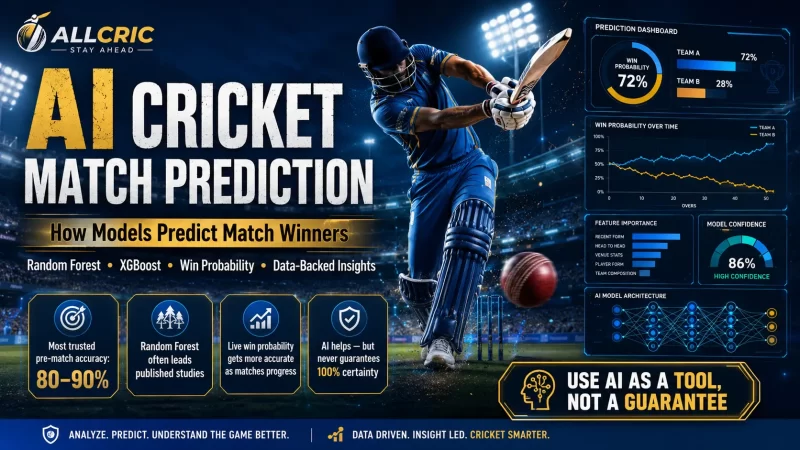
Random Forest shows up as the top performer across the majority of published research studies, followed closely by other tree-based models.
| Algorithm | How It Works | Typical Performance |
|---|---|---|
| Random Forest | Builds many decision trees on random data subsets, combines their votes | Consistently the top or near-top performer |
| Gradient Boosting / XGBoost | Builds trees one after another, each correcting the last one's errors | Close behind Random Forest, sometimes matching it |
| Decision Tree | A single tree of yes/no splits based on match factors | Solid, but usually beaten by Random Forest |
| Logistic Regression | A simpler statistical model estimating win probability directly | Used mainly as a baseline, underperforms tree-based models |
| Naive Bayes | A probability-based model assuming factors are independent | Weakest performer in most published studies |
Random Forest's "wisdom of the crowd" approach, combining many trees instead of relying on one, tends to be more reliable than any single decision tree on its own. This is exactly why it appears so often as the winning model in cricket research.
How Accurate Are AI Cricket Prediction Models, Really?
Published accuracy figures range from around 65% up to figures above 95%, and that huge range exists because of differences in dataset size, algorithm choice, and testing rigor, not because AI is wildly inconsistent in the real world.
Study Focus | Best Performing Model | Reported Accuracy |
Second-innings outcome (IJCA) | Random Forest | 89.82% |
IPL 2008-2024 dataset | Random Forest / Gradient Boosting | 86.78% |
IPL match outcome (ICHC) | Random Forest | 88.10% |
T20 World Cup dataset | Random Forest | 84.06% |
ODI outcome study | Decision Tree / Random Forest | Up to 98% |
ICC ODI dataset | Logistic Regression | 81% |
IPL dataset (Decision Tree + XGBoost) | XGBoost | 94.8% |
A few things worth noting from this table:
- Random Forest appears as the strongest or near-strongest model in almost every study
- Accuracy above 90% usually comes from smaller or more specific datasets
- No single number should be treated as “the” accuracy of AI cricket prediction, context always matters
Why Is Predicting a Test Match Harder Than Predicting a T20?
Test cricket adds a third possible outcome, a draw, on top of a win or loss, which genuinely makes prediction harder for a model compared to limited-overs formats where a result is far more likely.
- In T20 and ODI cricket, matches almost always produce a clear winner, giving models a simpler two-outcome problem to solve
- In Test cricket, a match can end in a draw even without either team being dismissed twice, purely because the five days ran out, which is why weather forecasts matter more in long-format prediction.
- This means Test prediction models have to weigh factors like weather forecasts for the full match duration and each team’s tendency to play for a draw defensively, on top of everything else
This is part of why you’ll notice most published cricket AI studies focus heavily on T20 and ODI data rather than Test cricket, the simpler win/loss structure is easier to model accurately.
Which Factors Actually Matter Most to These Models?
Toss result, venue history, team form, and player-specific performance metrics consistently rank as the most influential inputs across published studies.
Most commonly used and impactful features:
- Toss result and decision (bat or bowl first)
- Venue history and ground-specific scoring patterns
- Recent team form (last 5-10 matches)
- Head-to-head record, filtered by format and venue
- Individual player performance metrics, not just team-level stats
- Home advantage indicators
One research paper built two separate feature sets for comparison, one centered on home advantage, the other on toss decision, and found both meaningfully improved prediction accuracy compared to models without them. This confirms something analysts have long suspected, conditions-based factors genuinely help predictions, they’re not just commentary filler.
Player-level detail has also proven valuable. One study introduced a custom metric called “Player Consistency,” blending traditional batting and bowling statistics with dynamic performance ratings, a more nuanced input than simply using career averages.
Do Real Broadcasters Actually Use These AI Models Live?
Yes, this isn’t just academic research sitting in journals. Broadcasters and cricket analytics companies have built live win probability tools into real match coverage for years.
- ESPNcricinfo’s “Forecaster” displays a live win probability percentage for both teams throughout a match, recalculating after every ball
- CricViz, a cricket analytics company, has supplied data-driven insights and predictive models to broadcasters including Sky Sports, feeding AI-based analysis directly into TV commentary
- Fans watching a tight run chase have likely seen this exact kind of graphic without knowing the machine learning process behind it
Good news for regular fans: most of these live win probability tools are free to access, built directly into broadcast apps, cricket news sites, and score-tracking apps, no special software or subscription needed to see them during a match.
This matters because it shows these models aren’t purely theoretical, they’re built into how millions of fans actually experience live cricket coverage today.
Why Do Some Studies Report 95%+ Accuracy While Others Report 65%?
The gap usually comes down to dataset size, feature choice, and testing rigor, not a genuine difference in how good AI is at predicting cricket.
Common reasons accuracy numbers vary so widely:
- Small datasets: fewer matches make it easier for a model to accidentally memorize patterns instead of learning real ones (overfitting)
- Different feature sets: some studies include player-level data, others only use team-level stats
- Different testing methods: some studies test rigorously on unseen matches, others less so
- Format differences: T20, ODI and Test datasets behave differently and aren’t directly comparable
A 2020 study using Logistic Regression on ICC ODI data reported a more modest 81% accuracy, while a 2019 study using Decision Tree and XGBoost on IPL matches reported 94.8%. Both are legitimate results, but not directly comparable, since the datasets and features differed.
Why Don’t All Teams and Analysts Fully Trust AI Predictions?
A common concern is that many AI models work like a “black box,” meaning they give a prediction without clearly showing the reasoning behind it.
Human analyst vs AI model, side by side:
Human Analyst | AI Model | |
Can explain reasoning step by step | Yes, easily | Often difficult, especially with complex models |
Processes historical data | Slow, limited to memory | Extremely fast, thousands of matches at once |
Judges morale, body language, intent | Yes | No |
Consistent across every match | Can vary with mood or bias | Fully consistent |
Learns from very recent, unusual events | Quickly | Only after retraining on new data |
This is exactly why the most practical use of AI in cricket right now tends to be as a supporting tool alongside human analysis, rather than a fully trusted, stand-alone decision-maker.
How Does Live, In-Match AI Prediction Actually Work?
Live win probability trackers recalculate constantly as the match unfolds, using ball-by-ball inputs to update the win percentage in real time.
Inputs used for live prediction:
- Runs needed to win
- Wickets remaining
- Balls remaining
- Current run rate and required run rate
- Historical outcomes from similar match situations
One study measuring in-game prediction accuracy found:
Match Stage | Model Accuracy |
Early in the chase | ~55% |
Later in the chase | ~85% |
This makes intuitive sense, the further into a run chase you get, the less uncertainty remains about the outcome. A live win probability graphic right after the first over is far less reliable than the same graphic in the final over of a tight run chase.
Example: If a team needs 48 runs off the final 24 balls with 4 wickets in hand, a live model compares that exact combination against thousands of similar historical run chases to estimate a win probability, a calculation that becomes more precise the closer the match gets to its result.
Can AI Ever Predict Cricket With 100% Accuracy?
No, and this isn’t a limitation unique to cricket. No sport, and no AI model, can predict outcomes with total certainty.
Things no model can foresee for a specific delivery:
- A dropped catch
- A brilliant piece of fielding
- An umpiring error
- One batter having the innings of their life
AI narrows uncertainty, it doesn’t remove it. A well-built model giving a team a 75% win probability is saying that team wins roughly three times out of four in similar situations, not that the outcome is guaranteed.
What Should You Actually Take Away From AI Cricket Predictions?
Quick summary checklist:
- Treat AI predictions as one strong, data-backed input, not a final verdict
- Trust models tested on large, multi-season datasets more than small, single-tournament ones
- Favor tree-based models (Random Forest, Gradient Boosting) over simpler statistical models
- Be skeptical of accuracy claims above 95%, especially from small datasets
- Remember Test cricket is genuinely harder to predict than T20 or ODI, thanks to the possibility of a draw
- A realistic, believable accuracy range for pre-match prediction sits around 80-90%
- Combine AI output with pitch conditions, toss impact, weather, head-to-head data and team news, not as a replacement, but as a companion
👉 Get expert Today cricket match predictions 100 sure, top picks & fantasy tips – Download AllCric App or visit AllCric Website
FAQS❓
Random Forest consistently appears as the top or near-top performer across the majority of published cricket prediction studies, typically landing in the 84-90% accuracy range on properly tested, multi-season datasets.
This usually happens with smaller or narrower datasets, where the model can end up memorizing patterns specific to that sample rather than learning something that generalizes well to new matches, a problem known as overfitting.
Common sources include Cricsheet, a free public ball-by-ball dataset, along with ESPNcricinfo match records and community-compiled datasets on platforms like Kaggle.
Test cricket can end in a draw as well as a win or loss, adding a third possible outcome that limited-overs cricket doesn’t have, which makes the prediction problem more complex.
Yes. ESPNcricinfo’s Forecaster tool and analytics company CricViz, which has supplied insights to broadcasters like Sky Sports, are well-known examples of AI-driven prediction built into real match coverage.
Not entirely. AI processes large amounts of historical data faster and more consistently than a person can. Human analysts are still better at judging things like team morale, tactical intent, and reading conditions visually on the day, and can explain their reasoning in a way many complex models still can’t.
