
How Much Do Head-to-Head Stats Really Matter in Cricket Match Predictions?

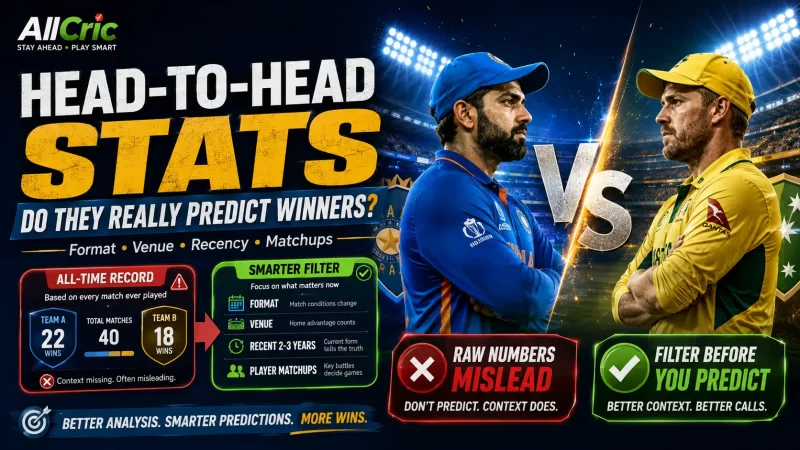
I’ve lost count of how many times a commentator has said “Team A leads the head-to-head 15-8” right before Team A loses badly. Head to head cricket stats prediction claims get thrown around constantly, but most of them are close to useless the way they’re usually quoted. The real value is buried underneath, and you have to dig for it.
This guide breaks down exactly when head-to-head stats actually help you predict a winner, and when they’re just a number that sounds impressive on TV. . Real data, real examples, no guesswork.
Are Head-to-Head Stats Actually Useful for Predicting Cricket Matches?
Sometimes, but only when filtered properly by format, venue, and recent years. A raw, all-time head-to-head number on its own is one of the weakest prediction tools in cricket.
The problem is simple: a head-to-head record spanning 70 years blends completely different eras, players, rules, and conditions into one misleading number. A stat from a 1980s Test series tells you almost nothing about a T20I being played this year.
Used the right way though, head-to-head data still has value. It can reveal genuine patterns, like a team’s specific struggle against a certain bowling attack, or a strong record at a particular venue, that are worth factoring into a prediction alongside form, conditions, and team news.
Why Do Broadcasters Love Head-to-Head Stats So Much?
Broadcasters use head-to-head numbers constantly because they’re easy to pull up on screen and sound dramatic, not because they’re actually good at predicting the result. Worth knowing this before you trust one on TV.
A graphic showing “Team A leads 20-8” fills airtime, gives commentators something simple to talk about, and creates a storyline for viewers. It doesn’t require any filtering by format, venue, or recency, which is exactly why the number often ends up misleading.
Once you know this, you’ll start noticing how often these graphics get quoted right before the “underdog” wins anyway. That’s not bad luck, it’s just a sign the stat was weak to begin with.
Why Do All-Time Head-to-Head Records Mislead Predictions?
All-time records mislead because they mix formats, eras, and squads that have almost nothing in common with today’s teams. A number that looks decisive is often just noise from a very different version of the sport.
Take India versus Australia, one of cricket’s biggest rivalries. Across all formats since 1947, Australia leads the overall head-to-head with 143 wins to India’s 111, out of 296 matches played, based on records updated through late 2025. That sounds like a clear historical edge for Australia.
But break it down by format and a completely different picture appears. In Test cricket, Australia leads 48 wins to 33 across 112 matches. In ODIs, the gap is even wider at 84 wins to 58 across 152 matches. Yet in T20Is specifically, India actually leads the rivalry, winning 22 of their last recorded meetings compared to Australia’s 12.
Example: If someone quotes “Australia leads India 143-111 all time” ahead of a T20I match, that stat is almost worthless for that specific game, since the format where the stat is being applied is the one format where India actually dominates. This single example shows exactly why format-blind head-to-head numbers can point you in the wrong direction entirely.
Why Are Small Head-to-Head Samples So Unreliable?
Small samples are unreliable because a handful of matches can swing wildly based on one bad day, one injury, or one unusual pitch, without actually reflecting which team is genuinely better.
Think of it like flipping a coin only 5 times. Getting 4 heads out of 5 flips doesn’t mean the coin is unfair, it just means 5 flips is too small a sample to draw a real conclusion from. Cricket head-to-head stats work the same way, especially in formats like T20Is where two teams might only meet 6 to 10 times in a couple of years.
A general rule worth remembering: the smaller the number of matches, the less you should trust the head-to-head record on its own, and the more weight you should give to current form and conditions instead.
Example: If two teams have played only 4 T20Is in the last two years, and one team won 3 of them, that looks like a strong 75% record. But with a sample that small, a single close match going the other way could have flipped the entire story, which is exactly why such a small head-to-head shouldn’t carry much prediction weight on its own.
Does Venue Matter More Than the Overall Head-to-Head Record?
Yes, venue-specific head-to-head data is usually far more predictive than an overall record, since home conditions, pitch type, and crowd support all shape results in ways a blended global stat completely hides.
Even within the same country, head-to-head numbers shift depending on where the matches were actually played. Looking at India versus Australia ODIs played specifically in India, the record sits far closer than the overall ODI head-to-head, closer to an even contest than the roughly 84-58 split across all venues combined.
This makes sense once you think about it. A team’s bowling attack, batting depth, and tactical approach usually suit certain conditions better than others. A side that dominates head-to-head meetings played in Australia might struggle heavily in the same matchup played in India, and blending both records together hides that completely.
Example: England has historically struggled against India in Tests played in India, largely due to spin-friendly conditions England rarely faces at home, even in years where England’s overall head-to-head record against India looked fairly competitive on paper.
Do Player-vs-Player Matchups Matter More Than Team Head-to-Head?
Often, yes. A specific batter’s record against a specific bowler, or against a certain style of bowling, is usually a sharper, more useful signal than the broad team-level head-to-head number.
Team head-to-head blends 11 different players and constantly changing squads together. Player-vs-player data, like how a top-order batter has performed historically against left-arm pace, or how a spinner has dismissed a particular opponent multiple times, is far more specific and often more predictive of what happens in the next match.
This is exactly the kind of detail experienced analysts and team think tanks study before a series, not the blended team record that gets shown on broadcast graphics. Captains use this information to plan bowling changes and batting order tweaks around known weaknesses.
Example: If a team’s opening batter has been dismissed by a certain type of left-arm swing bowling repeatedly across their career, that specific matchup detail matters more heading into a match against a team with that exact bowling threat than any team-wide head-to-head record ever could.
How Recent Should Head-to-Head Data Be to Matter?
The most useful window is usually the last two to three years, since squads, form, and playing styles change fast in modern cricket, and older results stop reflecting the current teams accurately.
Player retirements, injuries, and generational shifts change a team’s identity quickly. A head-to-head record built partly on matches from a decade ago includes players who may not even be part of either squad anymore, which makes that older data close to irrelevant for a prediction today.
This is exactly why serious analysts and bookmakers rarely lean on career-long head-to-head totals. Betting markets and professional prediction models weight recent form and recent head-to-head results far more heavily than all-time totals, since sharp money follows what’s statistically useful, not what sounds dramatic in a pre-match graphic.
Example: A team that lost most of its head-to-head meetings against a rival a decade ago, under a completely different captain and bowling attack, might now hold a strong recent record against that same rival with a rebuilt, younger squad. Quoting the old combined number would completely miss that shift.
What’s a Smarter Way to Use Head-to-Head Stats? A Worked Example
The smarter approach filters head-to-head data by format, venue type, and recency before drawing any conclusion, turning a vague, misleading number into a genuinely useful signal. Here’s exactly how that filtering changes the picture.
Start with the raw, unfiltered number: India versus Australia, all formats, all-time, Australia leads 143-111. On its own, that suggests Australia has the clear edge heading into any match between the two.
Now apply the filters. First, match the format, say the upcoming match is a T20I. That flips the picture completely, India actually leads 22-12 in that format specifically. Next, check the venue, if the match is in India, historical data shows Australia struggles more on Indian soil across formats. Finally, check recency, India’s stronger T20I record has mostly built up in the last few years with the current core squad still playing.
By the end of that filtering process, the “Australia leads head-to-head” headline from the start has flipped into a genuinely useful, India-favoring signal for this specific match, simply by applying format, venue, and recency filters properly.
Quick filtering checklist:
- Match the format first, Test, ODI, or T20I, never mix them.
- Match the venue type, home, away, or neutral ground.
- Cut the data to the last 2-3 years wherever the sample size allows it.
- Check the sample size, treat anything under 8-10 matches with real caution.
- Check player-vs-player matchups, not just team totals, if the data is available.
- Treat it as one signal, not the deciding factor, alongside pitch, form, and team news.
👉 Get expert Today cricket match predictions 100 sure, top picks & fantasy tips – Download AllCric App or visit AllCric Website
FAQS❓
No, but you should filter them by format, venue, and recent years before trusting them. A properly filtered head-to-head record is a useful supporting signal, while a raw all-time number is mostly noise.
Because the overall record blends Tests, ODIs and T20Is together across nearly eight decades. India’s stronger T20I record reflects the current squad’s strength in that specific format, which the combined all-time number completely hides.
Because a handful of matches can be swayed by one unusual result, injury, or pitch, without genuinely reflecting which team is better. The fewer matches in the sample, the less that record should influence a prediction.
They factor in recent, format-specific head-to-head data alongside current form, conditions and team news, but rarely give heavy weight to old, blended, all-time records, since those carry little predictive value for the game at hand.
