How to Predict Cricket Match Winners: A Complete Guide to Pitch, Toss, Form and AI Analysis
Ever picked a winner before a match started, only to watch the “weaker” team chase down 280 like it was nothing? Yeah, me too, more times than I’d like to admit. Cricket prediction looks simple from the couch, but after years of tracking pitch reports, toss patterns and team form, I can tell you it’s a puzzle with many small pieces, not one big answer.
This guide is your complete starting point for cricket match prediction. We will go through pitch conditions, toss impact, weather, head-to-head stats, playing XI changes, home advantage, and how AI models actually work behind the scenes. All the stats in this guide come from peer-reviewed studies, ESPNcricinfo analysis, and long-term ICC match data, named and linked throughout, not vague claims pulled from nowhere. Each section also links to a deeper guide if you want to go further on any single factor.
What Actually Decides a Cricket Match Winner?
The short answer: team quality matters most, conditions come second, and luck fills the rest of the gap. No single factor gives you a reliable prediction on its own.
A widely cited analysis by ESPNcricinfo’s Gaurav Sood and Derek Willis, covering more than 44,000 matches across formats, found that winning the toss adds only a 2.8% win probability edge on average. If you’re new to that term, win probability simply means the percentage chance a team has of winning at any given point, based on things like runs needed, wickets in hand, and balls remaining. It’s not a guarantee, just a running estimate that updates as the match moves. That 2.8% number surprises most fans, because commentators talk about the toss like it decides half the game. The data says otherwise.
Think of match prediction like cooking a curry. You need the right mix of spices, not just one strong ingredient. Pitch, toss, form, weather and team news all need to go into the pot together. Skip one, and the whole prediction tastes off.
In the 2019 ICC Cricket World Cup, New Zealand reached the final mostly on strong seam bowling and smart use of overcast English conditions, not because they won more tosses than other teams. Form and adaptability mattered far more than any single coin flip that tournament.
This guide walks through each ingredient one by one, starting with the one most casual fans skip completely, the pitch report.
How Do You Read a Cricket Pitch Report Before a Match?
A pitch report tells you how the surface will behave, whether it helps batters or bowlers, and how much it will change as the match goes on. Reading it properly is one of the most useful skills you can build for match prediction.
Dry, cracked pitches usually help spinners more as the game progresses, since the ball grips and turns sharply on worn surfaces. This is a big reason India often picks two or three spinners for home Tests. Grassy, green pitches help fast bowlers, especially on day one, because there’s more moisture and bounce for seam movement.
Flat, dry pitches with almost no grass are usually paradise for batters. You’ll often see 300-plus totals on tracks like these in ODI cricket played on subcontinent grounds during dry seasons.
Example: The M. Chinnaswamy Stadium in Bengaluru is known as a batting paradise, short boundaries and a flat surface. Totals above 200 in T20 cricket are common there. Compare that to a historically green top at the WACA in Perth, where extra pace and bounce made life much harder for batters before the ground was rebuilt.
One mistake beginners make is checking the pitch report three days before the match and locking in a prediction right then. That’s too early. Covers, rolling and sun exposure change the surface right up to match morning, which is why experienced analysts wait for the toss-day pitch inspection before finalizing anything. Grass cover, cracks, soil colour, all of it gets covered in more depth in the full pitch reading guide, including a few mistakes even experienced fans make when a pitch looks deceptive on TV.
How Does the Toss Impact a Cricket Match Result?
The toss gives a real but small edge. It is not a guaranteed advantage, and treating it that way is one of the most common prediction mistakes fans make.
According to the ESPNcricinfo study by Sood and Willis, based on data from over 44,000 first-class, List A, ODI and T20 matches, toss-winning teams win about 2.8% more often overall. A separate Medium/Sideline Strategists analysis of 2,932 ODIs found an even tighter split, a 50.68% win rate for toss winners, essentially a coin flip with a very slight lean.
Where the toss genuinely matters more is in day-night cricket. Research from gsood.com’s peer-reviewed cricket study found the toss advantage in day-night ODIs climbs close to 6%, mostly because dew makes the ball harder to grip for the team bowling second under lights. Curious which specific grounds see this effect the most? That’s broken down ground by ground in a separate venue-by-venue toss study.
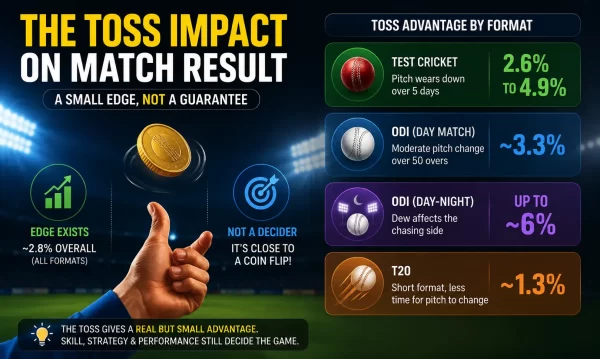
Here’s a quick reference table so you can see how the toss impact actually shifts by format, based on the combined findings across these studies:
Format | Toss Advantage | Why |
Test cricket | 2.6% to 4.9% | Pitch wears down over 5 days |
ODI (day match) | ~3.3% | Moderate pitch change over 50 overs |
ODI (day-night) | Up to ~6% | Dew affects the chasing side |
T20 | ~1.3% | Short format, less time for pitch to change |
Example: At Mumbai’s Wankhede Stadium, dew is heavy in evening games, and teams that won the toss and chose to chase won close to 57% of matches played there between 2008 and 2024. This single weather quirk has become such a known factor that “bowl first at Wankhede” is almost a rule of thumb among IPL captains now.
Should a Team Bat First or Bowl First?
There is no single correct answer here. It depends entirely on the format, the pitch on the day, and whether it’s a day match or a day-night one.
In Test cricket, batting first is still considered the safer default, since pitches usually get harder to bat on as the match wears into day four and five. Captains who win the toss in Tests choose to bat first around 56% of the time, according to long-term ESPNcricinfo data on Test toss decisions.
In T20 leagues like the IPL, chasing has become the more popular and often more successful strategy. Between the 2020 and 2024 IPL seasons, teams batting second won roughly 55-60% of matches, largely due to dew in evening games and the psychological clarity of knowing exactly what target they need. The “always chase” advice you hear on commentary doesn’t actually hold up everywhere equally, which is exactly what the ground-by-ground bat-or-bowl playbook digs into.
A separate analysis of IPL matches from 2008 to 2024 found that teams winning the toss and batting first won 48% of the time, while teams that chose to chase after winning the toss won nearly 53% of the time, a meaningful gap that’s shaped how modern captains approach the toss.
Example: In the 2023 ODI World Cup held in India, several captains preferred batting first on dry, used pitches expected to slow down and turn more as the match progressed, since setting a target under those conditions is often smarter than chasing a tricky total later.
How Do Weather Conditions Affect Cricket Match Predictions?
Weather changes how the ball moves, how fast the pitch plays, and even how quickly the outfield lets the ball run to the boundary. Ignoring weather in your prediction is a bit like ignoring the pitch report, you’re missing half the picture.
Overcast skies and high humidity help the ball swing more through the air, giving fast bowlers a real early advantage. This is exactly why captains often choose to bowl first under cloud cover, hoping to exploit swing conditions in the first hour of play. A 2009 study published in the Royal Meteorological Society journal Weather even argued that prevailing weather conditions mattered more to Ashes Test results in Australia than the actual difference in team strength.
Dew is a separate weather factor, and it mostly affects evening and day-night matches. When dew settles on the outfield, the ball gets wet, making it harder for bowlers, especially spinners, to grip and turn it properly. Exactly how much this shifts win probability at specific IPL venues is laid out in the dew and humidity breakdown, with real match numbers rather than just the general idea.
Example: In Ashes Test cricket played in England, overcast and humid conditions are common, and fast bowlers with strong swing skills, like James Anderson through the 2010s, thrived there far more than in drier countries like Australia.
Rain doesn’t just delay or wash out matches either. Once play restarts after rain, the Duckworth-Lewis-Stern (DLS) method resets the target based on overs lost and wickets remaining, and this can swing win probability instantly, sometimes flipping who the “favorite” is mid-match.
How Much Do Head-to-Head Stats Really Matter?
Head-to-head records matter less than most fans assume, unless you’re looking at a large and recent sample. A rivalry stat pulled from decades ago tells you almost nothing useful about tomorrow’s match, yet it’s one of the most repeated stats in cricket previews.
Take Australia versus India as an example. Across 304 international matches played since 1947, Australia leads with 146 wins compared to India’s 114, based on official head-to-head records as of late 2025. That sounds like a clear historical edge for Australia. But this number blends Tests from the 1950s with T20Is played in the last couple of years, completely different formats, squads, rules and conditions.
Break it down by format and the picture flips depending on era. In T20Is specifically, India actually leads Australia 22 wins to 12, the exact opposite of the overall trend. This is precisely why quoting an “all-time record” without a format filter can badly mislead a prediction. Filtering it properly, by year, format and venue, is a whole method on its own, one that’s covered step by step in the head-to-head filtering method.
Example: If India and Australia are playing an ODI in India, looking at their last five ODIs specifically played in India between 2023 and 2025 tells you far more than a 155-match all-time ODI record that includes series from the 1980s played on entirely different pitches with different rules around fielding restrictions and ball types.
Bookmakers and professional analysts rarely quote raw head-to-head numbers for this exact reason. Betting markets weight recent form and venue-specific results far more heavily than career totals, since sharp money follows what’s actually predictive, not what sounds dramatic in a TV graphic.
How Do Last-Minute Playing XI Changes Affect the Outcome?
A late change to the playing XI, especially involving the top order or the strike bowler, can shift win probability more than most fans realize. This is one of the most underrated factors in match prediction, and it’s the one prediction models struggle with the most.
If a team’s best fast bowler or an in-form top-order batter is ruled out an hour before the toss due to injury, illness, or a tactical decision, the entire balance of that side changes instantly. Predictions made using the “probable XI” published the day before can end up badly wrong once the real team sheet comes out.
Example: When a strike bowler like Jasprit Bumrah has been unavailable for India due to injury in recent years, the team’s bowling attack loses its biggest wicket-taking threat in both the powerplay and death overs. Predictions made without accounting for that absence tend to overrate India’s bowling strength significantly.
Impact substitute rules in leagues like the IPL, introduced from the 2023 season onward, have added another layer to this. Teams can now bring in a fresh player mid-innings based on match conditions, meaning even a “locked in” playing XI can shift the balance of the game after it has already started. Injury, tactical rest, and impact-sub swaps don’t carry the same weight in a prediction, and sorting out which matters most is exactly what the playing XI impact guide is for.
Experienced analysts always wait for the confirmed playing XI, announced right at the toss, before finalizing any prediction. That single habit alone improves accuracy more than almost any statistical model built on pre-match data.
How Much Does Home Advantage Really Matter in Cricket?
Home advantage is real, and in Test cricket it is one of the strongest factors of all, often stronger than the toss itself. In ODIs it still matters but less strongly, and in T20 cricket it barely moves the needle at all.
A long-term analysis of international Test and ODI matches played between 1988 and 2018, covered by Hindustan Times, found home teams winning close to 59% of the time across both formats. In T20 cricket, that number drops to almost an even 50-50 split between home and away sides, since shorter matches leave less room for local conditions to matter.
Some teams push this advantage even further. India’s Test win percentage at home was reported around 72-77% for the 2014-2019 stretch specifically, built largely on pitches prepared to suit their strong spin attack. South Africa went unbeaten across 27 straight home Tests between 2006 and 2017, a run built on pace-friendly conditions their bowlers knew inside out. I’ve ranked every major team’s home fortress strength using data like this in a separate team-by-team breakdown, including a couple of sides that surprisingly underperform even on their own turf.
Example: When England toured India in early 2024, they struggled heavily against turning pitches that Indian batters have grown up playing since childhood. The same England side that dominates at home in seaming conditions often looks completely out of sorts on dry, spinning Indian tracks, and that gap is exactly what home advantage means in practice.
The reasons behind home advantage are simple once you break them down: familiar conditions, no jet lag or long travel, home crowd support, and pitches often prepared specifically to suit the home team’s strengths.
How Does AI Predict Cricket Match Winners?
AI models predict cricket outcomes by training on historical data, toss results, venue history, team strength, player form, weather and pitch type, then finding patterns that would take a human analyst years to spot manually. But the accuracy numbers you see floating around online need some honest context.
Academic studies on cricket prediction report accuracy ranging anywhere from 57% to over 95%, depending heavily on the algorithm used and how the dataset was built. A study published via IEEE in 2023 found Random Forest and Decision Tree models reaching up to 98% accuracy on certain IPL datasets, while simpler models like Logistic Regression and Naive Bayes lagged behind at 65-67%.
Here’s the part most articles skip: very high accuracy numbers above 95% in small academic datasets are often a warning sign of overfitting. That means the model basically memorized old matches instead of learning something that actually generalizes to new, unseen games. A January 2026 study published in Scientific Reports, using a neural network approach on live, in-progress ODI data, reported a more modest and more believable 83% accuracy, closer to what real-world, live prediction systems typically achieve. The full data pipeline behind these systems, algorithms, features, honest limitations and all, is unpacked in plain language in the AI and machine learning deep-dive.
Example: A live win probability tracker during an ODI chase doesn’t just look at the final target. It constantly recalculates based on balls remaining, wickets in hand, current run rate and required run rate. If a team needs 48 runs off the final 24 balls with 4 wickets in hand, the model compares that exact situation against thousands of similar historical run chases to update the win percentage in real time.
No AI model, however advanced, can hit 100% accuracy in cricket. A brilliant diving catch, a strange umpiring decision, or one batter having the innings of their life will always keep the sport a little unpredictable, and honestly, that’s part of why we watch.
Putting It All Together: A Simple Prediction Framework
You don’t need a data science degree to predict cricket matches better than most casual fans. You just need a checklist, and the discipline to apply it in order, every single time.
- Check the pitch report first. Is it batting-friendly, bowling-friendly, or a track that will turn later?
- Factor in the toss and decision, but weight it small, somewhere between 1.3% and 6% depending on format.
- Look at the weather, especially dew for evening games and cloud cover for early swing.
- Filter head-to-head stats down to the last two or three years, matched by format and venue type.
- Wait for the confirmed playing XI before locking in any prediction, never trust the “probable XI.”
- Weigh home advantage heavily in Tests, moderately in ODIs, and lightly in T20.
- Use AI tools or win-probability trackers as one more signal, not the final word.
None of these factors work well in isolation. A spin-friendly pitch means little if the home side has no quality spinners. A toss win means little if that team just lost its best bowler to a last-minute injury. Good prediction is about layering signals together, not chasing one impressive-sounding stat and ignoring the rest.

👉 Get expert Today cricket match predictions 100 sure, top picks & fantasy tips – Download AllCric App or visit AllCric Website

FAQS❓
There isn’t just one. Pitch conditions and team form together carry more weight than toss or head-to-head stats, but ignoring any single factor completely will hurt your accuracy over time.
AI is faster at processing huge amounts of historical data. Human analysts are still better at judging things like team morale, injury impact, and reading a pitch visually on match morning. The strongest predictions usually combine both approaches.
Yes, but only a little. It adds roughly a 2.8% win probability edge on average across formats, higher in day-night ODIs because of dew, and noticeably lower in T20 cricket.
Realistic, well-built models operate around 70-90% accuracy for pre-match win probability. Claims above 95% from small datasets should be treated with caution, since they often signal overfitting rather than genuine skill.
In Test cricket, yes, home advantage tends to be a stronger factor than the toss itself. In T20 cricket, the gap almost disappears, with home and away teams winning at nearly equal rates.
Only when filtered by recent years, format and venue. A full career head-to-head record mixing old Test data with recent T20Is is one of the least reliable stats in cricket prediction.