Why Does the Playing XI Matter So Much for Predictions?
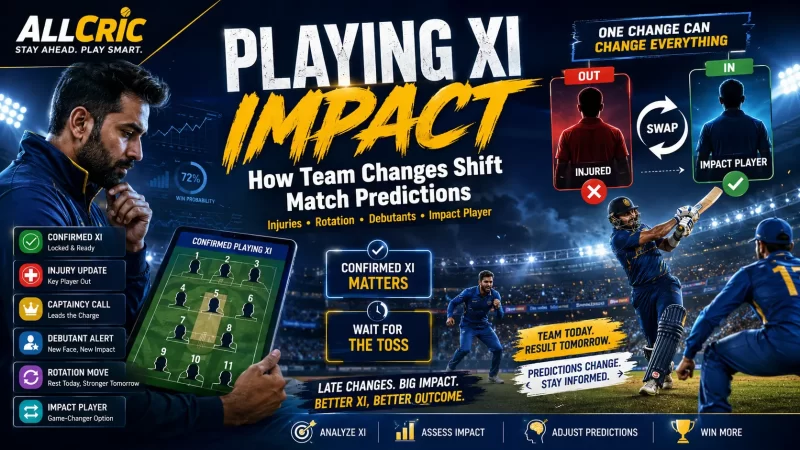
The playing XI is the actual list of 11 players who take the field, and any late change to it can shift the balance of a match more than most other single factors, including Head-to-Head stats. A prediction made on the wrong XI is basically a guess, even if you’ve already read the cricket pitch report before a match.
Team news, especially the confirmed XI, only becomes official right around the toss. Before that, media outlets usually publish a “probable XI” based on training sessions, team meetings, or informed guesses, which can turn out wrong.
This gap between “probable” and “confirmed” is exactly where a lot of casual predictions go wrong. Locking in a forecast a day early, before the real team sheet is out, means building your entire prediction on a guess about personnel, not fact.
When Does Each Format Actually Confirm the Playing XI?
Timing varies quite a bit by format, and knowing this helps you know exactly when it’s safe to finalize your prediction. Test cricket usually confirms the XI earliest, T20 leagues like the IPL confirm it latest.
In Test cricket, squads are named days in advance, and while the exact XI is still officially confirmed at the toss, teams often reveal their likely XI a day or two early through practice sessions and press conferences, since there’s less last-minute tactical reason to hide it.
In ODIs, the XI is usually confirmed at the toss, similar to Tests, with less flexibility to change based on the bat-or-bowl decision. In IPL T20 cricket specifically, since the 2023 season, teams can finalize their XI after the toss, reacting directly to whether they’ll bat or bowl first, making it the format where team news genuinely arrives latest.
How Often Do Late Playing XI Changes Actually Happen?
Late changes aren’t rare, they happen in nearly every international series to some degree, whether through injury, illness, rotation, or last-minute tactical calls, which is exactly why checking team news and weather conditions is a habit worth building every single match, not just occasionally.
Fast bowlers in particular are prone to niggles and injuries that surface during warm-ups on match morning, given the physical strain of fast bowling. It’s common enough that broadcasters usually run a dedicated team news segment right before every toss specifically because viewers expect changes.
How Much Does Losing a Key Bowler Change a Match?
Losing a strike bowler, especially a wicket-taking threat in the powerplay or death overs, can shift a team’s bowling attack dramatically, often more than losing a middle-order batter would.
A strike bowler isn’t just another name on the sheet, they’re usually responsible for a disproportionate share of a team’s wickets and pressure-building overs. Removing that player forces a captain to hand crucial overs to a less experienced or less effective bowler, which opposition batters can exploit.
Example: When India’s premier fast bowler Jasprit Bumrah has been ruled out through injury in recent seasons, India’s bowling attack has visibly lost its sharpest wicket-taking option in both the powerplay and death overs. Teams and analysts who don’t factor in that absence tend to significantly overrate India’s bowling strength going into the match.
Does Losing a Top-Order Batter Matter as Much as Losing a Bowler?
It depends on the team’s balance, but losing a genuine match-winning top-order batter can be just as damaging, especially in a batting lineup that relies heavily on one or two key players.
Some teams are deep enough to absorb a batting change without much drop in performance. Others are built heavily around one or two standout players, and losing that player forces everyone else to take on unfamiliar responsibility, often under pressure.
Example: A top-order batter ruled out due to injury or illness right before the toss forces a reshuffled batting order, often pushing a less experienced player up to face the new ball, historically the toughest period for any batter in the innings.
Does a Debutant in the Playing XI Make a Match Harder to Predict?
Yes, a debutant adds genuine unpredictability, since there’s no international or league-level track record to base a prediction on, unlike an experienced player whose strengths and weaknesses are already well documented.
Experienced analysts usually widen their uncertainty around a prediction when a debutant is included in either team, rather than assuming the newcomer will perform at the average level of the position they’re filling. Domestic form and age-group performances give some indication, but international or top-league cricket is a different level entirely.
Example: A specialist opening batter making their debut against a high-quality fast bowling attack faces a genuinely unknown test, domestic performances don’t always translate directly, which is exactly why teams and prediction models treat debutant-heavy XIs with more caution than settled, experienced lineups.
Does Changing the Captain Affect the Match Outcome Too?
Yes, a last-minute captaincy change, whether due to injury, rest, or rotation, affects tactical decisions like the toss call, bowling changes and field placements, on top of whatever impact the missing player has purely as a cricketer.
A stand-in captain may have a different tactical style, less experience with high-pressure decisions, or a different relationship with certain bowlers and batters compared to the regular captain. This can subtly shift things like bowling changes or batting order calls, even if the replacement captain is otherwise a very capable player.
Example: When a regular captain is rested or injured and a senior player steps in as stand-in captain, teams have sometimes shown a small dip in tactical sharpness during that specific match, simply because the stand-in hasn’t had the same repetitions making those exact in-game calls.
What Is Player Rotation and Why Does It Matter for Predictions?
Player rotation means a team deliberately rests a key player, often in a dead-rubber match (one that no longer affects the series outcome) or during a packed schedule, to manage workload and prevent injury, and it’s a planned change rather than a forced one.
This matters for prediction because rotation isn’t random, teams often signal it in advance through team management comments, and it usually happens in specific, predictable situations, series already won or lost, back-to-back matches with little rest, or a player carrying a minor niggle.
Example: A fast bowler managing a heavy workload across a long tour might be rested for a dead-rubber ODI after the series result is already decided, even though they’re fully fit, purely to keep them fresh for a bigger upcoming series or tournament.
What Is the Concussion Substitute Rule and How Does It Affect Predictions?
The concussion substitute rule allows a team to replace a player who has suffered a head injury with a like-for-like replacement, and it can change a match’s balance mid-game in a way that traditional cricket rules never used to allow.
This rule was introduced after the tragic death of Australian batter Phil Hughes, who was struck on the head by a delivery during a domestic match in 2014. It exists specifically for player safety, letting medical staff replace a concussed player without the team being short-handed for the rest of the match.
Unlike older fielding-only substitute rules, a concussion substitute can bat and bowl just like the player they’re replacing. This means a mid-match injury can genuinely alter team balance in real time, something worth checking if you’re tracking a match closely for live predictions.
What Is the IPL Impact Player Rule and How Does It Change Predictions?
The Impact Player rule, introduced in the IPL from the 2023 season, lets each team swap one player from their starting XI for a substitute at any point during the match, and that substitute can bat, bowl, and field fully, unlike older substitution rules.
Before the toss, each team names five substitutes alongside their playing XI. During the match, the captain can bring in one of those substitutes as the Impact Player, replacing any of the original 11, who then takes no further part in the game. This effectively gives teams 12 usable players across a match, though only 11 can bat.
The rule has changed team strategy significantly. Teams can now load their batting order with an extra specialist batter if they lose early wickets, or bring in a fresh bowler for the death overs regardless of how many overs the player they’re replacing has already bowled. Chennai Super Kings, the champions in the rule’s debut season, used it effectively, and Tushar Deshpande became the first-ever Impact Player in IPL history on March 31, 2023.
Example: If a team bowls out their designated powerplay specialist in the first six overs, they can later bring in their Impact Player as a fresh death-overs bowler who can still bowl their full four-over quota, a tactical option that simply didn’t exist in cricket before this rule.
This rule is unique to the IPL and does not apply in ICC-run international cricket, where teams must stick to a traditional playing XI with fielding-only substitutes. If you’re predicting an IPL match versus an international match, this is a real structural difference worth remembering.
Where Should You Actually Check the Confirmed Playing XI?
The most reliable sources are official team social media accounts, the broadcaster’s toss-time coverage, and dedicated cricket sites that update live team news right at the toss, rather than relying on previews written a day or two earlier.
Most official team accounts post the confirmed XI graphic within minutes of the toss finishing. Live broadcast coverage always shows both playing XIs on screen before the first ball, along with which players have been left out compared to the previous match, useful context for spotting a change quickly.
Cricket-focused apps and websites that specialize in live scores also tend to update team news fastest, usually faster than general news sites, since it’s their core content focus.
Quick Checklist Before You Predict Based on the Playing XI
- Wait for the confirmed XI at the toss, not the probable XI from the day before, and later still for IPL matches.
- Check if a strike bowler or key batter is missing, and adjust your read of team strength accordingly.
- Check for a captaincy change, since a stand-in captain can affect tactical decisions beyond just their own playing role.
- Watch for rotation policy, especially in dead-rubber matches or packed schedules, since rested players are a planned, foreseeable change.
- Note any debutants, and treat their performance as genuinely uncertain rather than assuming average output.
- Check the format, IPL matches allow Impact Player substitutions and post-toss team changes that international matches don’t.


 Get expert Today cricket match predictions 100 sure, top picks & fantasy tips – Download AllCric App or visit AllCric Website