Quick Terms Explained Before We Start
A few words used throughout this guide, explained simply first.
|
Term
|
What It Means
|
|
Defendable total
|
A first-innings score high enough that the bowling side has a real chance of stopping the chase
|
|
Powerplay
|
The opening overs of a limited-overs innings with fielding restrictions, usually the best scoring window
|
|
DLS
|
The formula used to reset a target if rain reduces the overs in a match
|
|
Chasing
|
Batting second, aiming to score more than the target set by the team batting first
|
Is It Better to Bat First or Bowl First in Cricket?
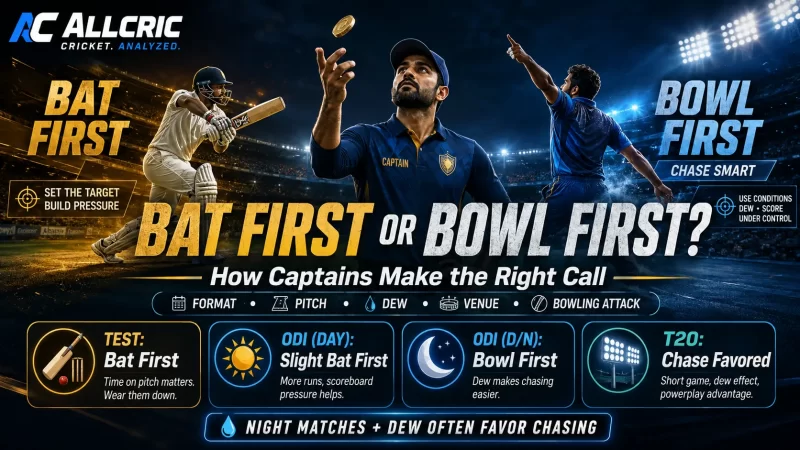
There’s no single correct answer, it depends on the format, the pitch, and whether it’s a day or day-night match. But the data does show clear, useful patterns by situation.
|
Format
|
Generally Better Choice
|
Why
|
|
Test cricket
|
Bat first
|
Pitch wears down over 5 days, batting last is hardest
|
|
ODI (day match)
|
Slight lean toward batting first
|
Less dramatic pitch change over one day
|
|
ODI (day-night)
|
Bowl first, chase
|
Dew makes the second innings easier to bat in
|
|
T20 (modern era)
|
Bowl first, chase
|
Knowing the target removes pacing guesswork
|
The short version: batting first still makes sense in Tests, while chasing has become the dominant strategy in T20 cricket over the last decade. ODIs sit somewhere in between, depending heavily on the specific ground and conditions that day.
Why Is Batting Last Physically Harder Than Batting First?
Batting last is harder mainly because the pitch has already been played on for longer, and it usually wears down in ways that help the bowling side, especially spinners working with cracks and rough patches.
- Cracks widen as a match goes on, especially under sun, giving spinners more grip and unpredictable turn
- Footmarks left by fast bowlers create rough patches outside the pitch, which spinners can aim at later in a match
- Grass wears off over time, removing whatever help it originally gave to seam bowlers, but often leaving a drier, more helpful surface for spin instead
This is exactly why Test cricket in particular treats the fourth innings, batting last, chasing a target on a four-day-old pitch, as the toughest challenge in the format. The same basic logic applies in a smaller way across ODIs and T20s too, just compressed into hours instead of days.
Why Has Chasing Become So Popular in T20 Cricket?
Chasing has become popular because batting second removes the guesswork. A team setting a target has to guess what a good score looks like, while a chasing team knows exactly what they need, which makes pacing an innings far simpler.
ESPNcricinfo’s analysis of IPL matches since 2015 found something striking, teams winning the toss chose to field first in 77.6% of completed matches. That’s not a small preference, that’s the overwhelming majority of captains making the same call.
And the data backs up why:
- Teams that chose to chase after winning the toss won 57.5% of matches
- Teams forced to chase after losing the toss still won 52.5% of matches
- This means chasing carries a real edge even without the toss advantage attached to it
Example: During the early rounds of IPL 2026, eight of the first thirteen matches were won by the chasing side, with captains choosing to bowl first after winning the toss in nearly every game. Only two skippers broke from this pattern in that stretch, and one of them, Rajasthan Royals’ Riyan Parag, won batting first by just six runs, a reminder that batting first can still work, it’s just become the less common bet.
Why Does Chasing Feel Mentally Easier for Batters?
Chasing feels easier mentally because batters are playing to a fixed, known number instead of guessing what “enough” looks like, and that clarity changes how aggressively and calmly a team can bat.
A team batting first has to constantly estimate, is 165 a good score on this pitch, or do we need 180? That uncertainty can lead to both overly cautious batting (leaving runs on the table) and overly reckless batting (throwing wickets away chasing an unclear target).
A chasing team doesn’t face that same guessing game. They know exactly how many runs they need and exactly how many balls they have left, which lets them pace an innings with far more precision, speeding up or slowing down based on real numbers, not estimates.
This is also part of why some batters are specifically valued as “finishers,” players who perform well specifically under the clear, escalating pressure of a run chase, since that situation suits a certain calm-under-pressure temperament better than setting a total does.
Does Your Bowling Attack Affect the Bat-or-Bowl Decision Too?
Yes, and this is a detail casual fans often miss. A team heavy on quality spin bowlers often prefers batting first and defending, since a worn pitch later in the match plays into their hands. A team built around fast, new-ball bowling often prefers bowling first, to attack with the new ball while it’s hardest and shiniest.
- Spin-heavy attacks: often prefer batting first, defending a total on a pitch that will help their spinners more as the match wears on
- Pace-heavy attacks with strong new-ball bowlers: often prefer bowling first, to exploit early seam and swing conditions before the ball gets old
- Balanced attacks: usually default to venue history and dew conditions rather than bowling-attack preference
Example: Chennai Super Kings’ strong historical bat-first record at their home ground, Chepauk, connects directly to their spin-heavy bowling attack. Setting a total there and defending it with quality spinners on a wearing pitch has been a repeated winning formula for them across IPL history.
What Does the Data Actually Say About ODI World Cups?
ODI toss decisions lean slightly toward batting first overall, but this shifts heavily depending on the specific tournament, host country, and whether matches are day or day-night fixtures.
In the 2023 ODI World Cup held in India, several captains preferred batting first specifically on dry, used pitches expected to slow down and turn more as the match progressed, since setting a target on a deteriorating surface is often the smarter play in that exact situation. This shows the format doesn’t follow one blanket rule the way T20 increasingly does, ODI decisions stay far more conditions-dependent match to match.
Unlike the IPL’s clear, tournament-wide statistical lean toward chasing, ODI cricket hasn’t shown the same one-directional trend across major tournaments, largely because ODIs are played across many different countries and conditions rather than repeatedly at the same handful of familiar grounds.
Does the Time of Day Change Whether You Should Chase?
Yes, significantly. Night matches favor chasing far more than day or day-night hybrid matches, mainly because of dew settling on the outfield as temperatures drop.
|
Match Timing
|
Chase Win Rate
|
|
Night matches (dew-heavy venues)
|
55.8%
|
|
Afternoon / day matches
|
49.3%
|
In afternoon matches, batting first actually holds a slight edge, since there’s no dew to hamper the bowling side later on. This single factor, dew, is one of the biggest reasons the “always chase” advice you hear on commentary doesn’t apply evenly across every single match.
Example: During IPL 2020, played entirely in the UAE due to scheduling changes that year, teams batting second won 15 of 18 matches finished in regular overs, largely because heavy dew made spin bowling and gripping the ball very difficult for the fielding side in the evening.
Does Every Ground Follow the Same Bat-First-or-Chase Pattern?
No, and this is where a lot of generic advice falls apart. Specific venues have their own strong tendencies based on pitch type, dew levels, and boundary size, and applying a blanket “always chase” rule ignores this completely.
- Chennai’s Chepauk Stadium: Chennai Super Kings hold a 56.2% win rate batting first here across IPL history, thanks to strong spin bowling and slower, drier pitches that make defending a total more realistic
- Mumbai’s Wankhede Stadium: heavy evening dew makes chasing the dominant strategy, teams winning the toss and choosing to chase here have won close to 57% of matches between 2008 and 2024
- High-scoring, flat pitches with short boundaries: totals above 200 become genuinely defendable, shifting the balance back toward batting first if a team can post a big score
When Should a Team Choose to Bat First Instead of Chasing?
A team should lean toward batting first when the ground has strong bat-first history, when dew isn’t expected to be a major factor, or when the pitch is flat enough to post a genuinely defendable total above 190-200.
Situations that favor batting first:
- Day matches with no dew expected later
- Venues with a strong historical bat-first win rate (like Chepauk for CSK)
- A batting lineup deep enough to post a total that’s hard to chase regardless of conditions
- A spin-heavy bowling attack suited to defending on a wearing pitch
- Rain forecast for later in the match, since a competitive total already on the board protects against a DLS-adjusted target working against you
Batting first also remains the generally safer default in Test cricket specifically, since a five-day pitch wears down significantly, and batting last on a worn, cracked surface is historically the harder assignment. Captains who win the toss in Tests choose to bat first around 56% of the time.
When Should a Team Choose to Bowl First and Chase?
A team should lean toward chasing when the match is a day-night fixture at a dew-heavy venue, when the pitch is expected to get harder to score on as the innings wears on, or when the batting lineup is built around chasing a known target rather than setting one.
Situations that favor bowling first:
- Night matches at venues known for heavy dew
- Pitches likely to deteriorate or slow down as the match progresses
- A pace-heavy attack that wants to exploit fresh, new-ball conditions
- A batting order with strong finishers suited to chasing pressure situations
- Historical venue data showing a clear chase-win advantage
Example: ESPNcricinfo’s research on IPL chases found the number of wickets lost in the powerplay strongly predicts chase success, each additional wicket down inside the first six overs meaningfully reduces win probability. This is exactly why a chasing team’s top order matters just as much as its finishers, a strong start protects the chase before the pressure even builds.
A Worked Example: How a Captain Actually Makes This Call
Here’s how the checklist below plays out in a real scenario, an IPL night match at a dew-heavy venue, both teams roughly evenly matched in squad strength.
- Format check: T20, which already leans statistically toward chasing
- Time of day check: night match, dew expected, this strongly favors bowling first
- Venue history check: this specific ground has a 57% chase-win rate over the past decade
- Pitch check: expected to stay fairly true, no major deterioration expected within 20 overs
- Bowling attack check: team has two strong pace bowlers ideal for exploiting the new ball early
- Decision: bowl first and chase, four separate factors point the same direction, and none point strongly toward batting first
This is exactly the kind of layered thinking real captains and coaching staff go through, not a single stat, but several factors stacking up in the same direction before the final call gets made.
Quick Checklist Before Making the Bat-or-Bowl Call
- Check the format, Test cricket generally favors batting first, T20 generally favors chasing
- Check the time of day, night matches with dew lean toward chasing, day matches are more balanced
- Check venue history, some grounds have a strong, specific bat-first or chase-first tendency
- Check the pitch, will it get easier or harder to bat on as the match progresses?
- Check your bowling attack, spin-heavy sides often prefer defending, pace-heavy sides often prefer bowling first
- Check your batting depth, a lineup that can post 200+ changes the calculation entirely
- Check the rain forecast, batting first is often safer if DLS could come into play later


 Get expert Today cricket match predictions 100 sure, top picks & fantasy tips – Download AllCric App or visit AllCric Website