Why “Winning” Isn’t the Same as “Making a Good Decision”
Imagine backing a team at odds that implied a 40% chance of winning, and they pull off the win. It feels like a great call. Now imagine your own analysis actually put their real chances at just 25%. You got lucky, the decision itself was still a poor one, mathematically. The reverse is just as true: a well-reasoned bet on a team with genuine 60% winning chances can still lose 4 times out of 10, purely due to natural variance.
This is the core idea behind positive EV cricket betting: judging the quality of a decision by the information available beforehand, not by the outcome that happened to occur. A single match result tells you almost nothing about whether your process was sound, only a large sample of similar decisions can do that.
What Is Expected Value (EV) in Cricket Betting?
Expected Value (EV) is a concept borrowed from probability theory and applied directly to betting markets. It answers one specific question: if you made this exact same bet an infinite number of times, would you profit or lose money on average?
In cricket betting, EV combines two things, your estimated true probability of an outcome, and the payout being offered for that outcome, into a single number that tells you whether the bet is mathematically favorable. A bet with positive EV (+EV) is expected to be profitable over the long run. A bet with negative EV (-EV) is expected to lose money over the long run, even if it occasionally wins.
The EV Formula, Broken Down Simply
The standard formula for expected value looks like this:
EV = (Probability of Winning × Potential Profit) − (Probability of Losing × Stake)
Breaking down each part:
- Probability of Winning — your best estimate of how likely the outcome actually is, based on form, conditions, and data (not the bookmaker’s number).
- Potential Profit — how much you’d gain if the bet wins, based on the odds offered.
- Probability of Losing — simply 1 minus your probability of winning.
- Stake — the amount risked on the bet.
If the resulting EV is greater than zero, the bet is +EV. If it’s less than zero, it’s -EV — a bet that will lose money on average no matter how good it “feels” on a given match day.
Positive EV vs. Negative EV: What Separates the Two
The dividing line between +EV and -EV always comes down to one comparison: your estimated true probability vs. the probability implied by the odds.
- If your true probability estimate is higher than the market’s implied probability → the bet is likely +EV.
- If your true probability estimate is lower than or equal to the market’s implied probability → the bet is likely -EV.
This is why professional bettors rarely talk about “who’s going to win” in isolation, they talk about whether the price being offered adequately reflects the chance of that outcome. A heavy favorite can be -EV if it’s overpriced, and a clear underdog can be +EV if the market has undervalued it.
A Worked Cricket Example: Calculating +EV Step by Step
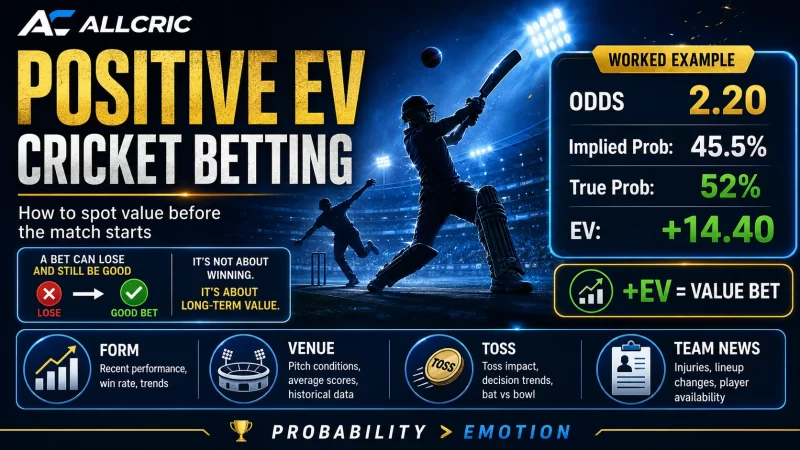
Let’s say Team A is playing Team B in a T20 match, and a bookmaker offers decimal odds of 2.20 on Team A to win.
- Step 1: Convert odds to implied probability. Implied Probability = 1 ÷ 2.20 = 0.4545, or about 45.5%
- Step 2: Estimate your own true probability. Suppose your analysis — based on recent form, head-to-head record, and venue history — suggests Team A actually has closer to a 52% chance of winning.
- Step 3: Calculate EV on a hypothetical $100 stake. Potential Profit if Team A wins = $100 × (2.20 − 1) = $120 EV = (0.52 × $120) − (0.48 × $100) EV = $62.40 − $48.00 EV = +$14.40
Since the result is positive, this qualifies as a +EV cricket bet — not because Team A is guaranteed to win, but because, over many similar situations, this type of bet would be expected to profit on average.
Where Your “True Probability” Estimate Actually Comes From
The entire +EV framework depends on one critical input: an accurate probability estimate. This This isn’t guesswork, reliable estimates typically draw from:
- Recent form — usually the last 5–10 matches for both teams
- Head-to-head history — how these specific teams have performed against each other
- Venue and pitch data — average first-innings totals, chase success rates, and whether the ground favors batting or bowling
- Toss trends — some venues show a strong bias toward batting or bowling first
- Weather and dew factor — especially relevant in day-night T20 matches
- Confirmed team news — injuries, rested players, and last-minute changes
Weak or outdated probability inputs are the most common reason casual bettors misjudge +EV, the formula is only as good as the estimate you feed into it.
Why the Bookmaker’s Margin Makes +EV Harder to Find
If you add up the implied probabilities of every outcome in a two-team cricket match, the total is almost always slightly above 100%, commonly landing around 105–110%. That extra percentage is the bookmaker’s built-in margin, sometimes called the “overround.”
This means the odds you see aren’t a neutral, pure probability estimate, they’re deliberately shaded to guarantee the bookmaker a theoretical edge regardless of outcome. To find genuine positive EV cricket betting value, your probability estimate doesn’t just need to beat the “fair” probability, it needs to beat the market’s inflated, margin-included probability. This is precisely why disciplined data analysis (rather than casual intuition) is required to consistently locate real +EV opportunities.
Common Myths About +EV Betting
Myth 1: “+EV guarantees a win.” False. +EV describes long-run expectation, not certainty on any single match. A +EV bet can still lose.
Myth 2: “If my bet won, it must have been +EV.” False. Outcome and decision quality are separate things. A bet can win by luck despite being a poor decision, and lose despite being a sound one.
Myth 3: “Betting on obvious favorites is always safe.” Not necessarily. Favorites are frequently overpriced precisely because casual bettors gravitate toward them, which can make backing an underdog the better value in certain matchups.
Myth 4: “You need to be a professional statistician to think in EV terms.” Not true. Basic implied-probability math and consistent record-keeping go a long way — the concept is accessible to any fan willing to slow down and compare numbers instead of reacting emotionally.
How +EV Connects to Value Betting and Cricket Odds and Probability
+EV and “value betting” are essentially the same idea described from two angles. A value bet is simply a bet where the odds offered are generous relative to the true chances of the outcome, which, by definition, is a +EV situation. Both concepts sit on top of the same foundation: a solid understanding of cricket odds and probability, and the ability to convert market odds into implied probability before comparing them against your own estimate.
This is also where the difference between “likely winner” and “good bet” becomes crucial. A team can have the highest probability of winning a match and still represent poor value if the odds have priced that probability too aggressively, while an underdog with a lower overall win chance can represent excellent value if the market has underpriced it.
Practical Ways to Estimate Probability for Cricket Matches
Building your own probability estimate doesn’t require professional-grade modeling software. A workable approach includes:
- Track recent form manually — win/loss trends over the last 5–10 matches for both sides.
- Study venue statistics — average first-innings scores and chase success rates at that specific ground.
- Factor in the toss — note historical toss-decision trends and how much they’ve influenced outcomes there.
- Check confirmed lineups — a missing strike bowler or top-order batter can shift probability by several percentage points.
- Use a reliable prediction tool as a cross-check — a transparent, data-driven cricket ai prediction app can serve as an independent second opinion against your own manual estimate, helping validate whether a probability gap is real or just a hunch.
Why Sample Size Is Everything in +EV Betting
Because cricket is a low-frequency, high-variance sport, no single match can validate or invalidate a +EV approach. A well-identified +EV situation might still lose 4 or 5 times out of 10, that’s expected, not a sign of failure. The edge in +EV thinking shows up only across a large number of similar decisions, evaluated collectively rather than match by match. This is precisely why disciplined tracking, logging your probability estimate, the odds taken, and the actual outcome over dozens or hundreds of matches, is the only reliable way to know whether your process is genuinely +EV over time.
Using AllCric’s AI-Driven Data to Support +EV Thinking
Estimating true probability manually is possible, but it’s time-consuming and prone to personal bias. This is where a platform like AllCric becomes genuinely useful for fans trying to think in +EV terms. AllCric positions itself as an AI-driven cricket analysis platform that processes millions of data points across players, teams, venues, and match situations in real time, rather than offering static, opinion-based tips.
Its match-center features, including live win probabilities, pitch reports, toss analysis, and context-aware insights that adjust through powerplays, middle overs, and pressure phases, give fans a consistent, data-backed probability baseline to compare against any market odds they encounter elsewhere.
Conclusion
Positive expected value isn’t a betting trick or a shortcut to guaranteed profit, it’s a disciplined way of thinking that judges decisions by the information available beforehand, not by how a single match happens to unfold. By learning to convert odds into implied probability, building your own honest probability estimates, and consistently comparing the two, you shift from reactive guessing to a repeatable, evidence-based process. It won’t make every bet a winner, but over time, it’s the only approach that can realistically separate skill from luck in cricket predictions.


 Get expert Today cricket match predictions 100 sure, top picks & fantasy tips – Download AllCric Appor visit AllCric Website