

AllCric

Home » Cricket » Cricket Match Predictions: How Data, Form & Pitch Work

How Cricket Match Predictions Are Made: Data, Form & Pitch Explained

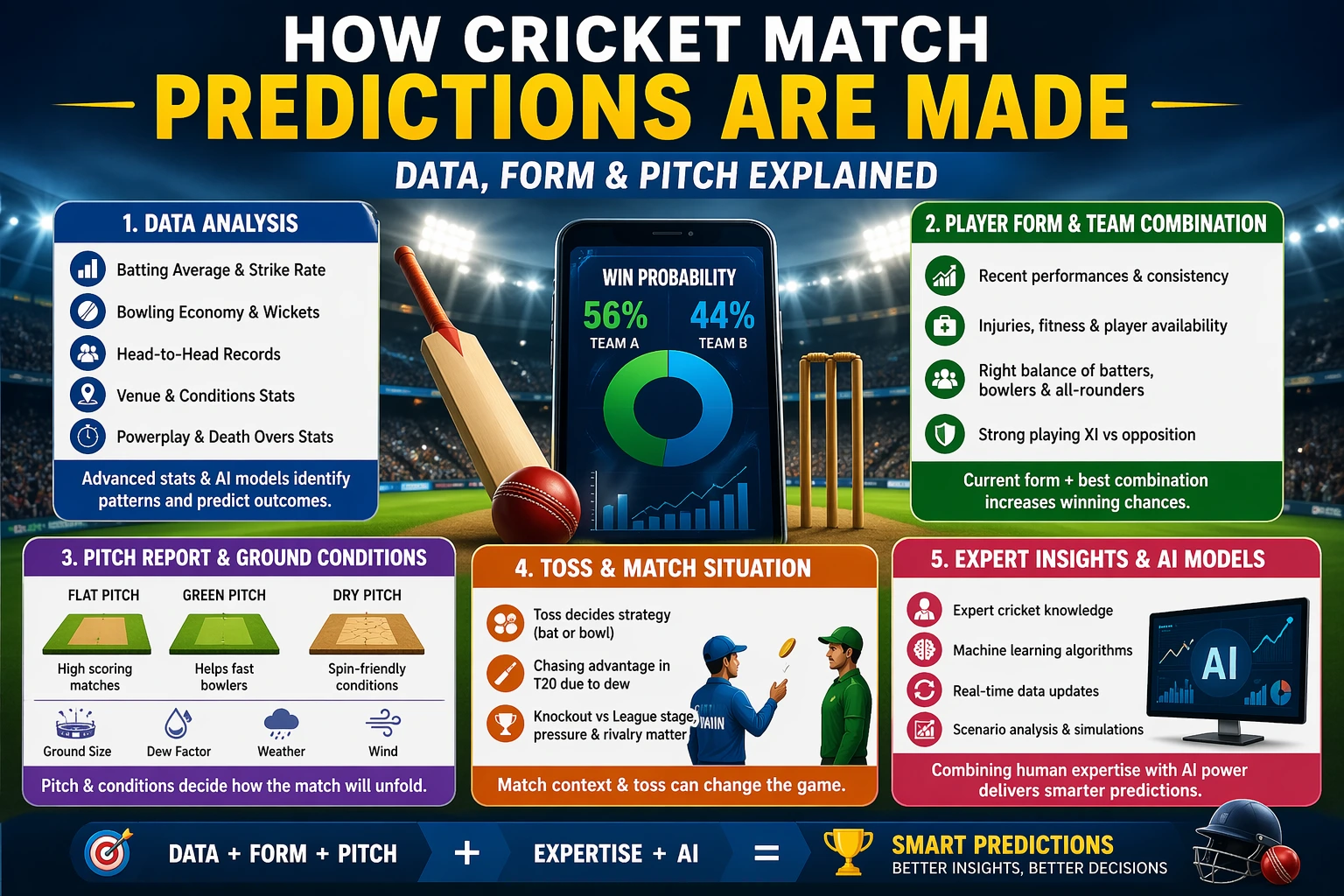
“How cricket match predictions are made using data analysis, player form, pitch report, toss impact, and AI insights infographic”
Infographic explaining how cricket match predictions work using data analysis, player form, pitch conditions, toss impact, and AI insights.

Cricket has now become a multi-billion dollar business, and with every single ball bowled, every single run scored, and every attempt to win all being scrutinised by millions around the world. 

Today, that interest goes well beyond the actual playing of the game; fans, writers, and enthusiasts are constantly attempting to predict the result of a game before the last ball is delivered. 

Today’s Cricket Match Prediction models base their predictions upon many thousands of complex data points, the historical flow of a match, the psychology of each player involved, and environmental conditions throughout the game. 

To truly understand how to construct the type of prediction being made, you have to take into account the three main pillars of cricket analysis – data, form, and the pitch.

The Foundation: Historical Data and Analytics

There is an extensive wealth of historical data that professional Cricket Match Predictions rely on. Predictive modelers and analysts use advanced technology to analyze many years of data and discover trends.

  • Head-to-Head Statistics: Some teams consistently have a large advantage over one another in head-to-head matchups. An example of this can be seen in the historical data that shows the psychological edge that Australia has over several teams in ICC tournaments.
  • Venue Statistics: Certain venues tend to favour high run totals. Data on the average first-inning scores and what the historical success rate is for chasing a certain total in that stadium will significantly affect a prediction’s accuracy.
  • Player Matchups: This is the most specific level of data and looks at how one particular opening batsman has fared against one specific opening bowler. 

The Momentum: Current Form and Player Availability

“Statistics” give you a record of events that have occurred in the past, while ‘Form’ provides an indication as to how an athlete’s form currently stands. 

Momentum plays a big role in cricket, helping to build a lot of belief amongst players, which is an important factor when predicting who will win a match against a team with superior skills.

Another major factor when predicting the result of a cricket game is “Player Availability”. To be as accurate as possible when making Professional Cricket Match Predictions, predictions must be updated in real-time when teams announce their squads or when there are any last minute injuries to players.

Reading the Surface: The Pitch and Ground Conditions

A cricket match’s surface is possibly the most significant “third party” to the game. The cricket pitch is different from football and basketball.

  1. Green Pitches: Favor fast bowlers; they provide swing, seam, and movement of the ball. Predictions for matches played on green pitches are often towards a low-scoring game dominated by bowlers.
  2. Dusty/Dry Pitches: More common in the Indian subcontinent, they favor spinners. Additionally, when playing on a dry pitch, the toss of the coin is extremely important as batting becomes next to impossible in the 4th innings of a Test or 2nd half of a T20 match.
  3. Flat Decks: Predictions for high-scoring games are common when using a flat deck playing surface, and one of the determining factors when making predictions is which team has the most power in their batting order.

Weather and External Factors

The weather has a significant impact on the game of cricket, as rain may force a match to end prematurely and could affect the final result. Humidity conditions are also good for swing bowlers, while extremely high temperatures can dehydrate players, thus reducing their ability to field well.

Dew is one of the biggest factors outside of a player’s skill in limited-overs matches today. In night-time matches, dew or moisture in the grass creates a slippery surface to bowl on and can cause bowlers problems with their grip. 

As a result of this factor, many reputable sources providing cricket match predictions will provide some kind of dew factor when they provide their pre-match prediction. 

The Role of Technology and AI

The use of Artificial Intelligence (AI) in the field of Cricket Match Predictions is beginning to advance quite rapidly. 

With machine learning algorithms being able to simulate a match thousands of times per second in order to try to account for things such as wind speed, player condition, and so on, this will definitely help improve the probability of outcomes of games. 

The AI model will give a percentage of likelihood of a team winning after each ball that is bowled throughout the match. 

Although there is no way to predict how a player will perform, this AI technology will give us an accurate idea of the likelihood for that player’s performance to improve or decline based on prior performance or overall team performance. 

The Impact of the Toss

Many people consider the toss to be based purely on luck; however, analysts rely on the toss as a very important step in finalizing their predictions. Regardless of how good the team is, there are conditions due to weather or playing conditions that can cause a team to win the match. 

The weather conditions and how the team won the toss are the key determinants for the captain when determining whether to bat first or bowl first; this gives the analyst the last piece of information needed to accurately predict how the game will go.

Conclusion

Predicting how a cricket match will play out is constructed from analyzing the historical and repetitive data, evaluating performance trends of individual players, and how those players will fare against different pitches and weather conditions, to garner accurate predictions of how a cricket match will be played.

Unpredictability is one of the many things that help generate a loyal fan base for cricket. Regardless of how much statistical information suggests an outcome should occur, the outcome of a match can be changed within seconds due to an unexpected or outstanding play.

FAQS

What factors are used in cricket match predictions?

Cricket match predictions are based on multiple factors such as player statistics, recent form, pitch conditions, weather, team combinations, and head-to-head records.

How important is player form in cricket predictions?

Player form is one of the most crucial elements. In-form players are more likely to perform well and significantly impact match outcomes.

Why is pitch report important for match prediction?

The pitch determines how the game will behave—whether it favors batsmen, fast bowlers, or spinners—making it a key factor in accurate predictions.