
AllCric

Home » Cricket » Ten Best Young Indian Cricket Players: Who Will Be The Future Of Cricket?

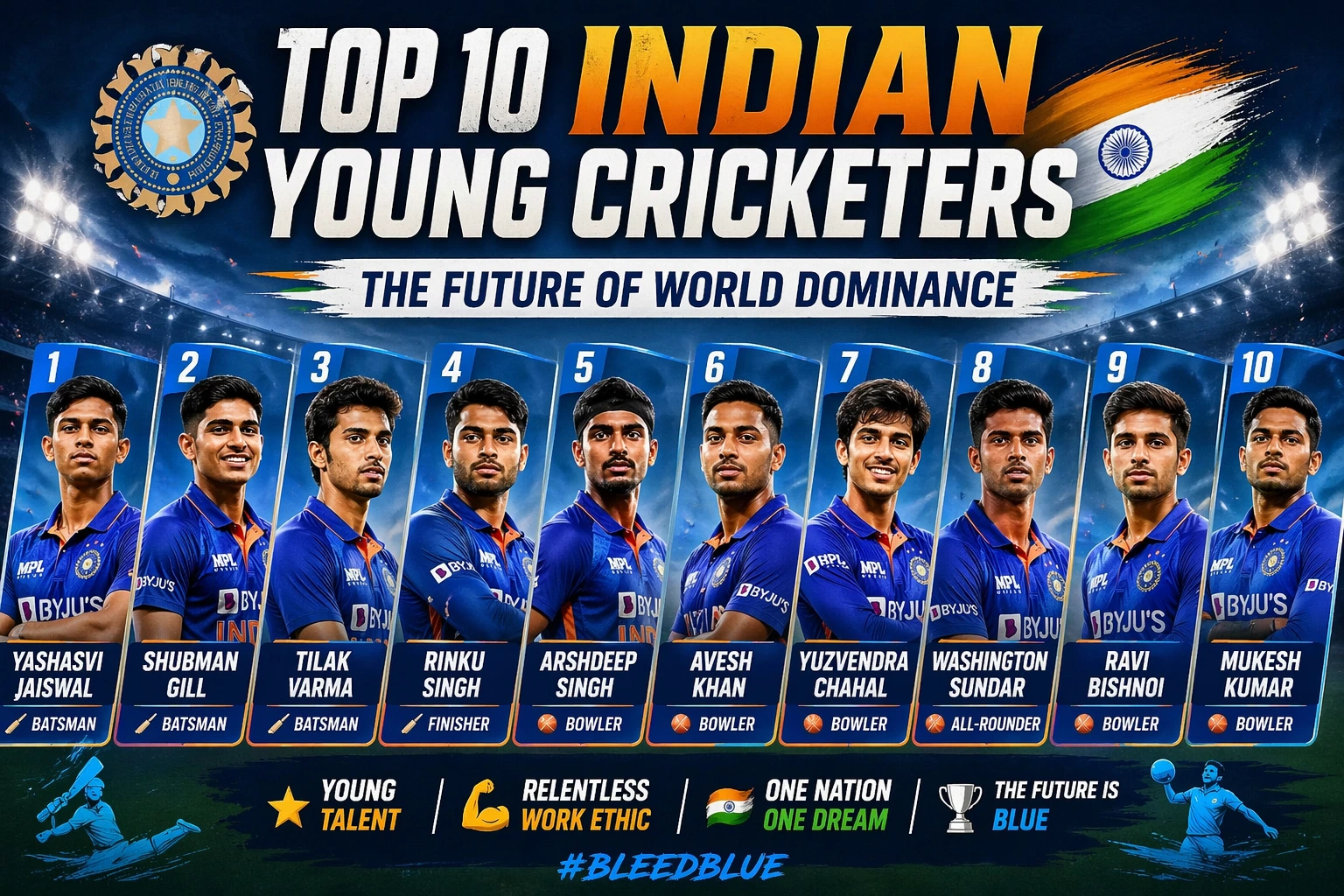
Top 10 Indian Young Cricketers: The Future of World Dominance

Infographic of top 10 Indian young cricketers including Yashasvi Jaiswal, Shubman Gill, Tilak Varma, Rinku Singh, Arshdeep Singh, Avesh Khan, Yuzvendra Chahal, Washington Sundar, Ravi Bishnoi and Mukesh Kumar in Team India jerseys with stadium background
Rising stars of Indian cricket showcasing the next generation of talent set to dominate world cricket

There is a major transformation occurring in international cricket. A new generation of cricketers is being born out of India, and the players who have been there for several years now have made names for themselves.

Along with this, the new generation of Indian young cricketers is taking the opportunity to play and lead at the senior level and fill this void to ensure that India will continue to play in the world’s most recognised sport. 

We will look at the top ten Indian young cricketers today who are going to be absolute stars of the future.

1. Yashasvi Jaiswal

Yashasvi Jaiswal is one of the greatest stories in modern sport – from living in tents and selling street food to becoming an established member of the Indian Test and T20 teams. 

He is arguably the brightest star of all the Indian young cricketers currently playing. Jaiswal has the ability to play an ultra-defensive style, a conventional style, and an ultra-aggressive style, making him a multifaceted asset across all formats of cricket.

2. Shubman Gill

Shubman Gill has quickly progressed from an exceptional young player to a senior player for Team India. He is referred to as “The Prince” but is still only 21 years old, and not only that, but he has successfully captained the Gujarat Titans franchise in IPL. 

Many cricket pundits see shades of former greats in Gill’s back-foot punches and graceful drives. Of all of the current Indian young cricketers who are at an elite level, he is consistently involved in discussions regarding the most technically proficient.

3. Abhishek Sharma

In T20s, Abhishek has proven to be one of the best and has also changed the way the T20 opening batsmen play. He will go on to have success in India due to his very young age and being able to hit a ball so well.

Being a left-handed batsman gives him good potential to perform well within India’s white-ball setup because he is an addition of a new dimension to Indian cricket, and with India’s current T20 squad being very shallow, Abhishek must be included in the plans for the future.

4. Mayank Yadav

Throughout the history of cricket, there has always been a need for speed, and given that in IPL 2024, Mayank Yadav consistently bowled at or above 155 km/h throughout the duration of the tournament, it may be indicative of a continuing rise of pace bowlers around the globe.

Mayank has put himself into the conversation for selection to play for India with his raw speed and some bounce that has a way of making even the best batsmen look second-rate.

5. Rinku Singh

While it may seem that all cricket teams should have a good finisher, Rinku Singh has become that for India. He has done an exceptional job of supplying India with added run totals, especially since he was able to finish last week against England when India needed an additional 20 runs from the final over!

While most of India’s young players focus on how flashy they can start a game, Rinku is outstandingly good at finishing games with a deep finish.

6. Dhruv Jurel

Ever since M.S. Dhoni retired from cricket, numerous players have attempted to take his place as India’s wicketkeeper and batsman; however, it seems that the innings behind the stumps have now fallen into several different players’ hands.

Additionally, Jurel demonstrates that Indian young cricketers are using ‘A’ tours as practice for the pressures of playing at the international test level.

7. Tilak Varma

Varma has shown his skills not only at the domestic level but also with success at the international level – he has performed successfully for the Mumbai Indians and now brings those successes with him to play at the international level as well. 

His versatility as a left-handed batsman gives balance in match play to the squad. He is regarded by various coaching staff as a top tactical performer among the younger Indian cricketers, as he can read and understand the game situation well.

8. Arshdeep Singh

Arshdeep Singh is a rarer breed in terms of left-arm pace. He is now arguably being considered as the main left-arm pacer for India in the death overs of T20 internationals. 

Due to the consistent ability to hit yorkers with ease and swing balls in the power play, Arshdeep is a must-have addition to any team. He is also recognised for having significant mental fortitude when facing adversity during games.

9. Riyan Parag

2024 has been a turning point for Riyan Parag after much speculation. He has shown this by shining on the domestic circuit before leading into the IPL with a fantastic season of cricket, thus proving himself as an all-rounder of good quality.

He has been taking wickets with his special style of bowling, he makes himself a key tactical option for his team in every game he plays.

10. Nitish Kumar Reddy

Nitish Kumar Reddy has had some glimpses of the kind of player that this nation has been looking for; the kind that has been required to help bring balance as a batting and bowling option. 

He plays a powerful type of cricket when batting and can pick up medium-fast wickets with his bowling. This is all that’s required for Nitish Kumar Reddy to have the opportunity to wear the ‘Blue of India’ for the first time in international cricket.

Conclusion

The future of Indian cricket is not only in secure hands; it is also in explosive hands. The players are far more than just athletes; they are the product of one of the largest scouting and training systems ever seen and the best in the world right now. 

Their growth will undoubtedly lead to many more ICC Trophies by India in the next ten years as they continue to gain experience.