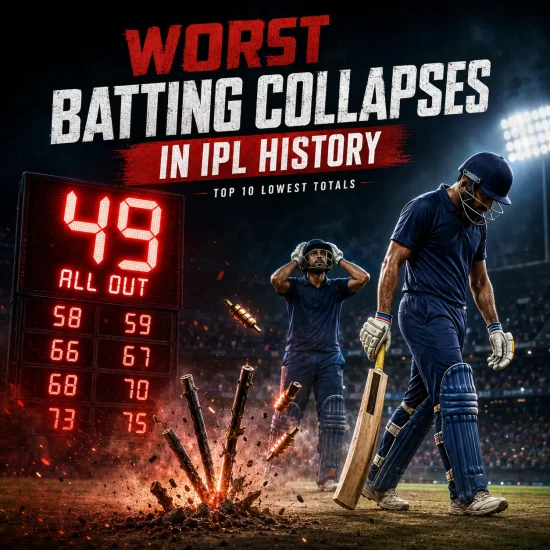
Top 10 Worst Batting Collapses in IPL History
1. Royal Challengers Bengaluru — 49 All Out (IPL 2017 vs KKR)
Royal Challengers Bangalore were bowled out for 49 runs at Eden Gardens while chasing 131 set by Kolkata Knight Riders on 23 April 2017, the lowest total in IPL history. TThis was not only the worst batting collapse by total but also the only sub-50 innings the league has seen. RCB’s 49 all out now stands among the most difficult IPL records to break. The RCB batting lineup, which featured some of the world’s best stroke-makers, was dismissed in just 9.4 overs, meaning the innings lasted barely half the available time. No batter reached double figures, and the bowling pair of Umesh Yadav and Colin de Grandhomme produced unplayable movement that rendered RCB’s entire top and middle order helpless. The collapse remains the most searched and discussed individual innings failure in the IPL’s 19-year history.
2. Rajasthan Royals — 58 All Out (IPL 2009 vs RCB)
Before RCB’s 49, Rajasthan Royals held the record for the lowest IPL total after being bowled out for 58 runs in 15.1 overs against RCB while chasing a target of 134 during the South African leg of IPL 2009. The chase looked manageable on paper, but RCB’s bowling unit, led by Anil Kumble and Zaheer Khan, found exploitable swing conditions at Newlands that turned the innings into a slow-motion implosion. The entire Rajasthan order disintegrated without building a single meaningful partnership, each wicket creating fresh panic for the next batter arriving at the crease.
3. Rajasthan Royals — 59 All Out (IPL 2023 vs RCB)
Fourteen years after their South African disaster, Rajasthan Royals revisited the same opponent for an eerily similar collapse. Chasing 172 against RCB, RR’s batting lineup was dismissed for just 59 runs in 10.3 overs at Jaipur in IPL 2023, both openers went for ducks, and none of the batters showed any resistance. What made this particularly devastating:
- Five batters were dismissed for ducks, including Yashasvi Jaiswal and Jos Buttler
- Shimron Hetmyer top-scored with just 35, highlighting how the rest contributed almost nothing
- RCB won by 112 runs, one of the biggest victories in the league’s history
4. Delhi Daredevils — 66 All Out (IPL 2017 vs Mumbai Indians)
At Feroz Shah Kotla on 6 May 2017, Delhi Daredevils were bowled out for 66 while chasing a large score set by Mumbai Indians, and despite having experienced players like Sanju Samson, Rishabh Pant, and Shreyas Iyer, not a single one of them managed to score even 5 runs. Mumbai Indians won by a landmark 146 runs, still the largest win margin in IPL history. The collapse was particularly striking because it featured household names who went through the innings without a single meaningful contribution. MI’s bowling attack maintained relentless pressure, never offering a loose delivery that might have allowed a partial recovery.
5. Delhi Daredevils — 67 All Out (IPL 2017 vs Punjab Kings)
Exactly five days before their collapse against Mumbai, Delhi Daredevils were bowled out for just 67 runs in 17.1 overs against Kings XI Punjab at Mohali on 30 April 2017, batting first and being restricted through consistent wicket-taking. Two collapses by the same franchise within five days of each other, within the same IPL season, is the most concentrated spell of batting failure any franchise has produced in the league’s history. Delhi’s 2017 campaign became a masterclass in everything that can go wrong when a batting order loses structure, confidence, and method simultaneously.
6. Kolkata Knight Riders — 67 All Out (IPL 2008 vs Mumbai Indians)
On 16 May 2008, KKR were bowled out for 67 against Mumbai Indians at Wankhede Stadium in just 15.2 overs, with not a single batter managing more than 15 runs, Shaun Pollock picking up three key wickets. This was one of the IPL’s earliest defining collapse moments, arriving just a few weeks into the inaugural season. With Sourav Ganguly captaining KKR and the franchise carrying enormous public expectation, the collapse was a brutal early warning that star names and IPL success don’t automatically correlate.
7. Royal Challengers Bengaluru — 68 All Out (IPL 2022 vs SRH)
In the 36th match of IPL 2022 at Brabourne Stadium, RCB were bowled out for 68 against Sunrisers Hyderabad in 16.1 overs, extras were their second-highest contributor with 12 runs, and SRH comfortably chased the target in just 8 overs, winning by nine wickets. A nine-wicket win by the chasing team is one of the most dominant results possible in T20 cricket, and the 8-over chase made this one of the most lopsided outcomes the league has ever produced. Marco Jansen and T. Natarajan’s new-ball discipline was simply unplayable.
8. Royal Challengers Bengaluru — 70 All Out (IPL 2014 vs Rajasthan Royals)
In an IPL 2014 match at Sheikh Zayed Stadium on 26 April, RCB managed only 70 runs against Rajasthan Royals, with Pravin Tambe taking several wickets and stifling the batting unit. Tambe, a leg-spinner who began his IPL career at the age of 41, produced one of the most unlikely bowling performances in the tournament’s history, dismantling an RCB lineup featuring Virat Kohli and AB de Villiers on a pitch where neither found any rhythm. The match remains one of the most remarkable underdog bowling performances in IPL history.
9. Kings XI Punjab — 73 All Out (IPL 2017 vs Rising Pune Supergiant)
Kings XI Punjab scored only 73 runs against Rising Pune Supergiant in IPL 2017 at Maharashtra Cricket Association Stadium, Pune, Shardul Thakur taking 3 wickets in a must-win game that Punjab could not recover from. The collapse ended Punjab’s realistic playoff hopes that season and remains their lowest-ever IPL total. Shardul’s disciplined seam bowling in overcast Pune conditions made this one of the most one-sided mismatches the league had produced to that point.
10. Delhi Capitals — 75 All Out (IPL 2026 vs RCB)
The most recent and structurally shocking collapse on this list. On 27 April 2026 at the Arun Jaitley Stadium, Delhi Capitals were dismissed for 75 runs by RCB, losing six wickets while scoring only 8 runs in the first four overs, the worst powerplay start in IPL’s 19-year history, as Josh Hazlewood (4/12) and Bhuvneshwar Kumar (3/5) extracted unplayable movement from a dry Delhi pitch. The 8/6 powerplay scoreline isn’t just historically bad, it is statistically near-impossible in professional T20 cricket. Bhuvneshwar Kumar, who also ranks among the bowlers with the most wickets in IPL history, combined with Josh Hazlewood to destroy Delhi’s top order. By the time DC’s middle order arrived, the match was already effectively over.
Common Patterns Behind IPL Batting Collapses
Looking across all 10 entries, several defining patterns emerge:
- RCB appear four times — highlighting a chronic vulnerability to collapse despite fielding world-class batting talent across multiple eras
- Delhi franchise appear three times in the top 12 all-time lowest scores, two of those at their home venue
- RCB’s bowling dismissed opponents to four of the lowest totals on record (58, 59, 70, 75), making them uniquely positioned as both the worst batting collapse team and the most effective collapse-inducing bowling unit
- IPL 2017 produced the highest concentration of sub-75 scores of any season — five in a single edition, suggesting that year’s pitches and dew-factor conditions created uniquely difficult batting environments
- No collapse in this top 10 featured a meaningful partnership — not a single 40-run stand appears anywhere in the match records listed above
AllCric: Your Fantasy Cricket Edge
In fantasy cricket, knowing which teams are collapse-prone under specific conditions is as valuable as knowing which batter is in form. AllCric is a match prediction and fantasy cricket companion app that delivers pre-match analysis, pitch and weather reports, player form breakdowns, and fantasy team recommendations all in one place. Whether you’re deciding whether to trust a fragile batting order or assessing a bowling unit’s collapse-triggering potential on a seaming surface, AllCric gives you the data-backed insight to make sharper decisions before every IPL match.
Conclusion
The list of the worst batting collapses in IPL history is dominated by two recurring themes: RCB’s paradoxical relationship with low scores despite their attacking identity, and Delhi’s chronic vulnerability at home when conditions assist pace. From RCB’s all-time record 49 in 2017 to DC’s structurally impossible 8/6 powerplay in IPL 2026, these collapses remind us that in T20 cricket, no batting lineup is immune to a bad day, particularly when an elite pace duo finds the right conditions in the opening six overs.