Summary
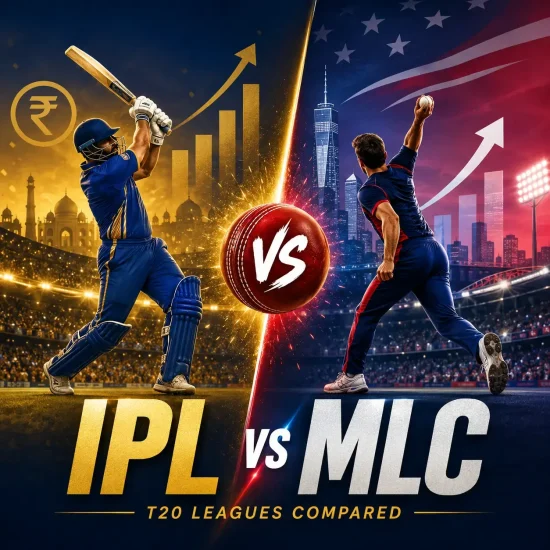
The global Twenty20 circuit is anchored by the mighty Indian Premier League (IPL), but Major League Cricket (MLC) in the United States has rapidly emerged as an ambitious contender. While the IPL remains the ultimate commercial behemoth of world cricket, MLC is redefining how the sport scales in a completely fresh market. This structured comparative analysis examines the critical differences between these two prominent tournaments—ranking them by format boundaries, financial caps, talent pools, and global broadcast viewers.
In the modern sports landscape, franchise T20 cricket drives global innovation, financial growth, and fan engagement. Since its groundbreaking debut in 2008, the Indian Premier League (IPL) has ruled undisputedly as the financial and cultural epicenter of the sport.
However, the global cricket map expanded significantly with the launch of MLC. The league’s investment, domestic opportunities, and international stars show how Major League Cricket is growing cricket in the USA. Driven by heavy technology investments and corporate backings, the American league has carved out its own distinct summer window. To understand this shifting ecosystem, we stack up the rookie American tournament against the established Indian heavyweight.
MLC vs IPL: The Tournament Format Comparison
The fundamental difference between the two competitions lies in their operational scale and schedule length.
The IPL is a grueling, multi-month marathon. It features 10 elite franchises playing a total of 74 matches across a massive home-and-away format, stretching over nine to ten weeks. This extensive schedule demands immense physical durability, deep squad reserves, and sustained tactical planning.
In contrast, MLC functions as a highly concentrated summer sprint. Featuring six teams, including MI New York, Texas Super Kings, and Washington Freedom, MLC packs its league phase and playoffs into a four-week window. Several franchises also have close links with IPL teams and their MLC counterparts. For players, it offers a high-intensity, low-fatigue championship framework.
Financial Power: Salary Caps and Player Remuneration
When comparing the financial landscapes, the scale of internal economies reveals a massive structural gap.
The IPL operates as the most lucrative cricket league on the planet. For the recent auction cycles, the Board of Control for Cricket in India (BCCI) locked in a hard team salary cap of approximately $14.5 million (INR 120 Crore) per franchise. Top marquee players regularly command record-breaking individual contracts, with elite stars securing over $3 million for a single season’s work.
Conversely, MLC manages a more conservative financial model as it establishes its commercial footprint. The salary cap for American franchises is fixed at a hard limit of $2 million per squad. While this is lower than the IPL’s massive purse, MLC maximizes its funds by offering premium overseas players up to $372,000 for just four weeks of active cricket. This high pro-rata rate makes the American circuit exceptionally attractive.
Talent Pools and Roster Composition Rules
The rules governing roster selection create vastly different playing dynamics on the field.
IPL Roster Blueprint
The IPL enforces strict protection rules designed to showcase local Indian talent. Franchises can build squads of up to 25 players, but they are limited to a maximum of 8 overseas signings. Crucially, a team can field only 4 international players in their live playing eleven, ensuring local domestic stars drive the core action.
MLC Roster Blueprint
Because the United States is an emerging cricket market, MLC relies on a heavily globalized roster model to guarantee elite quality. Squads feature a maximum of 19 positions, allowing up to 9 overseas signings. Teams can include up to 6 international superstars in their live starting lineups. This high overseas-player limit allows some of the top overseas players in MLC 2026, including Nicholas Pooran, Glenn Maxwell, and Trent Boult, to play alongside local USA talent.
Global Viewership and Commercials
The commercial reach of these two leagues highlights the difference between an established global phenomenon and a fast-growing startup.
The IPL is a media behemoth, with its broadcast rights trading for a record-breaking $6.2 billion across a five-year cycle. This places it alongside the NFL and English Premier League in terms of value per game. It attracts over 500 million live viewers in India alone, commanding absolute broadcast dominance.
MLC focuses its growth strategy on a dual market approach: capturing the passionate South Asian diaspora within North America while introducing the game to a brand-new domestic sports audience. Backed by television and streaming partners across different countries, MLC is reaching more cricket fans every season. Our guide explains where to watch Major League Cricket through official broadcasters and streaming services.
The Money Comparison: Top 3 Highest Paid Players
Indian Premier League (IPL) 2026 Top Earners
- Cameron Green (Kolkata Knight Riders): ₹25.20 crore ($3.02 million), the most expensive overseas player in auction history. (Per league rules, his direct pocketed payout is capped at ₹18 crore, with the remaining balance fueling the BCCI player development fund).
- Virat Kohli (Royal Challengers Bengaluru): ₹21.00 crore ($2.52 million), reclassified as the highest-paid retained Indian player for the 2026 season.
indianexpress.com - Matheesha Pathirana (Kolkata Knight Riders): ₹18.00 crore ($2.16 million), secured via a massive bidding war after surprisingly being released by CSK.
- Prashant Veer & Kartik Sharma (Chennai Super Kings): ₹14.20 crore ($1.70 million) each shared the spotlight as the most expensive uncapped Indian players in history.
Major League Cricket (MLC) 2026 Top Earners
Operating within a tighter $2 million total team salary cap, MLC matches the global premium market by offering massive pro-rata payouts across a condensed 4-week window:
- Nicholas Pooran (MI New York): $372,000: Holds the absolute tier-one maximum marquee contract ceiling.
- Rashid Khan (MI New York): $372,000: Commands the identical tier-one maximum bracket as the world’s premier spin asset.
- Glenn Maxwell (Washington Freedom): $350,000+: Commands an elite international slot to headline their middle-overs core.
Elevating Your Fantasy Edge with AllCric
Navigating the major structural differences between these two prominent global leagues requires an elite analytical companion. This is exactly where AllCric completely changes your strategy.
AllCric is an advanced cricket match prediction and fantasy sports platform engineered to help fans build winning rosters. The application simplifies complex statistics across both the IPL and MLC formats, providing clear pre-match insights, accurate weather updates, and detailed pitch profiles.
Conclusion
The comparison between the Indian Premier League and Major League Cricket is not about crowning a single winner; it highlights how T20 cricket is successfully diversifying. The IPL remains the financial and cultural engine of world cricket, while MLC serves as a fast-paced, high-quality showcase proving that the sport has a bright, highly profitable future in the United States.