Why AI Is Being Used in Cricket Prediction
Cricket generates an enormous amount of structured data, every ball bowled produces a record of line, length, speed, shot type, field placement, and outcome. This ball-by-ball granularity makes the sport unusually well suited to statistical modeling compared to more fluid, continuous sports like football. Broadcasters already use AI-driven models to display live win probability during matches, and analytics departments in franchise leagues like the IPL use machine learning to inform team selection, batting order, and bowling strategy.
It’s a short step from “AI predicts match outcomes for broadcast” to “AI predicts match outcomes for betting.” The appeal is obvious: if a model can process far more historical data and in-game variables than a human ever could, it seems reasonable to expect it might spot patterns, and therefore value, that the betting market has missed.
How AI Cricket Betting Predictions Actually Work
Most AI cricket prediction systems fall into a few broad categories:
- Statistical/machine learning models: These use historical match data, team records, head-to-head results, venue statistics, toss outcomes, and player form, to train models (often regression-based or ensemble methods like random forests and gradient boosting) that output a win probability or predicted score.
- Ball-by-ball simulation models: More advanced systems simulate an entire innings ball-by-ball thousands of times (a Monte Carlo–style approach), using player-specific scoring and dismissal probabilities to generate a distribution of likely outcomes rather than a single prediction.
- Player performance models: These focus narrower, predicting an individual player’s likely runs, strike rate, or wickets based on their recent form, matchup history against specific bowlers or batsmen, and conditions.
- Live/in-play models: These continuously update predictions as a match unfolds, factoring in current score, wickets in hand, required run rate, and historical data from similar match situations.
In all cases, the underlying idea is the same: convert historical patterns into a probability estimate for a future, uncertain event.
The Data Behind the Models
The quality of any AI cricket prediction is entirely dependent on the data it’s trained on. Common inputs include:
- Historical match results across formats (Test, ODI, T20)
- Player statistics, often broken down by format, venue, opponent, and recent form (form-weighted averages)
- Venue and pitch data, including historical scoring patterns and how much a ground favors batting or bowling
- Toss outcomes and decisions, since these correlate strongly with results at certain venues
- Weather data, relevant to both playing conditions and the possibility of rain-affected (DLS) outcomes
- Team news, such as injuries, rest rotations, or changes to the playing XI
The challenge is that much of this data is either limited in volume (a specific player may have only played a handful of matches at a given venue) or inherently noisy (form can be misleading over small sample sizes), which directly limits how confident any model’s output can really be.
What AI Cricket Predictions Can Do Well
AI models genuinely add value in several areas:
- Processing scale: A model can weigh hundreds of historical matches and thousands of data points instantly, something no human analyst can replicate in real time.
- Identifying non-obvious statistical patterns: For example, a model might surface that a particular team’s win rate drops significantly when chasing under lights at a specific venue, a pattern too subtle for casual observation.
- Live win-probability tracking: In-play models are genuinely useful for understanding how much a single over or wicket has shifted a team’s chances, which is why broadcasters rely on them.
- Player matchup analysis: Models can quantify how a specific batsman has historically performed against a specific bowling style, informing tactical and betting insight alike.
- Consistency: Unlike human judgment, a model isn’t swayed by recency bias, crowd sentiment, or a “gut feeling” about a team, it applies the same logic every time.
Where AI Predictions Fall Short
Despite the sophistication, AI cricket betting predictions have real, well-documented limitations:
- Small sample sizes: Cricket, especially in Test and franchise formats, doesn’t generate nearly as much data as sports played year-round with larger schedules, making models more prone to overfitting.
- Unpredictable human factors: Form slumps, personal circumstances, team morale, and player motivation are difficult to quantify and can dramatically affect outcomes in ways no dataset captures.
- Weather and pitch variability: Even with forecasts, actual playing conditions on the day (dew, pitch deterioration, wind) can shift outcomes unpredictably.
- Low-probability, high-impact events: A single dropped catch, a run-out, or an unplayable delivery can change a match’s entire trajectory, these are inherently random and resistant to modeling.
- Rule changes and format evolution: T20 and franchise cricket strategy has evolved rapidly (e.g., more aggressive powerplay batting), and models trained on older data can lag behind current tactical trends.
- Data quality gaps: Domestic and associate-nation cricket often has far less granular historical data than major international fixtures, weakening predictions for those matches specifically.
Why Cricket Is a Hard Sport for AI to Model
Cricket combines long-format strategic depth (Tests) with short-format chaos (T20s), and each format behaves differently statistically. A model tuned for T20 scoring patterns won’t transfer well to Test match dynamics, and vice versa. Additionally, cricket is unusually sensitive to conditions, the same two teams can produce wildly different results depending on pitch behavior, time of day (day-night matches), dew factor, and even altitude at certain venues.
Compounding this, cricket matches are relatively infrequent for any given team compared to sports like basketball or football, meaning models have fewer recent data points to calibrate against, and older data risks being less relevant as squads and playing styles change.
AI vs. Bookmaker Odds: Can Models Beat the Market?
Bookmaker odds already incorporate enormous amounts of information, historical data, expert analysis, and crucially, the real-time betting behavior of thousands of participants, some of whom may have access to team insider information (like an unannounced team change). This means betting markets are often described as “efficient”: by the time odds are published, most publicly available information (including what a basic AI model could compute) is usually already priced in.
For an AI model to genuinely find an “edge” over the market, it typically needs to:
- Use data or signals the market hasn’t fully incorporated yet (e.g., very recent, hyper-local weather data)
- Apply a genuinely novel modeling technique that captures patterns others miss
- Update faster than the market during live, in-play situations
In practice, most publicly available or off-the-shelf AI prediction tools are working from the same public data as everyone else, which makes it unlikely they consistently outperform odds that are already shaped by the same information, plus the collective wisdom (and money) of the betting public.
Red Flags: Spotting Overhyped “AI Prediction” Tools
Given the growing marketing around AI cricket betting predictions, it’s worth knowing the common warning signs of tools overselling their capabilities:
- Claims of guaranteed wins or “fixed” accuracy percentages with no methodology disclosed
- No transparency about the data sources or model type behind the predictions
- Predictions that are vague enough to seem correct regardless of outcome
- No acknowledgment of uncertainty, variance, or historical accuracy tracking
- Pressure tactics urging immediate high-stakes bets based on the prediction
Genuinely useful analytical tools tend to present probabilities and context, not certainties, and are transparent about their limitations.
How to Use AI Predictions Responsibly
- Treat predictions as one input, not a final answer. Combine model output with your own understanding of team news, conditions, and recent form.
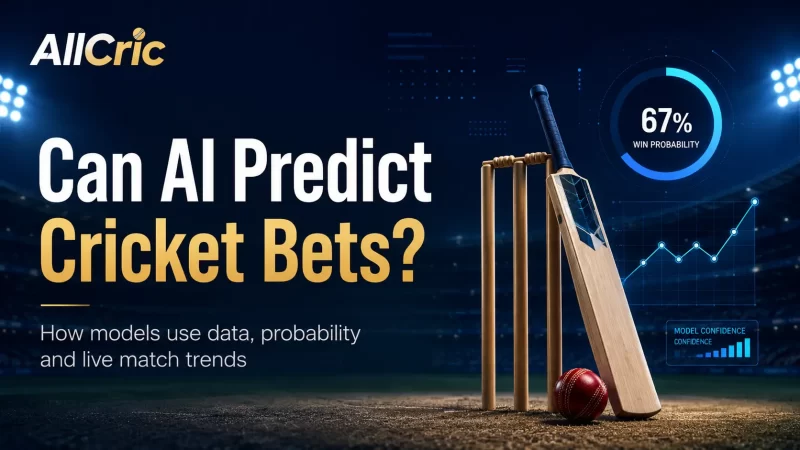
- Look at probability, not certainty. A model favoring one team 65% to 35% is describing a meaningful edge, not a guaranteed result.
- Check the track record. Any credible prediction source should be able to show historical accuracy over a meaningful sample size.
- Be skeptical of black-box tools. If a platform can’t explain roughly how its predictions are generated, treat the output with caution.
- Never bet more than you can afford to lose, regardless of how confident a prediction sounds.
How AllCric Uses Data to Help You Understand the Game, Not Just Predict It
Rather than promising a shortcut to beating the odds, AllCric focuses on giving fans the underlying context that any good prediction, human or AI, depends on: live scores, ball-by-ball updates, team form, head-to-head records, pitch and venue history, and player statistics, all in one place.
This matters because the honest answer to “can AI find an edge in cricket betting?” is that the real edge, if there is one, comes from combining good data with good judgment, not from blindly trusting a black-box output. By surfacing the same structured data that AI models are built on, form trends, venue tendencies, toss impact, and player matchups, AllCric helps fans build their own informed read on a match, rather than outsourcing that understanding entirely to an algorithm they can’t inspect.
Conclusion
AI has a legitimate and growing role in cricket analytics, processing scale, spotting subtle statistical patterns, and powering live win-probability models that genuinely add insight during a match. But when it comes to betting specifically, AI cricket predictions are not a guaranteed edge. Cricket’s small sample sizes, human unpredictability, and sensitivity to conditions mean that even sophisticated models operate with real uncertainty, and betting markets already price in most publicly available information. The most reliable approach is to treat AI predictions as one useful input among several, grounded in transparent data and realistic expectations, rather than a shortcut to guaranteed wins.



 Get expert Today cricket match predictions 100 sure, top picks & fantasy tips – Download AllCric App or visit AllCric Website