
AllCric

Home » Cricket » Types of Pitches in Cricket and How They Affect Match Results

Types of Pitches in Cricket and How They Affect Match Results

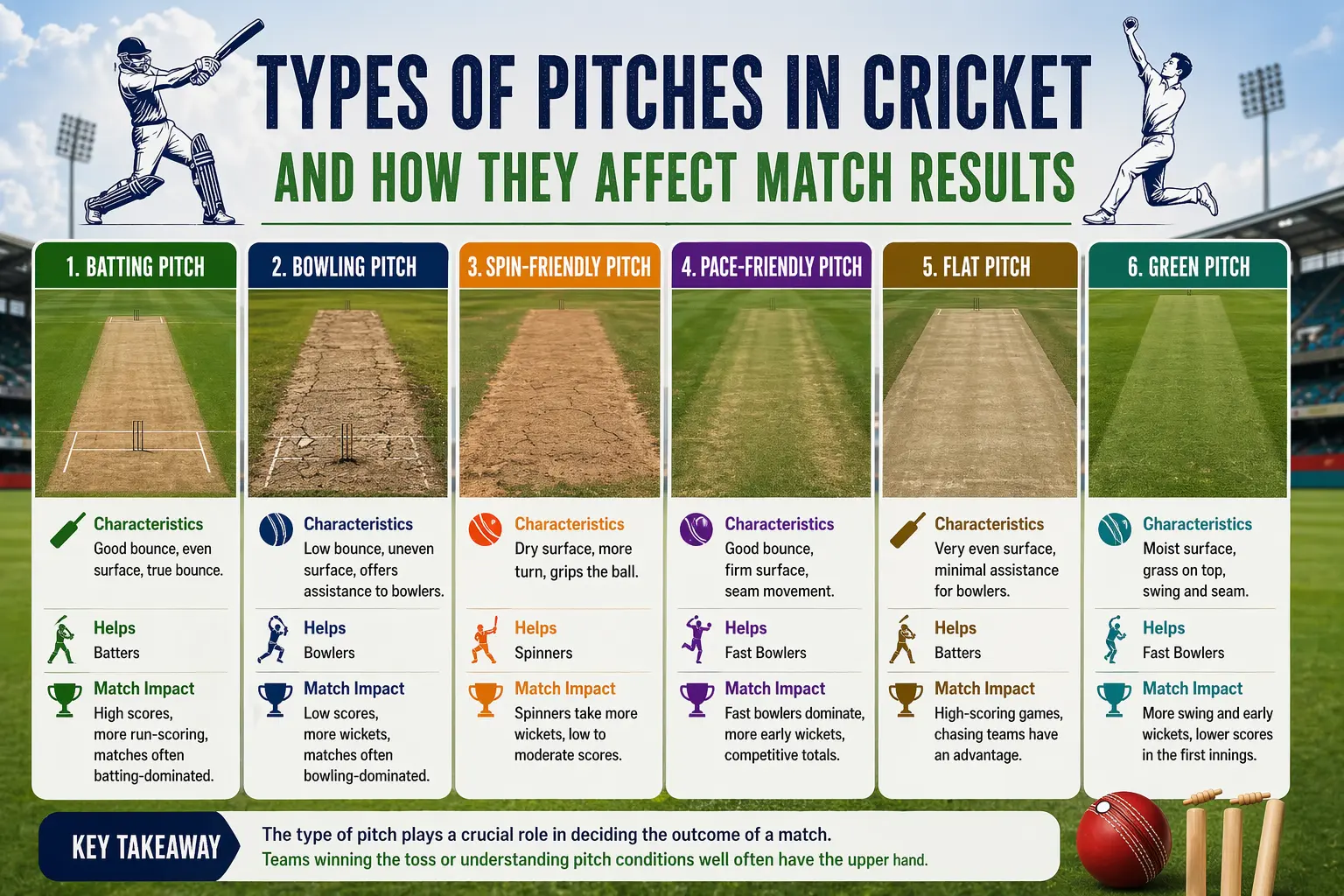
Types of pitches in cricket and how they affect match results including batting pitch, bowling pitch, spin friendly, pace friendly and green pitch infographic
Different types of cricket pitches and their impact on match results explained visually

If you’ve watched enough cricket, you’ve probably heard commentators say things like “this pitch will break up on day four” or “there’s a bit of grass on it, should help the seamers.” That’s not just filler talk. Pitch is able to entirely influence the course of a match.

Actually, you can sometimes learn more about the result of a game by knowing the types of cricket pitches than the team lists. Some surfaces make batting look easy. Others turn even world-class players into survivors.

Let’s learn more about it in an easy, practical way.

Why the Pitch Matters So Much

Cricket is not played on a normal field such as football or basketball. All pitches are a bit different, and those variations count.

A pitch can:

  • Help fast bowlers dominate early
  • Turn into a spinner’s paradise later
  • Stay flat and produce big scores
  • Or just completely fall apart

Captains are so much into examining it before starting the toss. And it is also the reason why the same team may seem invincible in one game and completely lost the next.

Green Pitches: A Fast Bowler’s Dream

A green pitch has a visible layer of grass. It may not be spectacular to an everyday observer but to bowlers it is gold.

The grass assists the ball to go round once it comes in contact with the surface.

The grass helps the ball seam around after it hits the surface. Add a bit of moisture underneath, and you also get swing in the air.

What does that mean in a match?

Batting becomes tough, especially at the start. The ball doesn’t come straight. It moves, sometimes unpredictably. Even well-defensive shots may turn out to be edges.

On these types of cricket pitches, teams usually prefer to bowl first. The concept is easy, capitalize on the initial movement before the pitch comes to rest.

Dry Pitches: Where Spin Takes Over

Such dry pitches are quite widespread, such as in the subcontinent. They might not seem as dangerous initially, but with time, they will show it.

The surface becomes worn out as the game goes on. Small cracks appear. The top layer becomes rough. That’s when spinners come into play.

The ball begins to grip and turn. Sometimes sharply.

Batting on day one might feel manageable. Batting on day four? Completely different story.

This is the reason why in such types of cricket pitches, teams tend to bat first. Early runs on the board can be very important when the pitch begins to assist in spinning.

Flat Pitches: Batters Love Them

Flat pitches are exactly what they sound like. Even surface, consistent bounce, and very little help for bowlers.

From a viewer’s perspective, these are the games where you see big scores. Centuries, fast run rates, and lots of boundaries.

For bowlers, though, it can be frustrating. There’s not much assistance, so they have to rely on variations, accuracy, and patience.

Games on such types of cricket pitches are usually determined by which team bats longer or how well it stands the pressure in high scoring scenarios.

Dusty Pitches: Trouble for Batters

Now imagine a pitch that looks dry, loose, and a bit worn out even before the match properly begins. That’s a dusty pitch.

These surfaces are heavily spin-friendly right from the start. The ball doesn’t just turn. It can grip, bounce unevenly, and make timing very difficult.

Batters who are confident against spin might manage. Others can struggle badly.

On these types of cricket pitches, teams with strong spin attacks usually have a clear edge. Matches can shift quickly, especially if one side isn’t comfortable playing spin.

Hard Pitches: Good Balance Between Bat and Ball

Hard pitches are compact and solid. You will find them making a good pace and bouncing.

Fast bowlers are able to extract something off the surface, particularly in the beginning. But when batters settle down, they can count on the bounce and swing their shots.

It is that balance that makes such types of cricket pitches interesting. They don’t heavily favor one side. Instead, they reward skill.

You’ll often get competitive matches where both teams have chances.

Damp Pitches: Early Advantage for Bowlers

Moist pitch is typically a result of weather conditions, either rainfall just before the game or high moisture.

Humidity of the surface alters the behaviour of the ball. It may skid, halt, or move in an erratic manner.

For batters, it’s not ideal. The timing is tricky and even basic shots might become dangerous.

Bowlers, especially seamers, can make the most of it early on. This is the reason why teams usually prefer to bowl first on such types of cricket pitches, in the hope of taking the early wickets before the conditions change.

Dead Pitches: Not Much for Anyone

A dead pitch is, frankly, a bit dull.

There’s very little movement, not much bounce, and minimal assistance for bowlers. The ball just comes on slowly and predictably.

Batters are able to relax and make long innings without much surprises.

In longer formats, games on such types of cricket pitches can tend towards draws. In shorter formats, they still produce runs, but without much drama from the surface itself.

How Pitches Change During a Match

The development of the pitch is one of the aspects that make cricket unique.

A new pitch on the first day is very different to the same pitch on the fifth day.

  • Early on, there might be moisture helping fast bowlers
  • Then it flattens out, making batting easier
  • Later, cracks and rough patches appear, helping spin

This development is important to know when examining the different types of cricket pitches and how a game is likely to go.

The Toss: More Important Than It Looks

The toss isn’t just a formality. It’s often influenced heavily by pitch conditions.

  • On green or damp surfaces, captains usually bowl first
  • On dry or dusty tracks, batting first is often safer
  • On flat pitches, it depends more on team strategy

Pitching correctly can give a team a tangible advantage prior to even a ball being bowled.

Team Selection Based on Pitch

Knowledge of types of cricket pitches will make teams select the appropriate players:

  • Pace-friendly pitches: More fast bowlers
  • Spin-friendly pitches: More spinners
  • Flat pitches: Added batters or all-rounders

Such a strategic change can spell out the difference between victory and defeat.

Real Impact on Match Outcomes

Let’s connect everything together. Pitch types directly influence:

  • Scoring patterns: High vs low scoring games
  • Match duration: Quick results vs long draws
  • Player performance: Experts perform well under favorable circumstances.
  • Game strategy: Batting, bowling shifts, and field positions

As an example, a fast bowler based team may not perform well in a dusty pitch and a spin-based team may win.

Final Thoughts

Cricket is not all about bat and ball at the end of the day. It’s bat, ball, and surface.

The pitch is a silent but powerful determiner of how bowlers strategize their spells, how batters strategize their innings, and how captains strategize decisions.

As soon as you get attuned to the types of cricket pitches, games start to get a lot clearer. The spontaneous falls, unforeseen recoveries, and commanding acts, they are frequently based on what is occurring beneath the feet of the players.

And this is what makes cricket so interesting. There is no such thing as the exact same two pitches, and no two matches will ever sound out in precisely the same way.

To get more information on cricket, coaching and professional analysis, visit the newest content on AllCric and be the first to see the game.

FAQS

What are the main types of pitches in cricket?

The main types include batting pitches, bowling pitches, spin-friendly pitches, pace-friendly pitches, flat pitches, and green pitches—each offering different conditions for players.


Which pitch is best for batting?

Flat pitches and batting-friendly pitches are best for batting as they provide even bounce and minimal assistance to bowlers, leading to high-scoring matches.


How do green pitches affect match results?

Green pitches favor fast bowlers by offering swing and seam movement, often resulting in early wickets and low-scoring games.


Why are spin-friendly pitches important in cricket?

Spin-friendly pitches help spinners get more turn and grip, making it difficult for batsmen to score and often leading to more wickets in the middle overs.