

Table Of Contents
- 1. INTRO: The Summer Washington Freedom Set the Standard
- 2. MLC 2024 — Season at a Glance
- 3. Washington Freedom — How They Were Built to Win
- 4. The Road to the Final — Washington Freedom’s Season Match by Match
- 5. The Final Decoded — Washington Freedom 207/5 vs San Francisco Unicorns 111
- 6. Season Report Cards — Every Team, Honestly Graded
- 7. The Player Awards
- 8. What MLC 2024 Means for Cricket in America
- 9. Looking Ahead — What MLC 2025 Said About the Washington Freedom Dynasty Question
- 10. CONCLUSION: More Than a Trophy
- 11. FAQS❓
Major League Cricket 2024: Full Season Review & Washington Freedom's Title
INTRO: The Summer Washington Freedom Set the Standard
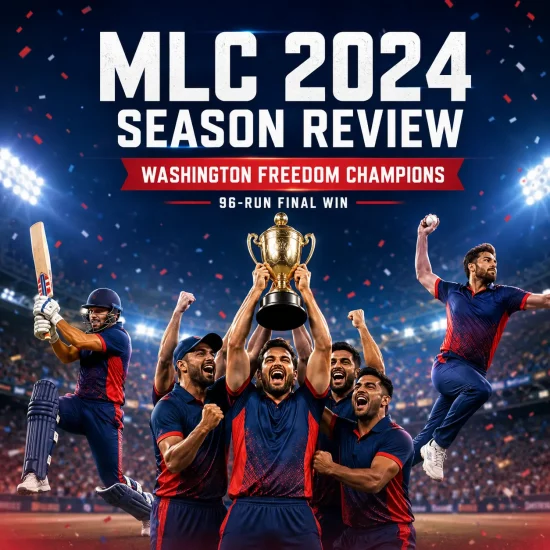
Grand Prairie Stadium, Dallas. July 28, 2024. Washington Freedom had posted 207/5 before dismissing the San Francisco Unicorns for 111 in exactly 16 overs. The resulting 96-run victory secured Washington’s first Major League Cricket championship and completed one of the most dominant campaigns in the competition’s short history.
The timing gave the tournament additional significance. The 2024 ICC Men’s T20 World Cup ended on June 29, and MLC began on July 5 — only six days later, not several weeks later. The World Cup had brought international cricket to the United States, staged India versus Pakistan in New York, and produced the USA national team’s memorable Super Over victory against Pakistan. MLC then offered American audiences an immediate domestic competition to follow.
Washington Freedom did not simply win in that environment. They finished first in the league phase, lost only once in nine completed or scheduled matches, won the Qualifier by seven wickets, and overwhelmed the Unicorns in the Final. Across the full season, their record was seven wins, one defeat and one no result.
This is the complete Major League Cricket 2024 season review: the verified points table, Washington’s squad construction, every match in their title run, the corrected Final scorecard, team report cards, official awards and what the season meant for cricket in the United States.
MLC 2024 — Season at a Glance
Major League Cricket’s second season contained six teams and 25 matches. Each side played seven league matches, after which the top four advanced to the playoffs. Washington Freedom and San Francisco Unicorns occupied the top two positions and received the double-chance route through the Qualifier.
Here is the verified final MLC 2024 points table:
| Position | Team | Matches | Won | Lost | N/R | Points | NRR |
|---|---|---|---|---|---|---|---|
| 1 | Washington Freedom | 7 | 5 | 1 | 1 | 11 | +1.891 |
| 2 | San Francisco Unicorns | 7 | 5 | 1 | 1 | 11 | +0.588 |
| 3 | Texas Super Kings | 7 | 3 | 2 | 2 | 8 | +0.604 |
| 4 | MI New York | 7 | 2 | 4 | 1 | 5 | -0.451 |
| 5 | Los Angeles Knight Riders | 7 | 2 | 4 | 1 | 5 | -0.710 |
| 6 | Seattle Orcas | 7 | 1 | 6 | 0 | 2 | -1.312 |
Washington and San Francisco finished level on 11 points, with identical records of five wins, one defeat and one no result. The decisive difference was net run rate.Washington’s NRR of +1.891 was more than three times San Francisco’s +0.588. That number reflected the margins of Washington’s victories: eight wickets against Los Angeles, 94 runs against MI New York, 42 runs against Texas, seven wickets in the Qualifier and 96 runs in the Final.The team was not relying on a succession of narrow finishes. Washington regularly created large separations between themselves and their opponents, either by defending substantial totals or completing chases with significant resources remaining.MI New York’s position also requires context. The defending champions qualified in fourth place with only five points and a negative NRR of -0.451. They finished level with Los Angeles Knight Riders but progressed because their net run rate was superior.That was not evidence of a title-level league campaign. It was evidence that the fourth playoff place remained available despite MI New York losing four of their seven league matches.
Washington Freedom — How They Were Built to Win
Washington Freedom’s 2024 championship was not the product of one player carrying the team. Their campaign combined experienced leadership, high-impact overseas players and a domestic group capable of deciding matches independently.
2a. The Coaching Revolution — Ricky Ponting + Cameron White
Ricky Ponting replaced Greg Shipperd as Washington Freedom’s head coach before the 2024 season, with Cameron White serving as assistant coach. Steve Smith was appointed captain. Washington’s own season review credited the Ponting-White coaching combination and the Australian playing group with bringing a more aggressive and clearly defined approach.The transformation was measurable.Washington had finished third in the 2023 league phase before losing in the Eliminator. In 2024, they finished first, became the first team to qualify for the playoffs and won both postseason matches convincingly.The tactical strength was role clarity.Travis Head and Steve Smith provided contrasting methods at the top. Head applied immediate boundary pressure, while Smith could absorb early movement and then accelerate. Glenn Maxwell supplied middle-order power and a genuine off-spin option. Rachin Ravindra added left-arm spin and batting depth. Marco Jansen, Lockie Ferguson and Saurabh Netravalkar gave Washington different new-ball and middle-over pace options.Andrew Tye played only two matches, so describing him as Washington’s season-long designated death specialist would overstate his role. His impact was concentrated in the Final, where he took 2/12.Washington’s strength was not that the same eleven or the same bowler solved every match. It was that the squad produced different match-winners without losing its overall structure.
2b. The Overseas Core — Built as a System, Not a Collection of Stars
Washington’s overseas players were high-profile names, but their statistics show why this was more than a celebrity roster.
Here is the corrected breakdown of Washington Freedom’s principal performers:
| Player | Role | Matches | Runs | Batting Average | Strike Rate | Wickets | Verified Highlight |
|---|---|---|---|---|---|---|---|
| Steve Smith | Captain / Opener | 9 | 336 | 56.00 | 148.67 | — | 88 off 52 in the Final |
| Travis Head | Opener | 9 | 336 | 48.00 | 173.19 | — | Five consecutive fifties |
| Glenn Maxwell | All-rounder | 8 | 153 | 38.25 | 164.51 | 10 | 54* off 23 in the Qualifier |
| Rachin Ravindra | All-rounder | 7 | 99 | 14.14 | 137.50 | 12 | 4/11 in the Qualifier |
| Marco Jansen | Pace bowler | 8 | — | — | — | 11 | 3/28 in the Final |
| Lockie Ferguson | Pace bowler | 7 | — | — | — | 10 | 4/26 against Seattle |
| Saurabh Netravalkar | Domestic pace bowler | 7 | — | — | — | 15 | Tournament-leading wicket tally |
| Andries Gous | Domestic wicketkeeper-batter | 8 | 153 | 25.50 | 119.53 | — | 59 against MI New York |
| Obus Pienaar | Domestic middle-order batter | 9 | 78 | — | 127.86 | — | 31* in recovery against Seattle |
Steve Smith — Smith and Head both finished on 336 runs, but Smith achieved the higher average because he was dismissed fewer times. His season strike rate of 148.67 was considerably quicker than the conservative stereotype often attached to his T20 batting.
His 88 from 52 balls in the Final was the defining performance, but it was consistent with his wider campaign. Smith could control the innings when early wickets fell and still provide six-hitting acceleration later.
Travis Head — Head’s season changed dramatically after a quiet beginning. His first three matches produced 33 runs. His following five innings brought 294 runs at an average of 73.50, including five consecutive half-centuries — an MLC record at the time.
Head finished with 336 runs at a strike rate of 173.19 and was named the tournament’s Most Valuable Player. He did not finish as the competition’s leading run-scorer — that honour belonged to Faf du Plessis with 420 — but Head’s sustained run during Washington’s title push carried greater championship impact.
Glenn Maxwell — Maxwell played eight matches, not nine. He scored 153 runs from five innings at an average of 38.25 and a strike rate of 164.51, while also taking 10 wickets.
His value lay in flexibility. Washington could use him as an attacking middle-order batter, a matchup bowler against left- and right-handed combinations, and an elite fielder. His unbeaten 54 from 23 balls completed the Qualifier chase after Ravindra’s 4/11 had helped dismiss San Francisco for 145.
Rachin Ravindra — The original description of an “average of 6.08 with the ball” was statistically correct but required clarification: 6.08 was his bowling average, not his economy rate.
Ravindra claimed 12 wickets from six bowling innings at an economy rate of 4.81 and a strike rate of 7.58. He produced two four-wicket hauls, including 4/11 in the Qualifier — the best bowling figures of MLC 2024 and his best T20 figures at that point.
Marco Jansen — Jansen took 11 wickets in eight matches at a strike rate of fewer than 17 balls per wicket. His height, left-arm angle and ability to attack the stumps gave Washington a point of difference with the new ball.
He was particularly influential in the playoffs, taking three wickets in the Qualifier and 3/28 in the Final.
2c. The Domestic Spine — America’s Real Secret Weapon
Saurabh Netravalkar — Netravalkar finished as MLC 2024’s leading wicket-taker with 15 wickets from only seven matches, placing him firmly among the best bowlers in Major League Cricket history. His average was 13.46, his strike rate was 10.53, and his economy rate was 7.67.
His influence was immediate. He took 3/24 in Washington’s rain-affected opening victory against MI New York, 3/18 against Seattle and 4/35 against Los Angeles.
Netravalkar’s success mattered beyond the numbers because he occupied a domestic roster position. Washington’s most productive bowler was a USA international, not a short-term overseas signing.
Andries Gous — Gous played eight matches, scoring 153 runs. His most important league-phase innings was 59 against MI New York, helping Washington reach 182/5 before bowling MI New York out for 88.
His value also included wicketkeeping and positional flexibility. He could open, bat through the middle phase or support the higher-impact overseas batters.
Obus Pienaar — Pienaar scored 78 runs from limited opportunities, but his unbeaten 31 against Seattle was one of Washington’s most important lower-profile contributions.
Washington had slipped to 64/5 while chasing 125. Pienaar and Lahiru Milantha added an unbroken 63, with Milantha making 33* and Pienaar 31*, to complete a five-wicket victory.
What Washington understood better than several opponents was that domestic players could be genuine match-winners rather than roster-compliance selections. Netravalkar led the tournament’s wicket chart, Gous produced a match-winning fifty and Pienaar completed a difficult chase.
The Road to the Final — Washington Freedom’s Season Match by Match
Washington played nine matches across the league and playoffs. The original match-by-match table had the opponents, sequence and results substantially wrong.
Here is the corrected journey:
| Match | Opponent | Result | Key Performer | What It Revealed |
|---|---|---|---|---|
| League Match 1 | MI New York | Won by 4 runs, DLS | Netravalkar 3/24 | Immediate new-ball impact in a shortened chase |
| League Match 2 | Texas Super Kings | No result | Head 32*, Smith 26* | Openers raced to 62/0 in four overs before rain |
| League Match 3 | Seattle Orcas | Won by 5 wickets | Ferguson 4/26; Milantha 33*, Pienaar 31* | Bowling depth and lower-order composure |
| League Match 4 | Los Angeles Knight Riders | Won by 8 wickets | Maxwell 3/15; Head 54 | Spin control followed by an efficient chase |
| League Match 5 | MI New York | Won by 94 runs | Gous 59; Jessy Singh 3/14 | Domestic players drove a dominant victory |
| League Match 6 | Texas Super Kings | Won by 42 runs | Smith 57; Ravindra 4/16 | Washington could defend a 200-plus total comprehensively |
| League Match 7 | San Francisco Unicorns | Lost by 6 wickets, DLS | Krishnamurthi 79* for SF | Washington's only defeat exposed their bowling in a shortened chase |
| Qualifier | San Francisco Unicorns | Won by 7 wickets | Ravindra 4/11; Head 77*, Maxwell 54* | Bowling variety and top-order power |
| Final | San Francisco Unicorns | Won by 96 runs | Smith 88; Jansen 3/28; Ravindra 3/23 | Complete championship performance |
The match Washington nearly lost was the first meeting with Seattle. Washington were chasing only 125 but collapsed to 64/5. The original article attributed the recovery to Smith, but Smith was already dismissed.
Lahiru Milantha and Obus Pienaar completed the rescue with an unbeaten 63-run partnership. Milantha finished on 33 from 30 balls and Pienaar on 31 from 30. Washington won with 10 deliveries remaining.The match was important because it showed that Washington could win after their headline batting group failed. Ferguson’s 4/26 and Netravalkar’s 3/18 had kept Seattle to 124, while two less celebrated batters finished the chase.
The Travis Head run did not begin in Washington’s third league match, as the original table suggested. Head’s five consecutive fifties came during the later part of the league phase and continued into the Qualifier.That sequence was central to Washington’s campaign, but it should be described accurately rather than attached to the wrong fixtures.The only defeat came against San Francisco in the final league match. Washington made 174/3 from 15.3 overs before rain altered the equation. San Francisco were set 177 from 14 overs and reached 177/4 in 13.4, winning by six wickets under the DLS method. Sanjay Krishnamurthi made an unbeaten 79 from 42 balls.The Qualifier was Washington’s response. San Francisco were dismissed for 145 in 19 overs, with Ravindra taking 4/11. Washington reached 149/3 in 15.3 overs, led by Head’s unbeaten 77 and Maxwell’s unbeaten 54 from 23 balls.Washington did not merely reverse the league-stage defeat. They removed any need for a late chase by winning with 27 balls remaining.
The Final Decoded — Washington Freedom 207/5 vs San Francisco Unicorns 111
Grand Prairie Stadium, Dallas. July 28, 2024.
4a. The Full Scorecard
Washington Freedom Innings — 207/5 in 20 overs
| Batter | Dismissal | Runs | Balls | 4s | 6s | SR |
|---|---|---|---|---|---|---|
| Travis Head | c Finn Allen b Pat Cummins | 9 | 6 | 2 | 0 | 150.00 |
| Steve Smith | c Josh Inglis b Pat Cummins | 88 | 52 | 7 | 6 | 169.23 |
| Andries Gous | c Finn Allen b Hassan Khan | 21 | 14 | 3 | 1 | 150.00 |
| Rachin Ravindra | b Haris Rauf | 11 | 9 | 1 | 0 | 122.22 |
| Glenn Maxwell | c Josh Inglis b Juanoy Drysdale | 40 | 22 | 1 | 4 | 181.82 |
| Mukhtar Ahmed | not out | 19 | 9 | 2 | 1 | 211.11 |
| Obus Pienaar | not out | 13 | 9 | 1 | 0 | 144.44 |
| Extras | b 1, lb 1, w 3, nb 1 | 6 | — | — | — | — |
| Total | 5 wickets | 207 | 20 overs | — | — | — |
San Francisco Unicorns Bowling: Carmi le Roux 4-0-40-0; Pat Cummins 4-0-35-2; Hassan Khan 4-0-42-1; Haris Rauf 4-0-41-1; Juanoy Drysdale 4-0-47-1.
San Francisco Unicorns Innings — 111 all out in 16 overs
| Batter | Dismissal | Runs | Balls | 4s | 6s | SR |
|---|---|---|---|---|---|---|
| Finn Allen | b Marco Jansen | 13 | 13 | 2 | 0 | 100.00 |
| Jake Fraser-McGurk | b Marco Jansen | 3 | 6 | 0 | 0 | 50.00 |
| Sanjay Krishnamurthi | c Travis Head b Saurabh Netravalkar | 13 | 9 | 3 | 0 | 144.44 |
| Josh Inglis | b Andrew Tye | 18 | 11 | 2 | 1 | 163.64 |
| Sherfane Rutherford | c Ian Holland b Glenn Maxwell | 4 | 9 | 0 | 0 | 44.44 |
| Hassan Khan | c Rachin Ravindra b Marco Jansen | 13 | 6 | 1 | 1 | 216.67 |
| Corey Anderson | c Ian Holland b Andrew Tye | 0 | 2 | 0 | 0 | 0.00 |
| Pat Cummins | lbw b Rachin Ravindra | 13 | 7 | 0 | 2 | 185.71 |
| Haris Rauf | st Andries Gous b Rachin Ravindra | 7 | 8 | 1 | 0 | 87.50 |
| Carmi le Roux | not out | 20 | 19 | 1 | 1 | 105.26 |
| Juanoy Drysdale | b Rachin Ravindra | 5 | 6 | 1 | 0 | 83.33 |
| Extras | lb 1, w 1 | 2 | — | — | — | — |
| Total | all out | 111 | 16 overs | — | — | — |
Washington Freedom Bowling: Marco Jansen 4-1-28-3; Saurabh Netravalkar 4-0-33-1; Glenn Maxwell 2-0-14-1; Andrew Tye 2-0-12-2; Rachin Ravindra 4-0-23-3.
4b. The Batting Masterclass — What the Scorecard Does Not Tell You
San Francisco won the toss and chose to bowl.Travis Head was dismissed at 11/1. Washington were not two wickets down at that point, as the original article stated. Gous was the second wicket, falling at 49/2 in the final over of the powerplay.The first six overs produced 49 runs and two wickets. That was a balanced phase rather than a Washington collapse or a decisive San Francisco victory.
Smith then controlled the innings through two different partnerships. Ravindra helped move the score forward before Haris Rauf bowled him for 11. Maxwell’s arrival created the decisive acceleration.Smith and Maxwell added 83 for the fourth wicket, carrying Washington from 86/3 to 169/4. Maxwell made 40 from 22 balls, while Smith moved from accumulation into sustained boundary-hitting.Smith’s final numbers — 88 from 52 balls, seven fours and six sixes — captured the balance of the innings. He did not simply bat through the overs. He scored at 169.23 and produced nearly 43% of Washington’s total from the bat.Mukhtar Ahmed then made 19 from nine balls, while Pienaar added 13 from nine. Pienaar’s original score of 11 from five balls was incorrect.Washington’s 207/5 was the highest team total of the 2024 MLC season.
Pat Cummins was San Francisco’s most successful bowler with 2/35. The remaining four bowlers conceded at least 40 runs each, and Washington scored 121 from the final 10 overs after reaching 86/3 at the halfway point.
4c. The Bowling Demolition — How Washington Dismantled the Chase
San Francisco needed 208.Jansen immediately attacked the top order. He bowled Fraser-McGurk for three and then dismissed Finn Allen for 13. Netravalkar removed Krishnamurthi, leaving San Francisco 30/3.The original article said Allen had scored a century in the Qualifier. That was incorrect. Allen had made only six in the Qualifier. His 101 came in the Challenger against Texas Super Kings, which San Francisco won to earn another match against Washington.The top-order dismissals were followed by a middle-order collapse. Maxwell removed Rutherford, while Tye dismissed Inglis and captain Corey Anderson in the same over. Anderson made a two-ball duck.San Francisco were 53/6 after 8.3 overs. At that point, the required rate had risen sharply and the recognised top and middle order had almost disappeared.Jansen completed figures of 3/28. Ravindra then removed Cummins, Rauf and Drysdale to finish with 3/23. San Francisco were dismissed for 111, giving Washington a 96-run victory.
4d. The Tactical Verdict
Washington’s strategy was not built around dismissing a supposed top three of Allen, Fraser-McGurk and Inglis. Inglis batted at number four, while Krishnamurthi occupied number three.The more accurate tactical interpretation is that Washington attacked San Francisco’s aggressive top four with different angles before they could establish a chase.
Jansen’s left-arm pace accounted for both openers. Netravalkar removed Krishnamurthi. Tye bowled Inglis. Four different methods — left-arm pace, swing, change of pace and straight-line attack — prevented San Francisco from building a single substantial top-order partnership.Washington’s attack also had no weak phase to target. Jansen and Netravalkar bowled the powerplay. Maxwell and Tye controlled the middle. Ravindra completed the innings.That variety, rather than one repeated plan, was the tactical reason San Francisco never recovered.
Season Report Cards — Every Team, Honestly Graded
| Team | Grade | Verdict |
|---|---|---|
| Washington Freedom | A+ | Champions, first in the league phase and dominant in both playoff victories |
| San Francisco Unicorns | B+ | Excellent league campaign but comprehensively beaten twice by Washington in the playoffs |
| Texas Super Kings | B | Reached the Challenger and produced the tournament's leading run-scorer |
| MI New York | C | Defending champions qualified narrowly before losing the Eliminator |
| Los Angeles Knight Riders | C- | Missed the playoffs on NRR after an inconsistent campaign |
| Seattle Orcas | D | One victory from seven matches and the competition's lowest NRR |
Washington Freedom — A+
First place, seven wins across the full tournament, the highest league-stage NRR and two emphatic playoff victories.
They also had the MVP, the leading wicket-taker, the best bowling figures and two batters who each scored 336 runs. No other side matched their balance across the season.
San Francisco Unicorns — B+
San Francisco equalled Washington’s 11 league points and were the only team to defeat them.Finn Allen scored 306 runs at a strike rate of 187.73, the highest tournament strike rate among the leading batters. Hassan Khan scored 204 runs at an average of 40.80 and took 10 wickets at an economy rate of 7.09. He was named Domestic Player of the Series.The grade falls below an A because Washington beat them by seven wickets in the Qualifier and 96 runs in the Final. The same opponent comprehensively solved them twice when the stakes were highest.
Texas Super Kings — B
Texas finished third in the league phase and defeated MI New York in the Eliminator before losing to San Francisco in the Challenger.Faf du Plessis was the tournament’s leading run-scorer with 420 at an average of 52.50 and a strike rate of 171.43. Their season therefore contained elite individual batting and a playoff victory, even though they were unable to reach the Final.
MI New York — C
MI New York’s original review incorrectly discussed Sunil Narine as one of their underperforming players. Narine represented Los Angeles Knight Riders, not MI New York.MI’s actual problems included a major decline from captain Kieron Pollard, who scored 63 runs in seven innings at an average of 12.60 and a strike rate below 100. Nicholas Pooran led their batting with 180 runs, but even his strike rate of 125 was well below the competition’s most destructive batters.The defending champions scraped into fourth place before losing to Texas in the Eliminator.
Los Angeles Knight Riders — C-
Los Angeles finished level with MI New York on five points but missed the playoffs because of their inferior NRR.Sunil Narine’s batting was a major disappointment: 27 runs in six innings at an average of 4.50. However, describing him as a complete liability ignores his bowling. He took five wickets and conceded only 6.21 runs per over, the second-best economy rate among bowlers who delivered at least 20 overs.The larger problem was that Los Angeles lacked consistent batting support and failed to convert a talented squad into enough wins.
Seattle Orcas — D
Seattle won one of seven matches and finished with an NRR of -1.312.Ryan Rickelton scored the season’s highest individual innings, an unbeaten 103, while Cameron Gannon took 11 wickets. Those performances were not enough to overcome repeated batting and bowling failures around them.A last-place finish by three points justified a significant reassessment, although calling for a ttal organisational rebuild went beyond what one seven-match season alone could prove.
The Player Awards
6a. Official MLC 2024 Awards
The original article incorrectly presented several statistical records as official awards. MLC officially announced four principal season awards:
| Category | Winner | Verified Performance | Status |
|---|---|---|---|
| Most Valuable Player | Travis Head, Washington Freedom | 336 runs, SR 173.19, five fifties | Official MLC award |
| Leading Run-Scorer | Faf du Plessis, Texas Super Kings | 420 runs | Official MLC award |
| Leading Wicket-Taker | Saurabh Netravalkar, Washington Freedom | 15 wickets | Official MLC award |
| Domestic Player of the Series | Hassan Khan, San Francisco Unicorns | 204 runs and 10 wickets | Official MLC award |
| Best Bowling Figures | Rachin Ravindra, Washington Freedom | 4/11 | Statistical leader, not listed as a separate official award |
| Highest Batting Strike Rate | Finn Allen, San Francisco Unicorns | 187.73 | Statistical category, not listed as a separate official award |
| Most Centuries | Faf du Plessis, Finn Allen and Ryan Rickelton | One each | Statistical category, not an official award |
| Best Economy, minimum 20 overs | Rashid Khan, MI New York | 6.15 | Statistical category, not an official award |
6b. Our Expert Awards at allcric.com
Biggest X-Factor: Glenn Maxwell:
Maxwell was not Washington’s leading run-scorer or wicket-taker, but he contributed 153 runs at a strike rate of 164.51 and took 10 wickets at an economy rate of 6.66.He was also central to the two playoff victories: 54* from 23 balls in the Qualifier and 40 from 22 in the Final. Washington had other options in every discipline, but very few players could alter both innings of a match as quickly.
Most Underrated Performance: Marco Jansen:
Jansen took 11 wickets in eight matches. His impact increased in the playoffs, where he took three wickets in the Qualifier and 3/28 in the Final.The original article claimed that he bowled the first over and took wickets in both playoff matches. The wicket contribution was correct, but the “first over” detail was not required to establish his value and has been removed.
Biggest Batting Disappointment: Sunil Narine:
Narine scored 27 runs in six innings at an average of 4.50. For a player coming from an exceptional IPL 2024 batting campaign, that represented a major drop.However, he was not a complete passenger. His five wickets and economy rate of approximately 6.21 meant his bowling remained useful. The disappointment was primarily with the bat, not across both disciplines.
Breakout Star: Hassan Khan, San Francisco Unicorns:
Hassan scored 204 runs at an average of 40.80 and a strike rate of 143.66. He also took 10 wickets at an economy rate of 7.09.Those were not merely promising numbers. They earned him the official Domestic Player of the Series award and established him as one of the season’s most valuable all-rounders.
Biggest Flop: Haris Rauf:
Rauf took four wickets in nine matches at an average of 73.50, an economy rate of approximately 9.09 and a strike rate of 48.50. He went wicketless in six of his nine appearances.His 1/41 in the Final reflected the broader campaign. For an established international fast bowler expected to provide wicket-taking threat, four wickets across a full nine-match season was a severe underperformance.
What MLC 2024 Means for Cricket in America
MLC 2024 began six days after the ICC Men’s T20 World Cup Final, not several weeks later.The United States had co-hosted the World Cup with the West Indies, defeated Pakistan in a Super Over and reached the Super Eight stage. Players such as Saurabh Netravalkar and Andries Gous then moved from the USA national team into Washington Freedom’s MLC campaign.That continuity mattered. American cricket did not disappear from the calendar after the World Cup. A domestic professional tournament followed almost immediately, with Indian viewers able to use AllCric’s guide on how to watch MLC live in India.Calling the World Cup definitively “the single most important moment” in U.S. cricket history would be an editorial opinion rather than a verifiable fact. It is safer to describe it as one of the most important visibility moments American cricket has experienced.
MLC’s significance was different from the World Cup’s. The World Cup was a global event partly staged in the United States. MLC was a repeatable domestic product with American city-based franchises, providing important evidence of how Major League Cricket is growing cricket in the USA. Netravalkar finishing as the league’s leading wicket-taker strengthened that domestic argument. An established USA international outperformed every overseas bowler in total wickets, taking 15 despite playing only seven matches.The original article also overstated Washington Freedom’s stadium proposal.The proposed Frederick Gateway project in Maryland has generally been discussed as a multipurpose cricket venue with an initial capacity around 10,000. Some early planning and public reporting referred to the possibility of accommodating up to 25,000 for major events, but it was not a confirmed 25,000-seat construction project during the 2024 season. The Frederick proposal became more concrete in 2025 and remained subject to planning and rezoning processes.The distinction matters. A proposed venue demonstrates ambition, but it should not be treated as completed infrastructure or as an established consequence of Washington’s 2024 title.
MLC still faces the larger identity question.Its international stars create immediate quality and global recognition. Its long-term American value, however, will depend on whether domestic players become visible, permanent venues emerge, local audiences return and youth players can see a credible route into professional cricket.The 2024 season offered evidence that both parts can coexist. Smith, Head and Maxwell gave Washington international quality. Netravalkar, Gous and Pienaar gave the team domestic substance.
Looking Ahead — What MLC 2025 Said About the Washington Freedom Dynasty Question
The original section was written as a preview of MLC 2025. That season has now been completed, so the analysis must be updated rather than left in future tense.Ricky Ponting remained head coach, and Glenn Maxwell captained Washington. Steve Smith had initially been expected to make a short appearance, but he did not play because of injury.Washington began the 2025 season with a 123-run defeat against San Francisco Unicorns. They then recovered to win eight of their next nine league matches, finishing first with eight wins, two defeats, 16 points and an NRR of +0.954.The Qualifier against Texas Super Kings was abandoned after the toss because of heavy rain. With no reserve day, Washington advanced to the Final because they had finished above Texas in the league table.They did not complete consecutive championships.MI New York defeated Washington by five runs in the 2025 Final, successfully defending 12 runs from the final over. Washington therefore followed their 2024 championship with a first-place league finish and runner-up result in 2025.That outcome answers the dynasty question more accurately than a preseason prediction could.Washington demonstrated sustained excellence. They finished first in consecutive league phases and reached consecutive Finals under Ponting. But a dynasty normally requires repeated championships, and the five-run defeat prevented them from earning that status after two seasons.The more defensible conclusion is that Washington became MLC’s most consistently successful team across 2024 and 2025, while MI New York remained the only franchise with two titles after winning in 2023 and 2025.
CONCLUSION: More Than a Trophy
When Steve Smith lifted Washington Freedom’s first MLC trophy at Grand Prairie Stadium on July 28, 2024, the result represented more than one exceptional Final.Washington had finished first in the league phase, recorded the competition’s strongest net run rate and won seven of their nine matches, with one defeat and one no result. They had the tournament MVP, the leading wicket-taker and the bowler responsible for the season’s best figures.Their 96-run Final victory was not an isolated performance. It was the strongest expression of the advantages they had displayed throughout the tournament: batting power at the top, multiple all-rounders, contrasting bowling options and domestic players capable of deciding matches.The season also demonstrated that U.S.-qualified players could be central to a championship rather than peripheral to it. Netravalkar led the tournament in wickets. Gous played a match-winning league innings. Pienaar completed one of Washington’s most difficult chases.MLC 2024 did not prove that cricket had entered the American sporting mainstream, but international audiences could follow the competition through the official platforms listed in AllCric’s guide on where to watch Major League Cricket. One season cannot establish that.It did prove that a U.S.-based professional competition could stage a credible second season, attract elite international players, produce strong domestic performances and crown a champion whose success was based on coherent squad construction rather than reputation alone.Washington Freedom did not merely win the 2024 title.They established the competitive standard that the other five franchises had to pursue.
👉 Get expert Today cricket match predictions 100 sure, top picks & fantasy tips – Download AllCric App or visit AllCric Website
FAQS❓
Washington Freedom won the MLC 2024 title, defeating San Francisco Unicorns by 96 runs in the Final at Grand Prairie Stadium in Dallas on July 28, 2024. It was Washington Freedom’s first MLC championship.
Travis Head received the official Most Valuable Player award after scoring 336 runs at a strike rate of 173.19. His campaign included five consecutive half-centuries, an MLC record at the time.
Saurabh Netravalkar of Washington Freedom finished as the leading wicket-taker with 15 wickets from seven matches at an average of 13.46 and a strike rate of 10.53.
Washington Freedom scored 207/5 from 20 overs, led by Steve Smith’s 88 from 52 balls and Glenn Maxwell’s 40 from 22. San Francisco Unicorns were dismissed for 111 in 16 overs, with Marco Jansen taking 3/28 and Rachin Ravindra 3/23. Washington won by 96 runs.
Ricky Ponting was Washington Freedom’s head coach, Cameron White was assistant coach, and Steve Smith captained the team.
Saurabh Netravalkar led the competition with 15 wickets. Rachin Ravindra recorded the best individual figures, taking 4/11 in the Qualifier against San Francisco Unicorns.
Yes. Washington finished first with 11 points and an NRR of +1.891. San Francisco also earned 11 points but finished second with an NRR of +0.588.

Related Articles
 Cricket
NZ vs IND Today Match Prediction & Fantasy Tips – 2nd T20 2026
 Cricket
IND-W vs ZIM-W Today Match Prediction & Fantasy Tips – 1st ODI 2026
 Cricket