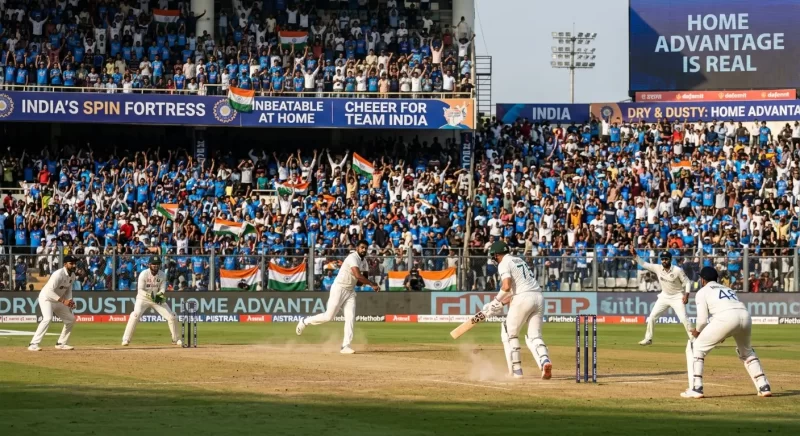
What Is Home Advantage in Cricket?
Home advantage in cricket simply means the edge a team gets from playing on their own turf. That includes familiar pitch conditions, no jet lag, home crowd support, and knowing the ground inside out.
But unlike football or basketball — where the playing surface is standardised everywhere — cricket grounds vary dramatically. The pitch in Chennai behaves nothing like the one in Leeds — something that becomes clearer when you understand different cricket pitch types. The bounce at the Gabba in Brisbane is completely different from a turning track in Ahmedabad. This makes home advantage more powerful in cricket than in almost any other sport.
What the Numbers Say: Home vs Away Win Percentage
Let us start with the most important question — do home teams actually win more? Yes. Clearly and consistently.
In the history of Test cricket, home teams have won more than one and a half times as much as away teams — winning around 40% of matches compared to roughly 26% for the away side. Since 2011, this gap has widened further, with home teams winning nearly 52% of matches while away wins stayed at around 26%. That is not a small edge. That is almost double the win rate.
Here is a simple format-by-format breakdown based on historical data:
Format | Approximate Home Win % | Approximate Away Win % |
Test | ~40–52% | ~25–26% |
ODI | ~55–58% | ~35–40% |
T20I | ~52–55% | ~42–45% |
Key insight: The gap between home and away win rates is largest in Test cricket, and smallest in T20Is. The shorter the format, the less home advantage matters. More on why that is, in the next section.
Why Does Home Advantage Exist? Four Real Reasons
1. Pitch Conditions
This is the biggest factor by far — something you notice clearly when looking at any detailed pitch report before a match. Home teams prepare pitches that suit their strengths. India produces spinning tracks for their finger-spin attack. Australia produces hard, bouncy wickets for their pace bowlers. England gets green, seaming pitches when their swing bowlers are around. Visiting teams often walk into conditions they have never practised in.
2. Familiarity with the Ground
Knowing the exact dimensions of a ground, which ends favour swing, how the outfield plays — these small details matter. Home players have spent years training at these venues.
3. No Travel Fatigue
Away teams often fly across time zones, deal with jet lag, and adjust to completely different climates and food. Home teams get to sleep in their own beds, stick to familiar routines, and avoid jet lag — and that makes a real difference over a long series.
4. Crowd Pressure
A full stadium roaring for the home team creates real psychological pressure on visiting batters and bowlers. Neutral umpires have reduced bias, but crowd pressure on players is very real.
Does Home Advantage Matter Equally in All Formats?
No — and this is one of the most important and underreported facts about home advantage in cricket.
Test Cricket:
Home advantage is strongest here. Pitches deteriorate over five days, and the longer a match goes, the more familiar conditions benefit the home side. Data analysis shows that home advantage actually gets bigger in later Tests within a series — meaning touring sides find it harder, not easier, as a series progresses.
ODI Cricket:
Home advantage still exists but is slightly reduced. Pitches are used for just one day so deterioration is less of a factor. However, boundary dimensions, outfield pace, and crowd support still tilt things toward the home team.
T20I Cricket:
Home advantage is the weakest here. Matches are decided in 40 overs total. One good innings from an away player can change everything. The format is fast enough that conditions matter less than individual brilliance.
The data confirms this. For formats like T20 or ODI cricket, results seem more influenced by individual performance and match momentum than by home conditions alone.
Country-by-Country: Who Benefits Most from Playing at Home?
India — The Most Dominant Home Team in Recent History
India won 18 consecutive Test series at home from February 2013 to October 2024 — the longest such streak by any team in history. Their run finally ended when New Zealand defeated them at home in October 2024.
This was no accident. India used turning pitches built specifically for their spin-heavy attack. Opponents like England and Australia were completely unprepared for the conditions. But here is the honest flip side — India historically struggled when playing in South Africa, England, New Zealand, and Australia (the so-called SENA countries). Their home dominance for years did not translate away from home, though that has been improving in recent years.
Australia — The Gabba Fortress
Australia went 31 Tests without defeat at the Gabba between 1988 and 2021 — a 32-year unbeaten streak that only ended when India chased down 328 on the final day in January 2021.
That is home advantage at its most extreme. Australia’s pace-friendly conditions at home have historically been too much for visiting sides — but India’s 2021 win proved that even the strongest home fortress can be broken.
England — Strong at Home, Inconsistent Away
Out of over 550 Tests on home soil, England have won around 43% of them — a strong home record built on swing-friendly conditions. But England have historically struggled in Asia, where those conditions simply do not exist.
The Pattern Is Clear
Home advantage is strongest when a team’s playing style is built specifically around their home conditions. Spin bowlers in India. Pace bowlers in Australia. Swing bowlers in England. When teams travel to the opposite type of conditions, they often struggle.
When Does Home Advantage NOT Matter?
This is the part most cricket articles miss entirely. Home advantage is real — but it is not absolute. There are clear situations where it disappears.
ICC Tournaments on Neutral or Semi-Neutral Venues
When the ICC World Cup or Champions Trophy is played, the host country gains some advantage from crowd support and familiarity, but other top teams prepare specifically for those conditions. The 2011 ODI World Cup was hosted by India, Sri Lanka, and Bangladesh — and India won. But the 2023 ODI World Cup was also in India, and Australia won it. Home country hosting does not guarantee a title.
Franchise Leagues Like the IPL
In the IPL, players from 10+ countries play in the same team. The “home” concept essentially disappears — a foreign player playing for Rajasthan Royals in Jaipur faces the same conditions as an Indian teammate. Franchise leagues have significantly reduced the home-away knowledge gap because players travel and play in different conditions every season.
When a Team is Simply Outclassed
Home advantage adds maybe 10 percentage points to a team’s win probability — one of many factors used when trying to predict cricket match results. Analysis suggests that on average, a home team has a win rate roughly 10 percentage points higher than their skill level alone would suggest. But if a visiting team is far superior in quality, that 10% gap will not save the home side. A weak home team still loses to a strong touring side.
Modern Preparation and Analytics
Today’s touring teams arrive with detailed pitch reports, drone footage of grounds, and data on how surfaces behave across all five days. The information gap between home and away teams is smaller than ever before — even if the conditions gap remains.
Myth vs Reality: The Final Verdict
Here is the straight answer:
Home advantage in cricket is real. But it is also overrated.
It is real because the data is clear — home teams win significantly more in Tests, particularly in conditions they have engineered for themselves. India’s 18-series winning streak at home and Australia’s 32-year unbeaten record at the Gabba are not luck. They are the result of deliberate pitch preparation and deep familiarity with conditions.
But it is overrated because:
- It matters far less in T20Is than most people assume
- It disappears entirely at neutral venues and in franchise cricket
- A quality touring side can overcome it — India’s 2021 Gabba win proved that
- The format shortens, the advantage shrinks
Home advantage is a real factor — especially in Test cricket. But it is one factor among many, not a guarantee of anything.