
How to Use AI Signals to Pick Your Fantasy Captain
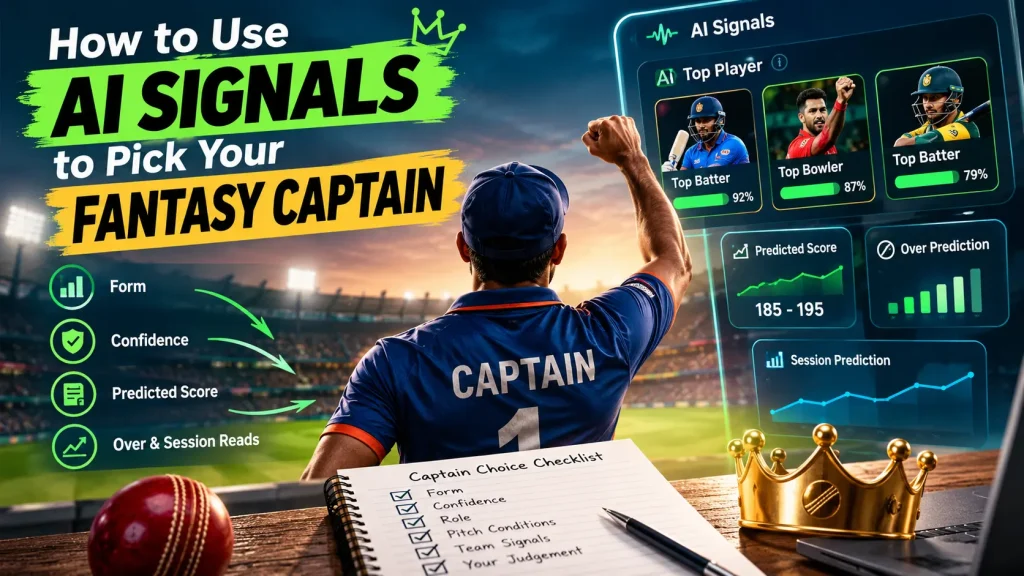
Picking a fantasy captain is not just about choosing the biggest name. AI Signals can help you compare form, confidence, player role, pitch conditions and match outlook, so you can build a stronger shortlist before making the final call.
Summary
The captain choice is the single biggest decision in most fantasy cricket teams, because it multiplies one player’s points. This guide shows how to build an AI fantasy captain pick using AllCric’s AI Signals: start with the AI Top Player rankings, check confidence scores, cross-check with predicted score, over and session reads, then apply your own judgement on role, pitch and risk. It includes a step-by-step method, a scoring checklist, a comparison table for choosing between candidates, safe and differential captain strategies, and the mistakes to avoid. The main point: signals help you build a shortlist and break ties, but they cannot guarantee points, so treat them as research support, not a promise.
Why the Captain Pick Matters?
In most fantasy cricket formats, your captain earns bonus points, and your vice-captain earns a smaller bonus. That makes the captain pick the highest-leverage choice in the team. A great captain can carry a modest squad. A poor one can sink an otherwise strong team.
The problem is that the obvious choice is rarely obvious. Big names look safe but may be out of form. In-form players may face tough conditions. Everyone else in your contest is looking at the same names.
This is where AI fantasy captain pick tools help. They do not replace your judgement, but they add a structured view of form, conditions and likelihood. This guide is based on how AllCric, a live cricket score, prediction and fantasy app, presents its AI Signals.
Why Use AI for Fantasy Captain Choices
Human captain picks tend to lean on reputation, recent headlines and gut feel. AI-driven reads can help in a few specific ways:
- They focus on form. AllCric’s AI Top Player module ranks the top three batters and bowlers based on recent form.
- They add a confidence layer. Each player card shows an AI confidence bar, so you can see how strongly the model leans.
- They reduce reputation bias. The app’s own pro tip is that form beats fame, because a quiet player in good form can outscore a big name having an off day.
- They help break ties. When two candidates look equal on paper, a confidence score or a projected-score signal can tip the balance.
- They save time. A ranked shortlist gets you to a decision faster than scanning every stat line.
What they do not do is remove risk. Cricket is volatile, and one wicket or one dropped catch can change a player’s day.
The AllCric Signals That Matter for Captain Picks
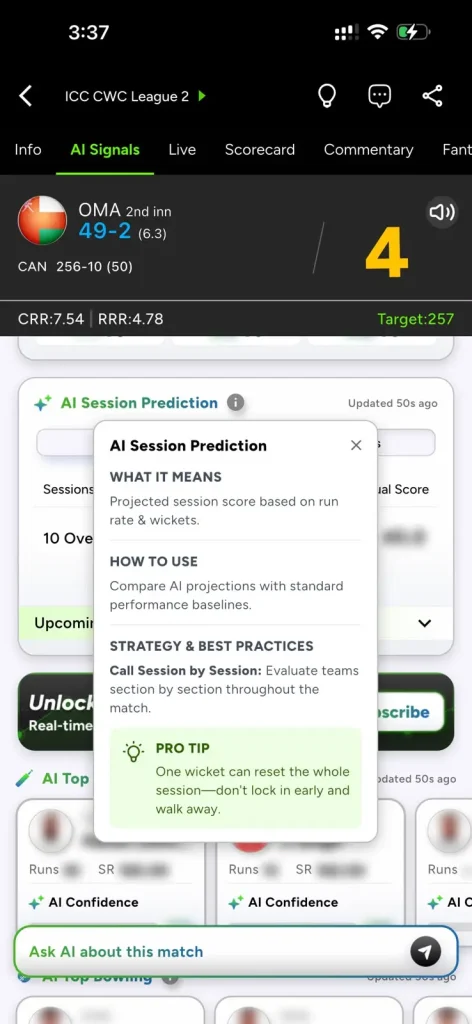
AllCric’s AI Signals tab sits alongside the Info, Live, Scorecard, Commentary and Fantasy tabs. Several of its modules feed directly into captain decisions.
|
Signal |
What it shows |
How it helps your captain pick |
|
AI Top Player |
Top three batters and bowlers by recent form, with runs and strike rate for batters, wickets and economy for bowlers, plus an AI confidence bar |
Gives you a form-based shortlist of potential captains |
|
AI Predicted Score |
Projected innings score based on run rate and wickets |
Shows whether a batting side is likely to post a big total, which lifts batter value |
|
AI Over Prediction |
Over outcome read based on form and pitch conditions, with a confidence percentage |
Helps gauge how bowlers and batters may fare in specific passages |
|
AI Session Prediction |
Projected session score shown against the actual score |
Shows how a section of the match may unfold, useful for in-match decisions |
Each module includes an information panel and an update time. The AI Top Player guide says to check confidence scores for each player and to use top picks as potential captains to strengthen your overall lineup.
AI Fantasy Captain Pick: A Step-by-Step Method
Here is a repeatable method for turning signals into a captain choice.
1. Open the match and check the basics:
Look at the two teams, the format (T20, ODI or Test), the venue and any line-up information that is available. The format matters most: a captain who suits a T20 may not suit a 50-over game, because the number of balls faced and overs bowled is very different.
2. Open AI Signals and read AI Top Player:
This module lists the top three batters and top three bowlers based on recent form. For batters, note the runs and strike rate. For bowlers, note the wickets and economy rate. Then look at each player’s AI confidence bar, which shows how strongly the model leans toward that player.
3. Build a shortlist of three to five names:
Start with the top-ranked players, then add anyone else you rate on role or conditions. A shortlist keeps you from fixating on a single name, and it gives you real options to compare in the later steps.
4. Check the team-level signals:
Open AI Predicted Score and read the over and session cards. If a batting side is projected to post a big total, top-order batters on that side gain value. If the reads point to a low-scoring game, a bowler on the defending side may be the stronger captain case.
5. Apply role and batting position:
Form alone is not enough. A top-order batter who faces many balls has more points potential than a lower-order hitter with the same form rating. Likewise, a frontline bowler who bowls a full quota has more upside than a part-timer.
6. Consider pitch and conditions:
Use the venue and match information in the app, where available, to judge whether batting or bowling is likely to be favoured. A bowler’s captain case weakens on a flat pitch, and a batter’s case weakens when the surface is helping the bowlers.
7. Ask AI for a sanity check:
Use the Ask AI bar to compare your shortlist, for example by asking which of two players has the stronger recent form in this match, or what the risk is of picking a particular player as captain. Use the answer to test your own reasoning, not to replace it.
8. Choose captain and vice-captain:
Pick your captain from the strongest overall case, meaning form, role, conditions and confidence together. Use the vice-captain slot as a hedge, either on your second-best case or on a player whose strengths differ from your captain’s.
9. Recheck before the deadline:
Line-ups, toss results and conditions can change the picture. If something changes, such as a player being left out or a pitch playing differently, go back to your shortlist and update your choice. Also check the update time on each signal to make sure you are reading fresh information.
Reading AI Confidence Scores Properly
The AI confidence bar is easy to misread. Here is how to think about it.
- Confidence is how strongly the model leans, not a guarantee. A high bar means a stronger lean, not a certain outcome.
- Compare within the module. Look at confidence relative to the other players shown, not in isolation.
- Combine with role. A confident read on a player who bats low or bowls few overs may be less useful than a moderate read on a player with a bigger role.
- Check freshness. Each module shows an update time. Make sure the read is recent.
- Look at the trend. AllCric’s own guidance is to watch overall trends rather than a single irregular data point.
A useful rule of thumb: use confidence to rank and break ties, not to override what you know about the match.
Captain Checklist: Questions to Ask Before You Lock In
Before you confirm your captain, run through these questions.
|
Question |
Why it matters |
|
Is the player in recent form? |
Form is the starting point of the AI Top Player ranking |
|
Is the player likely to play a big role? |
Batting position and bowling overs drive points potential |
|
Do conditions suit the player? |
Pitch and venue shape what is realistic |
|
Is the team likely to score or defend heavily? |
Predicted score reads affect batter value |
|
Is the confidence read recent? |
Stale data can mislead |
|
What is the downside? |
A good captain choice survives a bad day better than a risky one |
|
Is the player confirmed to play? |
An unconfirmed player is a risk |
Comparing Two Captain Candidates
When two players look close, a side-by-side comparison clarifies the choice. Here is a template you can fill in from the app.
|
Factor |
Candidate A |
Candidate B |
|
AI Top Player rank |
Check the module |
Check the module |
|
AI confidence |
Read the bar |
Read the bar |
|
Recent form (runs and strike rate, or wickets and economy) |
Read the card |
Read the card |
|
Role and batting position or overs |
Check the line-up |
Check the line-up |
|
Conditions and venue |
Judge from the pitch read |
Judge from the pitch read |
|
Risk if they fail |
Estimate |
Estimate |
You can also paste the comparison into Ask AI as a question, such as which of two players has the stronger recent form in this match.
Safe Captain vs Differential Captain
Captain strategy depends on what you want from your team.
Safe captain. A highly ranked, in-form player with a big role. This tends to suit smaller contests or when you want consistency. The trade-off is that many other teams will pick the same player, so you gain little edge when they do well.
Differential captain. A strong but less obvious candidate, such as a player with good form and a decent confidence read who fewer people are likely to pick. This tends to suit larger contests where you need to stand out. The trade-off is higher risk, because you are leaning away from the crowd.
A balanced approach is to use AI signals to build a shortlist, pick a safe option as captain in contests where consistency matters, and use a differential as vice-captain, or the other way around when you want to take a calculated risk.
Using Ask AI for Captain Suggestions
The Ask AI bar at the bottom of the AI Signals tab lets you ask match-specific questions in plain language. For an AI captain suggestion workflow, good questions include:
- Which batters are in form in this match?
- Which bowlers look strongest for captain today?
- Between these two players, who has the stronger recent form?
- What is the risk of picking this player as captain?
- What does a high AI confidence score mean for this player?
Asking for the downside is as useful as asking for the upside. Treat the answers as informed estimates, and check the in-app screen for what Ask AI can do on your plan.
D11-Style Fantasy: Applying Signals to Captain and Vice-Captain
Many fantasy platforms, including those in the D11 style, give the captain double points and the vice-captain a smaller multiplier. The exact scoring rules differ by platform and can change, so always check the rules of the platform you play on.
The logic of the signals carries across formats:
- Use form-based rankings to build your shortlist.
- Use team-level reads to judge whether batters or bowlers are likely to have a big day.
- Use confidence to break ties.
- Use the vice-captain slot as a hedge on the second-best case.
This article is about using AllCric’s signals as research. It is not tied to any specific fantasy platform, and AllCric’s signals do not guarantee points on any of them.
Common Captain Mistakes to Avoid
- Picking on reputation alone. Form beats fame, and the app’s own tip says so.
- Chasing last match’s hero. One big score is a data point, not a trend.
- Ignoring role. A player who bats low or bowls a few overs has less upside.
- Overlooking conditions. A bowler’s captain case weakens on a flat pitch.
- Trusting a single signal. Cross-check across modules.
- Ignoring freshness. Check update times and line-up news before the deadline.
- Overreacting to one over or one innings. Look at the trend.
- Forgetting the downside. Ask what happens if your captain fails.
Final Thoughts: Build a Shortlist, Then Decide
The best way to use an AI fantasy captain pick workflow is to let signals do the heavy lifting on the shortlist and then apply your own judgement on role, conditions and risk. Start with AI Top Player, check the confidence bars, cross-check with the team-level reads and use Ask AI to stress-test your choice.
Open the AI Signals tab before your next lock-in, build your shortlist and compare it with your own instincts. Where they agree, you can pick with more confidence. Where they differ, you have found the decision worth thinking about.
FAQS
Start with AI Top Player to build a shortlist, check confidence scores, cross-check with predicted score and over and session reads, then apply your own judgement on role and conditions.
AI Top Player is the most direct, since it ranks the top three batters and bowlers by recent form and suggests using top picks as potential captains.
No. It means the model leans more strongly, not that the outcome is certain.
You can ask match-specific questions about form and risk. Treat the answers as input, not a final decision.
It depends on the contest. Safe picks suit consistency, and differentials suit larger contests where you need to stand out.
No. Signals are estimates, and fantasy results are never guaranteed.
NOTE:
Fantasy cricket is a game of skill and uncertainty. AI signals can improve your research, but they cannot remove risk. A few ground rules:
- Play within limits you are comfortable with.
- Treat signals as support for your decisions, not guarantees.
- Check the rules and the legal status of paid fantasy contests where you live, including any age or regional restrictions.
- Take breaks, and seek help if play stops being enjoyable.
This article is general information and not financial advice.