
Best Questions to Ask AI During a Live Match (20+ Questions)
AI can be much more useful during a live match when you ask the right questions. From run rates and momentum to player form and fantasy picks, clear match-based questions can help you understand what is happening and why.

Summary
The quality of an AI answer depends on the quality of the question. This guide shows which ask AI cricket questions work best during a live match, grouped by what you want to know: the game situation, momentum, players, fantasy decisions and cricket terms. It explains how AllCric’s Ask AI bar works, gives ready-to-use question templates, shows how to phrase a question for a clearer answer, and lists the questions to avoid. The main point: ask specific, match-based questions, treat answers as informed estimates, and use Ask AI alongside the scoreboard and the AI Signals tab rather than instead of them.
Why the Right Question Matters For Accurate Live Match Predictions?
A live match produces more questions than a scoreboard can answer. Is the required rate becoming a problem? Is the bowler who just conceded a boundary actually in form? Is it time to worry, or is this a normal wobble?
A cricket AI chatbot is built for exactly these moments, but the answers you get depend on what you ask. A vague question such as “Who will win?” invites a vague answer. A specific question such as “How does the current run rate compare with the required rate, and what does that mean with eight wickets in hand?” gives the assistant something concrete to work with
This guide collects the best ask AI cricket questions to use during a live game, organised by what you are trying to understand. It is based on how AllCric, a live cricket score, prediction and fantasy app, presents its Ask AI feature and AI Signals.
How Ask AI Works in AllCric
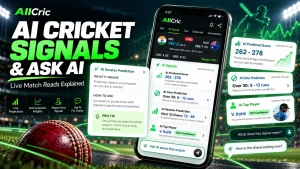
Ask AI is a natural-language assistant inside AllCric. In the match screen, an Ask AI about this match bar sits at the bottom, visible across the AI Signals tab. You type a question in plain English and get an answer based on the match you are viewing. AllCric’s App Store description presents it as an intelligent match companion that gives instant, context-aware answers to match-specific questions. Earlier release notes described it as an AI chatbot in beta, and later updates mention an optimised chatbot experience.
Three things make it useful in a live setting:
- Match context: because it is opened from a specific match, it starts from the live situation rather than from a blank slate.
- Plain language: you do not need to know any special commands or stats terms.
- Speed: it sits on the same screen as the score, run rates and signals, so you can ask without leaving the game.
As with any AI tool, answers are informed estimates. They do not guarantee outcomes, and they are only as current as the data behind them. Check the in-app screen for what Ask AI can and cannot do in your plan.
What to Ask Cricket AI: Questions by Goal
A good way to decide what to ask cricket AI is to start with your goal. The table below maps common goals to the kind of question that works.
|
Your goal |
Question style |
Example |
|
Understand the situation |
Ask for a comparison or summary |
“How do the current and required run rates compare right now?” |
|
Spot momentum shifts |
Ask what changed and why |
“What changed in the last three overs?” |
|
Judge players |
Ask about form in this match |
“Which batters are in form in this match?” |
|
Make fantasy decisions |
Ask for shortlists with reasons |
“Which bowlers look like good captain options today?” |
|
Learn the game |
Ask for plain-language explanations |
“What does a high AI confidence score mean?” |
Questions About the Game Situation
These are the best starting points, because they ground the conversation in facts you can check against the scoreboard.
Take the match shown in AllCric’s AI Signals screen: Oman chasing 257 against Canada, at 49 for 2 after 6.3 overs, with a current rate of 7.54 and a required rate of 4.78. Useful questions in that situation include:
- “How many runs do Oman need, and from how many overs?” A simple check that confirms the target maths (208 more runs from 43.3 overs).
- “How does the current run rate compare with the required rate?” Shows whether the batting side is ahead of or behind the pace.
- “How much does having eight wickets in hand matter at this stage?” Explains why wickets in hand give a chasing side flexibility.
- “What would a good next five overs look like for the chasing team?” Frames the next phase of play.
- “What does the AI predicted score suggest about this innings?” Links the answer to the AI Signals card, which in this example showed a projection of 262.0 runs.
Questions About Momentum and Turning Points
Momentum is where a cricket AI assistant earns its place, because it is hard to judge from a single glance at the score.
- “What has changed in the last few overs?” Prompts a recap of wickets, boundaries and rate changes.
- “Is the run rate trending up or down?” Gets at direction, not just a single number.
- “How big a deal was that wicket?” Asks for the impact of a key dismissal on the situation.
- “Is this a normal wobble or a real turning point?” A good habit question, in the spirit of AllCric’s own tip that a single irregular over does not break a pattern.
- “What would the next session need to look like for the other team to get back in the game?” Connects to session-level thinking, which the AI Session Prediction card encourages.
Questions About Players and Form
AllCric’s AI Top Player module ranks the top three batters and bowlers by recent form, using runs and strike rate for batters and wickets and economy rate for bowlers. Ask AI questions can build on that.
- “Which batters are in form in this match?”
- “Which bowler is most likely to be effective in the next spell?”
- “How is this bowler’s economy looking compared with the match so far?”
- “Who is the most dangerous batter left in the line-up?”
- “Why is this player ranked among the top performers?”
The app’s own pro tip is that form beats fame, so a good follow-up is to ask whether a big name has actually been performing recently, or whether the numbers say otherwise.
Questions About Fantasy Picks
AllCric is also a skill-based fantasy companion, and Ask AI is a natural place to sanity-check a team. Questions that work well:
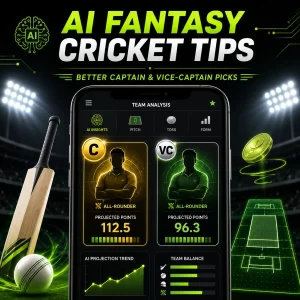
- “Which batters and bowlers look strongest for captain today?” A shortlist, rather than a single pick, gives you room to apply your own judgement.
- “Who has the best recent form in this match?”
- “Is it worth picking a bowler in these conditions?”
- “What is the risk of picking this player as captain?” Asking for the downside is as useful as asking for the upside.
- “If I had to choose between these two players, which one has the stronger recent form?” A direct comparison, which is a good use of a tie-breaker.
No answer can guarantee fantasy points. Treat suggestions as input for your own research, and play within limits you are comfortable with.
Questions to Learn Cricket Terms and Rules
Ask AI also works as a learning tool, especially for newer fans who want to follow along without feeling lost.
- “What is the required run rate and why does it matter?”
- “What does strike rate tell me about a batter?”
- “What is economy rate?”
- “What is a powerplay?”
- “What does a high AI confidence score mean?” A direct way to understand the signals in the app.
- “What does the AI session prediction show?”
These questions help you build the vocabulary to read the other signals more confidently.
How to Phrase AI Match Questions for Better Answers
The way you phrase AI match questions changes how useful the answers are. A few habits help.
- Be specific. Name the team, player or phase. “How is the chase going?” is weaker than “How is Oman’s chase going after seven overs?”
- Include the goal. Say what you are trying to decide: “I am picking a captain” or “I want to understand the run rate.”
- Ask one thing at a time. Short, focused questions are easier to answer than long, layered ones.
- Ask for the reasoning. Follow up with “why?” to see what is driving the answer.
- Ask for both sides. “What could go wrong for the favoured team?” prevents one-sided reads.
- Refresh after key events. After a wicket or a big over, ask again. The situation has changed.
Compare these two versions of the same question:
|
Weaker |
Stronger |
|
“Who will win?” |
“With 208 needed from 43.3 overs and eight wickets in hand, what are the main risks for the chasing team?” |
|
“Best player?” |
“Which batters are in form in this match, and why?” |
|
“Is this good?” |
“Is a run rate of 7.54 against a required rate of 4.78 a strong position at this stage?” |
Using Ask AI With the AI Signals Tab
Ask AI works best when it sits alongside the AI Signals tab rather than replacing it. The tab includes AI Predicted Score, AI Over Prediction, AI Session Prediction and AI Top Player, each with an information panel and an update time.
A simple workflow:
- Scan the signals. Look at the predicted score, over and session outlooks and the top players.
- Spot a surprise. Note anything that looks odd, such as a high-confidence read that does not match your impression.
- Ask a targeted question. For example: “Why is the AI predicted score above the target?”
- Check the timestamp. Make sure the read is recent before acting on it.
- Revisit after key events. Ask again after a wicket or a big over.
Some AI Signals data appears behind a subscription prompt in the app, so what you see may differ by plan.
Questions to Avoid
Some questions set you up for weak answers, or ask for something no model can deliver.
- “Guarantee me the winner.” No tool can guarantee a result . Ask about likelihood and risks instead.
- “Tell me exactly how many runs will be scored.” Projections are estimates with a range. Ask what factors could push the total up or down.
- Questions with no match context. “Is he good?” with no player or match gives the assistant little to work with.
- Questions that assume stale data. If a lot has just happened, check the update time or ask again.
- Requests for personal or private information about players. Keep questions to the match and publicly relevant performance.
- Treating the answer as the final word. Use it as one input alongside the scoreboard and your own knowledge.
Final Thoughts: Ask Better, Watch Smarter
The best ask AI cricket questions are specific, grounded in the match and tied to a decision or a point of curiosity. Start with the situation, probe momentum, check player form, sanity-check your fantasy picks and use the assistant to fill gaps in your cricket vocabulary.
Open the AI Signals tab in your next live match, scan the signals, spot something that surprises you and ask about it. Then compare the answer with what the scoreboard shows. Used that way, Ask AI becomes a quick second opinion that helps you watch smarter, one question at a time.
FAQS
It is a natural-language assistant inside the app. You type a question about the match and get a context-aware answer.
Specific, match-based questions work best, such as comparing run rates, asking what changed in recent overs or asking which players are in form.
It can discuss likelihoods and risks based on the situation, but no tool can guarantee a result.
Yes, as a research aid. You can ask about form and risk, but results are never guaranteed.
Yes. You can ask for plain-language explanations of terms such as required run rate, strike rate or economy rate.
Access and usage details can change, so check the in-app screen for the current offer.