What Is Live Cricket Betting and How Is It Different From Pre-Match Betting
Live cricket betting (also called in-play betting) allows odds to be placed while the match is actually happening, rather than only before it starts. Unlike pre-match odds, which are based on team form, squad strength, conditions, and historical data, live odds update continuously based on what’s unfolding on the field: the current score, wickets in hand, overs remaining, and the flow of the game.
This is the fundamental difference: pre-match betting prices in expected performance, while live betting prices in actual, real-time performance. As a result, live cricket betting probability can swing dramatically within a few overs, something that simply doesn’t happen with fixed pre-match odds.
How Win Probability Models Actually Work in Cricket
Live win probability is typically calculated using models built on historical match data, essentially, a database of thousands of previous matches showing what happened next from similar situations (same score, same wickets lost, same overs remaining, same target).
At a basic level, these models consider:
- Current score and wickets in hand
- Overs remaining (or balls remaining, in the shortest formats)
- Target score (in the second innings) or projected first-innings total
- Required run rate vs current run rate
- Pitch and ground scoring history (some grounds are historically higher- or lower-scoring)
- Historical outcomes from statistically similar game states
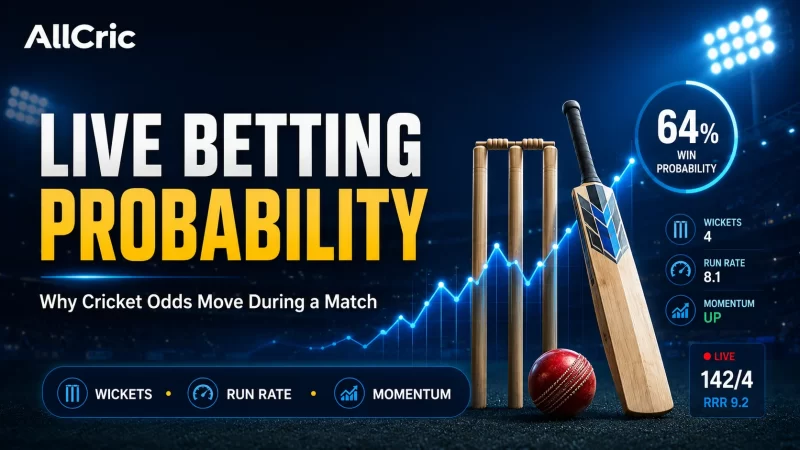
The output is usually expressed as a percentage, for example, “Team A: 68% to win”, which is then reflected in the live odds. As each ball is bowled, the model recalculates, and the odds adjust to match the new probability estimate. This is why you’ll notice odds moving even on a single dot ball late in a tight run chase, the model has updated its estimate of the game state.
The Key Variables That Move Live Cricket Betting Probability
Several match variables directly influence how live odds shift:
- Wickets falling: losing a set batter or several wickets in a cluster sharply changes the probability, especially with overs still remaining.
- Boundaries and scoring rate: a flurry of fours and sixes can swing the required run rate and probability quickly, particularly in T20s.
- Dot-ball pressure: a string of dot balls builds required run rate and can shift probability even without a wicket falling.
- Overs remaining: fewer overs left amplifies the impact of every subsequent event on probability.
- Partnership stability: an established, in-form partnership reduces perceived risk of collapse, subtly shifting probability toward the batting side.
- Weather and light interruptions: potential for a reduced/rescheduled match (via DLS calculations) can add volatility to probability, especially in rain-prone conditions.
- New ball/reverse swing periods: certain phases of an innings (new ball, death overs) carry historically higher wicket-taking probability, which live models often factor in.
How Wickets Change the Game State and the Odds
Wickets are the single biggest driver of sudden probability shifts in cricket. Losing a wicket does two things simultaneously:
- It removes a batting resource (fewer wickets in hand to absorb risk later in the innings).
- It often changes the run-scoring approach, since a new batter typically needs time to settle, which can slow scoring temporarily.
The impact of a wicket is not uniform, it depends heavily on context:
- Losing a well-set, high-impact batter (especially a top-order anchor or a power-hitter in the death overs) causes a much larger probability shift than losing a tailender.
- Losing early wickets in a run chase compounds pressure because there are more overs left for the bowling side to exploit, and the required run rate keeps climbing on fewer remaining resources.
- Losing a wicket right before a asset like a set batter approaching a milestone can also affect momentum-based pricing, even though the raw statistical impact might be modest.
This is why identical scorelines (say, 120/3 after 15 overs) can carry very different win probabilities depending on which three wickets were lost and how the remaining batting order is structured.
Run Rate, Required Run Rate, and Their Impact on Probability:
In the second innings of a limited-overs match, the gap between the current run rate (CRR) and the required run rate (RRR) is one of the clearest live indicators of win probability:
- If RRR is climbing faster than the batting side can realistically sustain (based on wickets in hand and the pitch), the win probability for the chasing team drops.
- If CRR consistently exceeds RRR with wickets in hand, win probability rises for the chasing side, often quite sharply in T20 cricket where a small margin of overs can swing outcomes.
- Even in the first innings, a rapidly accelerating run rate raises the projected total, which indirectly recalibrates the eventual chase difficulty and pre-set win probability for both sides once the target is known.
Because required run rate compounds under time pressure (fewer overs left means each dot ball or wicket has outsized impact), live probability models weight the final overs of a limited-overs innings far more heavily than the middle overs, which is exactly why odds can swing wildly in the last 3–5 overs of a close T20 match.
Momentum in Cricket: Real Factor or Betting Market Psychology?
“Momentum” is one of the most debated concepts in cricket analytics. There are two angles to consider:
- Statistical momentum (data-backed): Some elements of momentum are measurable, for example, a bowling side taking two wickets in quick succession genuinely increases the statistical likelihood of a further breakthrough in the next few overs, partly due to new-batter vulnerability and partly due to psychological pressure on the batting side. Similarly, a batting side finding boundaries consistently reduces required run rate pressure, which is a real, quantifiable shift.
- Perceived momentum (market psychology): Betting markets can also move based on the perception of momentum, commentary narratives, crowd energy, or a batter looking “in the zone”, even when the underlying statistical shift is smaller than the odds movement suggests. This is where in-play markets can occasionally overreact to a boundary or a dropped catch, creating short-lived value discrepancies for bettors who can separate genuine probability shifts from market overreaction.
Understanding this distinction is one of the more advanced skills in reading live cricket betting probability, not every big odds swing reflects an equally big change in actual win chances.
Format Matters: T20 vs ODI vs Test Live Probability Swings
- T20 cricket sees the fastest and largest live probability swings because fewer overs mean each ball carries more statistical weight. A single over can shift win probability by 15–20% or more in a tight chase.
- ODI cricket shows more gradual shifts, since 50 overs allow more time to recover from a bad phase, though the death overs (41–50) still produce sharp movement similar to T20 death overs.
- Test cricket live probability evolves over days rather than balls, driven by session-by-session shifts: a strong session with the bat, a cluster of wickets after tea, or deteriorating pitch conditions on days 4–5 all reshape probability, but far more gradually than in limited-overs formats.
Reading a Live Odds Movement: A Practical Walkthrough
Imagine a T20 run chase: Team B needs 60 runs off the last 30 balls with 6 wickets in hand.
- At this point, a model might estimate Team B’s win probability at roughly 55%, given a manageable required run rate with wickets in hand.
- If Team B scores a six and a four in the next over (14 runs), the required rate drops sharply, and the win probability might jump to 68 to 70%.
- If instead Team B loses two wickets in that same over while scoring only 3 runs, win probability could fall to 35 to 40%, since both the run-rate pressure and reduced batting depth compound against them.
This illustrates why live cricket betting probability is never just about the current score, it’s the interaction between runs, wickets, and overs remaining, recalculated continuously.
Common Mistakes Bettors Make During Live/In-Play Betting
- Reacting emotionally to a single boundary or wicket without considering overall match context.
- Ignoring overs remaining when assessing how significant a run-rate change really is.
- Overweighting commentary-driven “momentum” narratives instead of the actual game state.
- Betting on perceived momentum after it’s already priced in, missing the window where real value existed.
- Failing to account for pitch deterioration in Test matches, where late-match conditions can favor bowlers more than early-match odds suggest.
- Not tracking required run rate trends over several overs, rather than just the current ball.
How AllCric Helps You Track Live Match Momentum and Probability
Following how wickets, runs, and momentum interact in real time requires quick access to accurate, ball-by-ball information, which is exactly the gap a platform like AllCric is built to fill. AllCric is an AI-first cricket insights and fantasy platform (not a betting operator) offering ultra-fast live scores, ball-by-ball commentary, and improved current run rate (CRR) and required run rate (RRR) displays alongside live target tracking.
For anyone trying to understand how live cricket betting probability shifts during a match, having CRR, RRR, and target data updated instantly, along with smart alerts for tosses, lineups, and milestones, makes it easier to separate genuine game-state changes from short-lived market noise. Rather than relying purely on commentary tone or crowd reaction, tools like AllCric let you follow the actual numbers behind each shift in momentum, giving you a clearer, data-grounded picture of how the game situation is really evolving ball by ball.
Conclusion
Live cricket betting probability isn’t random, it’s the product of continuously updated models reacting to wickets, run rate, overs remaining, and match context. Wickets remove batting resources and often disrupt scoring tempo; run rate dynamics compound under time pressure, especially in the death overs; and momentum, while partly real and partly psychological, plays a genuine role in how markets move. Understanding these mechanics doesn’t guarantee predicting outcomes, cricket remains inherently unpredictable, but it does help you interpret why the odds are moving the way they are, rather than simply reacting to the scoreboard.



 Get expert Today cricket match predictions 100 sure, top picks & fantasy tips – Download AllCric App or visit AllCric Website