Summary
Uncover the technological framework that powers elite modern sports analytics. This comprehensive deep dive explains how an AI cricket prediction engine operates under the hood, exploring how millions of data points, from century-old ball-by-ball archives to real-time pitch telemetry, are transformed into precise forecasts. Learn about the exact machine learning models, feature engineering pipelines, and real-time tracking systems that apps like AllCric use to decode the complexity of the sport, empowering users with data-driven insights.
For generations, sports forecasting relied on traditional punditry, human intuition and basic averages, creating an ongoing debate around AI cricket prediction versus expert analysis. A commentator might look at a team’s win-loss record at a certain ground or review a player’s batting average over the last month to make a subjective claim about who holds the upper hand.However, cricket is a game defined by fine margins. A sudden drop in temperature can induce late swing, an unexpected choice at the toss can alter psychological momentum, and a single tactical matchup can change the direction of an entire tournament.
Today, relying solely on gut feeling is no longer enough. Advanced platforms have integrated AI cricket prediction frameworks to turn the sport into a highly precise science. By analyzing past trends and processing billions of historical records in milliseconds, artificial intelligence extracts hidden patterns that the human eye completely misses.This blog breaks down how AI prediction cricket works, from the raw data collection to the complex mathematical algorithms that deliver precise percentages.
The Complexity of Predicting Cricket
Compared to continuous-flow sports like soccer or basketball, cricket is unique. It is a discrete game broken down into thousands of individual, highly structured events, delivery by delivery.
Every single ball bowled contains an intricate matrix of parameters:
- The release velocity and angle of the bowler.
- The micro-wear and soil moisture of the pitch.
- The batsman’s historical comfort against specific trajectories.
- The geometric dimensions of the boundary ropes.
- The shifting weight of the required run rate.
Because these factors change with every ball, traditional static analytics (like simple run-rate calculations) fail to capture the real story. This high level of multi-variable complexity makes cricket the perfect canvas for a cricket prediction AI.
The Core Workflow of AICricket Prediction
An enterprise-grade AIprediction model does not simply guess an outcome. It processes information through a structured pipeline that converts real-world sporting elements into actionable mathematical outputs.
Step 1: Data Ingestion (Feeding the Engine)
An AImodel is only as powerful as the information it consumes. Predictive frameworks continuously feed on two main types of data: historical databases (like ball-by-ball logs going back decades) and live operational feeds delivered via low-latency cricket data APIs.
This ingestion layer captures:
- Granular Ball Logs: The exact outcome of every delivery bowled in modern professional matches, noting the run value, dismissal type, and point of impact on the pitch.
- Player Historical Profiles: Complete career maps categorizing how a player behaves across distinct game phases: the Powerplay, middle-overs consolidation, and high-pressure death overs.
- Venue Telemetry: Ground-specific historical behaviors, average first-innings tallies, soil properties (clay vs. silt content), and local altitude metrics.
Step 2: Feature Engineering (Translates Cricket Into Math)
Raw statistics cannot be plugged directly into an algorithm without context. Data scientists use a process called feature engineering to transform baseline numbers into specific variables that help the machine learn effectively.
Key calculated features include:
1. Head-to-Head Matchup Mining
Instead of looking at a batsman’s overall strike rate, the engine isolates their specific record against a distinct bowling archetype. For instance, it calculates how a right-handed opening batter performs against a left-arm fast bowler who swings the ball back into the pads during the first six overs.
2. Recency Decay Weights
Standard career averages look too far into the past, blending a player’s current hot streak with matches played three years ago. AI utilizes Exponential Moving Averages (EMA). This technique applies a mathematical decay curve that places higher importance on a player’s last 5 to 10 innings, capturing their true current form.
3. Environmental & Ground Adjustments
Venues react differently to ambient weather. The engine analyzes local humidity levels, wind directions, and the calculated probability of evening dew, a major factor that leaves a white ball slick, making it incredibly difficult for spin bowlers to grip and control.
Step 3: The Machine Learning Models
Once the data is cleaned and structured into features, it enters the algorithmic core. Rather than relying on a single formula, advanced platforms deploy an ensemble approach, combining multiple specialized machine learning models to maximize overall precision.
1. Gradient-Boosted Decision Trees
XGBoost is a dominant algorithm in sports data science. It trains a series of simple decision trees sequentially, with each new tree correcting the errors made by the previous one. This method excels at identifying non-linear relationships, such as how a low economy rate from a world-class spinner completely restructures the scoring patterns of the middle-overs phase.
2. Random Forest Classifiers
This model constructs a vast forest of independent decision trees during its training phase. By combining the individual votes of hundreds of trees, it removes statistical anomalies and balances predictions when handling highly volatile variables, such as projectable team totals during a steep run chase.
3. Long Short-Term Memory Networks (LSTM)
For deep learning operations, LSTM networks are utilized because they process sequential data. Because cricket matches are built on shifting momentum, an LSTM network reads the progression of overs as a continuous timeline, learning how past events (like back-to-back maidens) influence future outcomes.
In-Game Live Tracking & Monte Carlo Simulations
The true power of real-time AI cricket prediction becomes visible once a match begins and the model starts updating its forecasts after every major event.The moment the toss concludes, the pre-match model recalibrates its baseline based on whether the captain chooses to bat or bowl first.
By running thousands of virtual match scenarios from the current state of play, the system maps out the likelihood of different outcomes. If a team requires 48 runs off the final 24 balls with 4 wickets in hand, the system evaluates that exact scenario against thousands of identical historical situations to update the win probability instantly.
Understanding Accuracy: Can AI Guarantee a Win?
When discussing accuracy, it is important to address a common misconception: No AI model can predict a sporting event with 100% certainty.
The goal of advanced machine learning is not to eliminate all unpredictability, but to calculate true mathematical probability. If a model projects a team’s win percentage at 75%, it means that in a controlled simulation under identical conditions, that team wins 75 out of 100 times. Human elements, like a brilliant individual catch or an unexpected umpiring error, will always ensure that cricket retains its magic.
Top models regularly achieve an accuracy rate between 78% and 85% when forecasting pre-match outcomes in established formats like the Indian Premier League (IPL) or Big Bash League (BBL), outperforming standard human guessing frameworks.
Elevating Your Strategy with AllCric
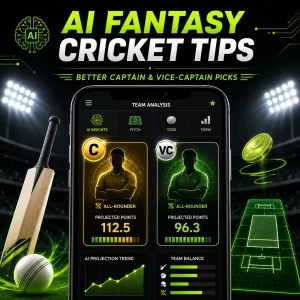
Translating these complex data streams into practical strategies requires a refined, user-friendly interface. This is where AllCric steps in as a strong option for users searching for the best AI prediction app for cricket, with live analysis, win probabilities and fantasy insights presented in a simple format.
AllCric is an advanced cricket match prediction and fantasy sports companion app built to help fans create data-driven fantasy rosters. The platform simplifies complex data tracking by delivering actionable, clear match insights. AllCric provides in-depth pre-match analysis, detailed venue breakdowns, pitch moisture indicators, and historical player matchups.
Conclusion
The integration of artificial intelligence has permanently changed how we understand cricket analysis. By processing vast datasets, factoring in real-time environmental shifts, and utilizing ensemble machine learning models, predictive engines replace speculation with statistical reality. As technology continues to evolve, these models will only become sharper, offering an immersive, deeply analytical experience for fans and fantasy players around the world.