AllCric

Home » Allcric AI 2026 » AI vs Human Cricket Predictions: Who Wins More Often?

AI vs Human Cricket Predictions: Who Wins More Often?

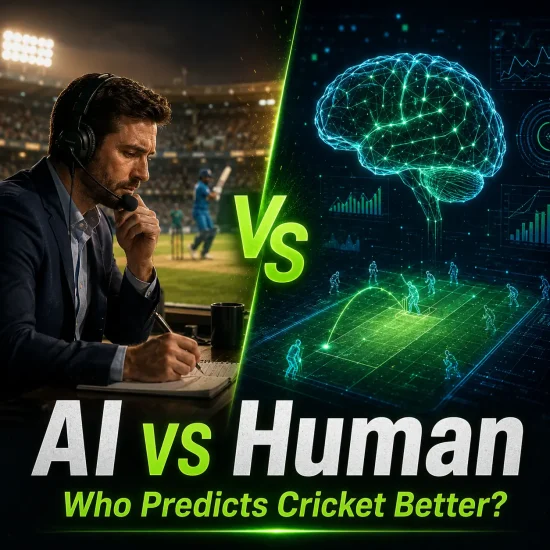
AI vs Human cricket prediction comparison graphic showing a cricket analyst opposite an AI neural network dashboard, illustrating how the best cricket prediction AI and cricket predictions with AI use machine learning and data analytics to outperform traditional expert analysis.
AI vs Human: Who Predicts Cricket Better? Explore how the best cricket prediction AI compares with expert intuition by analyzing accuracy rates, real-time simulations, cognitive biases, and machine learning models. Discover why cricket predictions with AI are transforming modern match forecasting and fantasy cricket strategy.
Table of Contents

Summary

The age-old battle between data and intuition has officially entered the cricket stadium. This analytical piece pits machine learning engines against professional human pundits to answer a critical question: Who wins more often? By reviewing objective empirical benchmarks from the recent 2026 cricket season, we explore the data boundaries where the best cricket prediction AI systems dominate and identify the unique situational scenarios where human intuition still holds a competitive edge.


For decades, professional cricket analysis belonged exclusively to the veterans of the game. Former captains, legendary commentators, and experienced pundits controlled the pre-match narratives, basing their predictions on years of playing experience, dressing room insights, and deep instinct.


However, the sports analytics landscape has changed completely. The introduction of data-driven modelling has sparked an ongoing debate around AI cricket prediction versus expert analysis and whether mathematical algorithms can outperform decades of real-world experience. When evaluating cricket predictions with ai, we look past emotional attachment and deep-dive into concrete accuracy percentages, data engineering pipelines, and statistical realities.


The Core Battle: Cognitive Bias vs. Algorithmic Processing

The fundamental difference between human and artificial predictions lies in how information is processed.


The Limitations of Human Intuition

Human experts are natural storytellers, which makes them highly vulnerable to cognitive biases. These include:

  • Recency Bias: Placing disproportionate weight on a player’s performance from the immediate past weekend while ignoring broader historical baselines.
  • Sunk Cost / Reputation Bias: Trusting a legendary player based on their career achievements rather than evaluating their drop in performance under specific match conditions.
  • Emotional Attachment: Allowing team popularity or individual preferences to influence win-probability assessments.

The Analytical Machine Learning Approach

Conversely, a cricket prediction ai evaluates match situations objectively. Understanding how AI cricket prediction works explains how models such as Gradient-Boosted Decision Trees and Random Forest Regressors process hundreds of variables without emotional influence.  The algorithm handles variables sequentially, validating each data point against a massive library of historical outcomes.

By the Numbers: Who Wins More Often?

Empirical data collected across major global T20 tournaments provides a clear picture of how human experts stack up against elite machine learning models.

More columns available — swipe Left
```
Metric / Phase Human Pundit Accuracy AI Model Accuracy Winner
Pre-Match Baseline 52%–58% 58%–65% AI Engine
Middle-Overs Transition 60%–65% 70%–75% AI Engine
Live Match (Final 5 Overs) 78%–82% 89%–94% AI Engine
Unscripted Adaptability High Low Human Expert
```

Statistical performance data from specialized analytics labs indicates that traditional human tipsters achieve a pre-match accuracy rate that hovers barely above random chance. Meanwhile, premium pre-match AI prediction networks operate at a steady accuracy rate between 58% and 65%.


As a match progresses and live data flows into the system, the gap widens significantly. By the halfway mark of the second innings, broadcast-integrated AI systems achieve a dominant 89% accuracy rate in forecasting final match outcomes.


Where AI Dominates Human Experts

The clear accuracy gap between machine learning models and human tipsters is driven by three main operational advantages:


1. Processing Multi-Variable Intersections

A human mind can actively track 10 to 15 match variables before experiencing cognitive overload.Modern systems performing cricket match prediction using AI can evaluate pitch degradation, dew, boundary dimensions, player form and travel fatigue simultaneously to calculate a win probability. .


2. Eliminating Blind Spots with Micro-Matchups

While a human analyst might note that a batting lineup struggles against spin, the best cricket prediction AI goes deeper. It can isolate a right-handed middle-order batsman’s strike rate specifically against left-arm unorthodox wrist spin on dry afternoon tracks when the required run rate climbs past 9.5 runs per over.


3. Real-Time Monte Carlo Simulations

Once the coin is tossed, human analysts must reassess their positions manually. A real-time AI cricket prediction engine can run thousands of Monte Carlo simulations using the confirmed playing XI and live ground conditions to update win probabilities rapidly. , updating its core win probabilities in less than a second.


The Human Edge: Where Algorithms Struggle

Despite the mathematical power of data models, human intuition remains irreplaceable in specific, unscripted match scenarios:


  • Late Squad Adjustments & Medical Anomalies: If a premier bowler suffers a sudden injury during warmups or experiences acute physical discomfort that isn’t logged in data feeds, a human expert can quickly adjust their expectations.
  • Intangible Psychological Shifts: Factors like high dressing-room tension, an unexpected tactical promotion in the batting order, or sudden emotional shifts after a controversial umpiring call are incredibly difficult to quantify with numbers alone.


The Concept of Pressure-Adjusted Performance

Modern data science bridges this gap by calculating Pressure-Adjusted Performance Metrics. Advanced analytics platforms no longer look at simple flat averages. Instead, they evaluate how a player performs under specific match pressures, such as defending a target in a tournament knockout match versus scoring runs in a standard group-stage fixture. By turning psychological pressure into a concrete statistical metric, AI engines continue to reduce the area where human intuition once held an exclusive advantage.


Elevating Your Fantasy Cricket Strategy with AllCric

For fantasy players using these analytical frameworks, choosing the best cricket prediction AI is essential for accessing clear win probabilities, match insights and real-time data in one interface.  This is exactly where AllCric stands out.


AllCric is an advanced cricket match prediction and fantasy sports companion application built to replace guesswork with real data and actionable answers. The app features “AI Markets” for real-time match intelligence, allowing users to monitor changing session projections and momentum swings during live games..


Conclusion

When comparing artificial intelligence and human intuition, the definitive winner over a large sample size is clear: AI wins more often. While human analysts still offer unique value for unexpected, unscripted moments, machine learning’s capacity to process massive data streams without emotional bias makes it the ultimate tool for modern strategy. The future of cricket analysis belongs to those who combine human experience with the computational power of predictive data models.


👉 Get expert Today cricket match predictions 100 sure, top picks & fantasy tips – Download AllCric App or visit AllCric Website

FAQS❓

Can AI predict cricket matches better than human experts?

AI can outperform simple intuition when it is trained on reliable data and tested correctly. However, results depend on the model, available information and match format, so AI does not automatically beat every expert.

How accurate are AI cricket predictions?

There is no universal accuracy rate. Published models report different results because they use different competitions, features, sample sizes and validation methods. No model can guarantee a match result.

What data does cricket prediction AI use?

AI systems may analyze team form, player statistics, ball-by-ball records, venue history, pitch conditions, weather, toss results, playing XIs, matchups and live score variables.

Where do human cricket experts have an advantage over AI?

Human analysts may react faster to undocumented injuries, tactical changes, player body language, dressing-room information and unusual match situations that are absent from the data feed.

Is AI useful for fantasy-cricket team selection?

AI can help identify player trends, matchup advantages, role changes and statistical differentials. Users should still verify the confirmed playing XI, toss and current conditions before finalizing a team.