
Most Successful ODI Captains by Winning Percentage
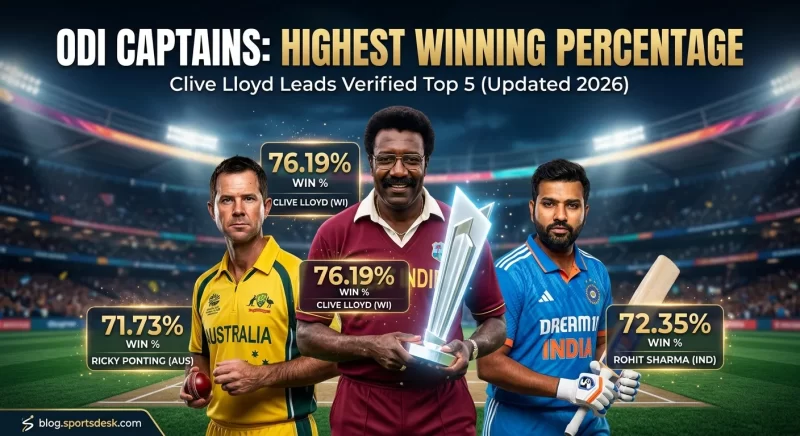
Who is the most successful ODI captain ever? Is it Ricky Ponting with 230 matches? Or MS Dhoni with the 2011 World Cup win? Most people guess wrong — because the answer isn’t about the most wins, and the debate around the best cricket captains in the world often depends on how you measure greatness. It’s about winning percentage.
In this article, you’ll get a clear, data-backed ranking of ODI captains by win percentage — with the criteria explained honestly, so you can judge for yourself.
What Is Winning Percentage in ODI Cricket?
It’s simple:
Win % = (Matches Won ÷ Matches Played) × 100
This tells you how often a captain won, not just how many times. A captain who played 10 matches and won 8 has a better win percentage than someone who played 200 and won 130 — even though the second number sounds bigger.
One important thing: We’re only looking at captains who led in a minimum of 50 ODI matches. Anyone with fewer matches may have faced easier opponents or played fewer high-pressure games — so the comparison wouldn’t be fair.
ODI Captains with Highest Winning Percentage (Top 5)
| Captain | Country | Matches | Wins | Win % |
|---|---|---|---|---|
| Clive Lloyd | West Indies | 84 | 64 | ~76.19% |
| Rohit Sharma | India | 56 | 42 | ~72.35% |
| Hansie Cronje | South Africa | 138 | 99 | ~71.73% |
| Ricky Ponting | Australia | 230 | 165 | ~71.73% |
| Virat Kohli | India | 95 | 65 | ~68.42% |
Stats sourced from ESPNcricinfo and verified reports. Rohit Sharma’s data is as of end of his ODI captaincy tenure in 2025.
Most Successful Captain in ODI
1. Clive Lloyd — The Man at the Top
Clive Lloyd led West Indies in 84 matches from 1975 to 1985, winning 64 of them. His win percentage of 76.19% is the highest among captains who led in 50 or more ODI matches. But here’s the context you need: Lloyd led West Indies to World Cup glory in both 1975 and 1979, and he is one of only four men to have led a side to more than one ICC title. He also had arguably the most dominant team in cricket history behind him — players like Viv Richards, Gordon Greenidge, Joel Garner, and Michael Holding. His win percentage reflects both great leadership AND a generationally exceptional squad.
2. Rohit Sharma — The Modern Leader
Rohit Sharma led India in 56 ODI matches, winning 42 of them, which gives him a win percentage of 72.35% — the highest ever for any Indian captain in ODI cricket. Globally, this places him second among all captains in the history of the format. He also led India to the 2025 ICC Champions Trophy, and the 2023 ODI World Cup where India were unbeaten all the way to the final. His numbers are impressive, and the era he played in was far more competitive than Lloyd’s time, especially when you compare how modern captains are handling pressure across formats and leagues.
3. Hansie Cronje — The Complicated Legacy
Cronje led South Africa to 99 wins in 138 ODI matches, with one tied match and three no results. His win percentage of 73.70% is outstanding. The problem? His career ended when he was implicated in a match-fixing scandal in 2000. This raises an uncomfortable question — how many of those wins were clean? That shadow makes it impossible to take his stats at full face value.
4. Ricky Ponting — The Volume King
Ponting holds the record for the most matches and most wins as a captain in ODI cricket. He led Australia to 165 victories in 230 matches, with a win percentage of around 71.73%. He also led Australia to back-to-back World Cup wins in 2003 and 2007. Where Ponting stands apart from Lloyd is volume and consistency — he maintained a win percentage above 71% across a much longer career and against far more competitive opposition in the 2000s.
5. Virat Kohli — The Aggressive Leader
Virat Kohli holds a winning percentage of 68.42% from 65 wins in 95 matches as ODI captain, placing him seventh overall globally. Kohli captained during a very competitive era and built India into a consistent run-chasing machine. However, he never won an ICC ODI trophy as captain — which is why he doesn’t rank higher on the all-time list despite the strong win percentage.
Is Winning Percentage the Full Picture?
No — and this is where most articles stop being honest.
Here’s what win percentage doesn’t tell you:
Team strength matters a lot: Clive Lloyd had Viv Richards, Joel Garner, and Malcolm Marshall — arguably the greatest combination of batting and bowling ever assembled. His 76% would look very different with an average squad.
Era matters: ODI cricket in the 1970s–80s had fewer competitive teams. The number of strong sides has grown significantly since then. A 72% win rate in 2022–2025 means more than a 76% rate in 1978–1985.
Sample size matters: Clive Lloyd played only 84 matches. Ricky Ponting played 230. Sustaining a high win rate over a longer career is much harder.
ICC trophies matter: MS Dhoni’s win percentage (~55%) looks lower than everyone on this list — but he won the 2007 T20 World Cup, 2011 ODI World Cup, and 2013 Champions Trophy. No other captain has three ICC titles across formats.
The bottom line: Win percentage is a useful number, but it’s not the only number.
Conclusion
So, who is the ODI captain with the highest winning percentage? By the numbers, Clive Lloyd holds the top spot with 76.19%. But if you factor in era, competition level, and volume — Rohit Sharma’s 72.35% in modern cricket is arguably more impressive than it looks on paper. And if you go beyond win percentage to overall impact — many would argue MS Dhoni is still the greatest ODI captain of all time, simply because of what he won when it mattered most.
👉 For accurate IPL fantasy tips and reliable match predictions, follow our website and download the AllCric App to get expert predictions directly.
❓FAQs
A: Clive Lloyd of West Indies, with approximately 76.19% from 84 matches (64 wins).
A: Rohit Sharma, with a win percentage of 72.35% — the highest ever for any Indian ODI captain.
A: Win percentage is calculated as wins ÷ matches. Ponting won more matches in total, but his rate (71.73%) is slightly lower than Lloyd’s and Rohit’s. He played many more games, which makes his record equally impressive.
A: It’s one of the best individual metrics, but not the complete picture. ICC trophy wins, performance in knockouts, and the strength of opposition all need to be factored in.
A: 50 matches. Captains who led fewer than 50 ODIs are excluded because the sample size is too small for a fair comparison.