
Does Winning the Toss Matter in Cricket? 20+ Years of Data Analysis
Introduction
Have you ever wondered why captains sweat over the toss before a cricket match? It lasts barely thirty seconds — a coin spins, gravity decides, and a captain calls. Yet coaches track toss data obsessively, analysts prep double strategies, and fans debate endlessly online.
The cricket toss hands the winning captain a single but powerful choice: bat or bowl. That choice can shape field settings, bowling rotations, and even the psychological momentum of an entire match. But here’s the question every serious cricket fan eventually asks — does winning the toss actually increase your chances of winning the match, or does skill always find a way regardless?
In this guide, we break down over two decades of cricket data across T20s, ODIs, and Tests to give you a clear, honest answer. By the end, you’ll know exactly when the toss truly matters, when it doesn’t, and how to read toss decisions like a seasoned analyst.
What Is the Cricket Toss and Why Does It Matter?
The toss has been part of cricket since 18th-century England, introduced as a neutral mechanism to decide which team chooses their innings. The winning captain can either bat first — aiming to post a competitive total on a fresh pitch — or bowl first — looking to exploit early conditions or the dew factor later in the game.
Its importance varies significantly by format:
- T20: Conditions shift within hours, making the toss a genuine tactical weapon, especially in evening matches where dew settles on the outfield.
- ODI (50-over): A balance between pitch deterioration and dew effects. Context matters enormously.
- Test Cricket: A five-day game gives both teams time to adapt, meaning the toss is influential but rarely decisive on its own.
Cricket Toss Statistics: What 20+ Years of ODI Data Actually Says
Let’s move past opinion and into numbers. An analysis of 2,932 ODI matches played between January 2000 and September 2023, sourced from Cricinfo, tells a surprisingly balanced story.
Overall toss win rate:
- Teams that won the toss: won 50.68% of matches (1,486 wins)
- Teams that lost the toss: won 49.32% of matches (1,446 wins)
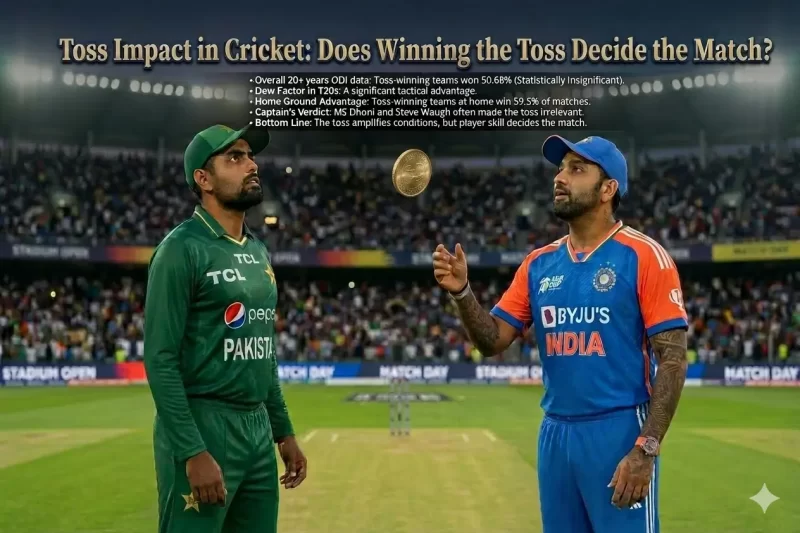
That 50.68% figure is statistically insignificant. In plain terms, winning the toss gives you barely more advantage than flipping another coin. Over those 24 years, toss-winning teams had a win rate above 50% in only 11 years. In the remaining 13 years, teams that lost the toss won more matches.
Bowling first vs. batting first:
When toss-winning captains chose to bowl first, their teams won 52% of the time. When they chose to bat first, win rate dropped to 49%. More tellingly, in 17 out of 24 years analyzed, teams that won the toss and elected to field first had a higher win rate. Bowling first has been the more consistently successful choice — but only marginally.
T20 Toss Strategy and the Dew Factor
In T20 cricket, the dew factor is everything. Evening moisture settles on the outfield from around the 10th over onwards in subcontinental matches, making the ball slippery and difficult for spinners to grip, while helping batters time their shots with far less resistance. This is why captains winning the toss in Asian T20s almost universally elect to field first.
Additionally, chasing gives teams the psychological advantage of knowing the exact target, allowing them to pace their run-chase with precision. The powerplay conditions — whether the ball swings or skids — are also at their most extreme in the first innings, adding another variable the chasing team avoids.
Does Winning the Toss Matter in ODI Cricket? The Day vs. Day-Night Split
This is where the data gets genuinely surprising. Breaking down ODI results by game type reveals a critical contrast:
- Day games: Teams bowling first won 52% of matches, compared to just 43% for those batting first. Chasing in daylight is strongly preferred.
- Day/Night games: Teams batting first won 54%, while bowling-first teams won 52%.
This directly contradicts the popular assumption that dew always favors chasing teams in day-night ODIs. The data suggests that posting a large first-innings total in floodlit conditions creates enough psychological and scoreboard pressure to neutralize the dew advantage entirely.
Toss Impact in Test Cricket: A Five-Day Test Match
Test cricket is where toss decisions become most complex. A captain must factor in pitch deterioration over five days, weather windows, day-night pink ball behavior, and their own team’s bowling and batting depth.
Batting first on a fresh surface remains conventional wisdom, but in England or New Zealand — where cloud cover assists swing bowling early — fielding first has proven equally effective. At spin-friendly subcontinental venues, some captains now prefer bowling first before the pitch flattens out mid-match.
The toss in Test cricket is not about luck — it’s about reading a pitch better than your opponent.
Home Ground Toss Advantage in Cricket: Venue-by-Venue Breakdown
One of the most striking findings in the dataset is how dramatically venue type changes the toss’s value:
- Home ground: Toss-winning teams won 59.5% of matches
- Away ground: Toss-winning teams won just 41.37% of matches
- Neutral venue: Toss-winning teams won 50.69% of matches
A home captain winning the toss on familiar territory wins nearly 60% of the time. This reflects the compounding advantage of local pitch knowledge, awareness of how the surface behaves across the day, and crowd support. Conversely, away teams who win the toss win less than 42% of their matches — meaning a wrong call on foreign soil can actively hurt you.
Environmental Factors That Shape Smart Toss Decisions
Smart captains do not call heads on instinct. Modern toss decisions are backed by specific environmental data:
- Cloud cover in England and South Africa creates swing conditions that favor bowling first
- Dew probability in South Asia and the UAE directly determines whether chasing or defending is safer
- Pitch type — dry, dusty surfaces deteriorate quickly, favoring batting first, while green-tops favor bowling first
- Altitude at venues like Johannesburg reduces swing but increases pace, making standard toss assumptions unreliable
Pre-match research now includes curator reports, weather forecasts, and venue win-loss records broken down by toss decision. The coin may be random, but the decision that follows it no longer is.
Player Psychology and the Cricket Toss
Beyond statistics, the toss carries a psychological dimension that is hard to quantify but genuinely real. Winning the toss and executing your strategy successfully creates a sense of control that cascades through an entire batting lineup. Players perform more confidently when the game feels like it’s going to plan.
Some of cricket’s greatest captains built reputations for making the toss irrelevant entirely:
- MS Dhoni was equally composed setting totals or chasing them — the toss rarely unsettled his plans
- Steve Waugh’s Australian sides regularly converted losing-toss situations into victories through preparation and aggression
- Clive Lloyd’s West Indies of the 1970s–80s were so dominant that toss outcomes barely registered
The best teams treat the toss as one minor input among many — not a verdict on the match.
FAQs
No. Over 20+ years of ODI data, toss-winning teams win only 50.68% of matches — statistically identical to chance. Player form, execution, and match conditions are far stronger predictors.
Dew in evening matches makes the ball difficult to grip in the second innings, helping batters significantly. Chasing also gives teams a precise target to pace their innings against, reducing guesswork.
The toss can be more influential in Tests at venues where pitches dramatically deteriorate over five days. In ODIs, its statistical impact is marginal except in specific conditions — day games and home venues show the strongest toss effect.
Teams winning the toss at home win 59.5% of ODI matches. Away from home, that drops to just 41.37% — local knowledge of conditions is the true multiplier, not the coin itself.
While no model predicts the coin flip, analytics tools use venue history, weather data, and pitch reports to recommend the statistically optimal decision — bat or bowl — for specific conditions.
Conclusion
After two decades of data and the lived experience of cricket’s greatest captains, the verdict is clear: the toss is a condition-amplifier, not a match-decider.
In specific circumstances — heavy dew on a subcontinental evening, a deteriorating Test pitch, or a home captain with unparalleled pitch knowledge — winning the toss and making the right call delivers a real, measurable edge. But these are targeted advantages within a bigger picture where player skill, preparation, and mental resilience consistently outweigh the flip of a coin.