
Best D11 Prediction App for Small League and H2H in 2026
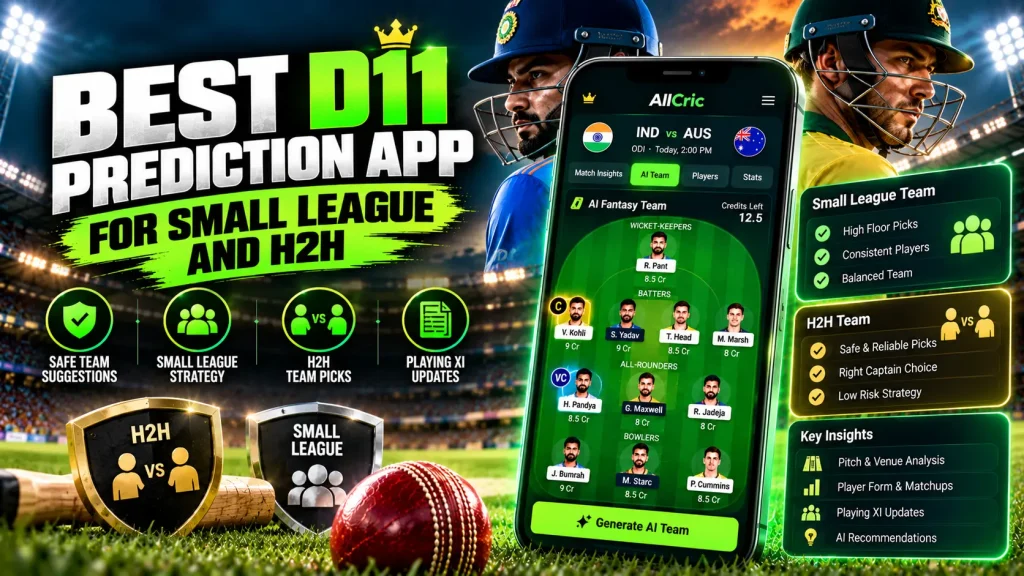
Small League and H2H teams need consistency more than risky differentials. The right D11 prediction app can help you focus on reliable players, balanced roles, sensible captain choices and confirmed Playing XI updates before you finalise your team.
Summary
Small leagues and head-to-head (H2H) contests reward a very different approach from grand leagues. With only a handful of rivals, you are not trying to stand out from thousands of entrants. You are trying to avoid mistakes and build a team that scores steadily. A good small league prediction app helps you do that by favouring reliable performers, balanced roles and sensible captain choices. In this guide, “D11” refers to the 11-player fantasy cricket team format, not any particular brand.
This guide explains how small league and H2H contests differ from larger ones, what a “safe” fantasy team actually looks like, what makes a prediction app stand out for these formats, what to check before choosing one, and how reliable these tools are. It also compares four apps and explains why AllCric is our top pick.
Key takeaways
- In small leagues and H2H, consistency usually matters more than upside. A high-floor team built on reliable players is the usual goal.
- A “safe” team lowers risk but never removes it. Cricket is high variance, and no app can guarantee points or a win.
- The best h2h team app builds contest-specific teams, respects credit and role rules, updates after the toss and playing XI, and explains its picks.
- AllCric is our top pick for these formats. Its listing highlights AI team creation for Head-to-Head, Small League and Grand League formats, risk-aware strategies for different contest types, and teams that follow credit, role and platform rules.
- In India, the Promotion and Regulation of Online Gaming Act, 2025 prohibits online money games. Use these apps only for free-to-play fantasy, learning and entertainment, and never stake money.
What Are Small League and H2H Contests?
In fantasy cricket, you pick 11 players from the two squads, stay within a credit budget, balance roles such as wicket-keeper, batter, all-rounder and bowler, and name a captain and vice-captain. Those two picks usually earn bonus multipliers, commonly 2x for the captain and 1.5x for the vice-captain, although exact rules vary by platform. That 11-player lineup is your “D11 team.
The format of the contest then decides how you should think about that team. A head-to-head (H2H) contest pits you against a single opponent. A small league is a contest with a limited number of entrants, anywhere from a handful of friends to a few dozen players. Both are very different from a grand league, where a very large field competes and the ranking is top-heavy.
|
Contest type |
Typical field |
What usually works |
Main risk |
|
Head-to-head |
Two players |
A safe, high-floor team built around reliable performers |
One poor captain pick can decide the result |
|
Small league |
A handful to a few dozen entrants |
A balanced, consistent team with in-form players |
Overthinking and adding too many risky names |
|
Grand / mega league |
Hundreds to very large fields |
A sound core plus a few well-judged differentials and a distinctive captain |
Too many risky picks can sink an otherwise good team |
Always read the rules for the specific contest you join, since team limits, scoring and entry rules vary by platform.
Why Small League and H2H Team Building Is Different
In a grand league, you need to separate yourself from thousands of similar teams, which is why strategy writers talk so much about differentials and bold captain picks. In a small league or H2H contest, the logic reverses. With few opponents, you do not need to beat the whole crowd. You need to beat a few people, and the most common way to lose is to make an avoidable mistake: picking a player who is not in the XI, giving the captain slot to someone who bats too low, or leaning on too many volatile players.
That is why advice for these formats keeps returning to the same ideas. Pick reliable, in-form players. Keep your captain choice safe and high-floor. Add at most one or two risky picks, and only with a clear reason. The aim is a team whose likely outcome is solid, rather than one that relies on a handful of lucky events.
A simple illustration shows why. Imagine two hypothetical players. Player A usually scores between 30 and 60 fantasy points, because he bats in the top order and bowls a full quota. Player B has scored 0 on some days and 120 on others, because he is an explosive late-order hitter. As captain, Player A’s multiplier turns an ordinary day into 60 to 120 points, while Player B’s multiplier turns a failure into zero and a big day into 240. In a grand league, Player B’s ceiling may be worth the risk. In H2H, where you only need to finish ahead of one opponent, Player A’s reliability is usually the better bet.
What Does a Safe Fantasy Team Look Like?
The phrase “safe fantasy team” can sound like a guarantee, so it is worth being clear: safe means lower risk, not no risk. A safe team is one whose expected points are less dependent on a few unpredictable events. The table below describes its building blocks.
|
Building block |
What it looks like |
Why it lowers risk |
|
Reliable core |
Players who bat in the top order or bowl a full quota, with steady recent form |
They get more chances to score fantasy points |
|
Safe captain |
A consistent top-order batter or an all-rounder who both bats high and bowls |
Two routes to points means less dependence on one skill |
|
Dependable vice-captain |
A reliable player, ideally with a different skill from the captain |
Covers you if the captain fails |
|
Balanced roles |
The right mix of wicket-keepers, batters, all-rounders and bowlers within the rules |
Avoids over-reliance on one department |
|
Spread across both sides |
Avoiding too many players from one team |
Limits damage if one side collapses |
|
Confirmed XI |
Every player verified as playing |
Removes the most avoidable mistake |
|
Careful all-rounder choices |
Preferring all-rounders who genuinely bowl, over part-timers who rarely do |
Part-timers often add little beyond their batting |
|
Pitch fit |
Players whose skills match the conditions |
Conditions often decide which roles score |
Notice that none of these require guesswork about the future. They are about making sure the foundations are sound, which is exactly the kind of job an app can help with.
What Makes a Small League Prediction App Stand Out?
Plenty of apps list popular picks. A standout D11 small league app does something more specific: it understands that a team for a small contest should not look like a team for a mega contest. The table below describes the capabilities that matter most.
|
Capability |
What it means in practice |
Why it matters for small league and H2H |
|
Contest-aware team building |
Different team styles for H2H, small league and grand league |
A safe team and a bold team need different logic |
|
Risk-aware strategy |
Prioritises reliability, with limited, deliberate risk |
Matches the goal of avoiding mistakes |
|
Rule compliance |
Automatically respects credit limits, role counts and platform rules |
Saves time and avoids invalid lineups |
|
Explained picks |
Shows why a player is in or out |
Lets you check the logic and learn from it |
|
Safe captain and vice-captain guidance |
Suggestions based on role, batting order, form and conditions |
Captaincy is where most small-contest mistakes happen |
|
Playing XI and toss updates |
Refreshes once lineups are confirmed |
Teams built on stale information are the most common failure |
|
Pitch, form and matchup data |
Recent returns, venue records and batter versus bowler records |
Provides the evidence behind safe choices |
|
Customisation |
Must-have and exclude options, role limits and adjustable strategies |
Lets you apply your own judgement |
|
AI assistant |
Ask AI or a chatbot for quick match-specific questions |
Helpful when two safe options look close |
|
Live scores in the same app |
Research, pick and follow the match in one place |
A smoother match-day experience |
What to Consider Before Choosing a Small League App
Before you rely on any tool, run through the checklist below. It covers what to look for and what should make you cautious.
|
Factor |
What to check |
Warning sign |
|
Legality |
The app is for free-to-play fantasy and information, and does not push deposits or entry fees |
Requests to stake money or share banking details |
|
Contest-type support |
It builds different teams for H2H, small league and grand league |
One generic team for every contest |
|
Safety focus |
Reliability and floor are prioritised for small contests |
Every suggestion is a high-risk differential |
|
Explanations |
Picks come with reasons |
A list of names with no reasoning |
|
Data freshness |
Fast reflection of the toss and playing XI |
Teams that include players who are not playing |
|
Captain and VC logic |
The app treats the two slots separately and favours dependable options |
Captain suggestions that ignore batting order or bowling overs |
|
Rule compliance |
Credit and role rules are respected automatically |
Teams that break contest rules |
|
Pricing and access |
What is free, what needs a subscription, and how renewals work |
Hidden costs or unclear renewal terms |
|
Coverage |
It supports the tournaments you follow |
Limited coverage for the leagues you play |
|
Privacy |
The data-safety information on the store listing |
Excessive permissions for a cricket app |
|
Honest claims |
Language about insights and probabilities |
Promises of “sure-shot” or “guaranteed” teams |
Beyond the table, think about how you play. If you want a fast draft before each match, a quick team generator may be enough. If you want to learn why teams are built the way they are, prioritise explanations and strategy features. And remember that fantasy games are for adults, and that sensible time limits are a good habit even when a contest is free.
Are Small League Prediction Apps Reliable and Useful?
The honest answer is that they are useful, but not guaranteed. A good app can save research time, keep your lineup inside the rules, flag factors you might miss such as batting position or a difficult matchup, and help you avoid the kind of avoidable mistake that loses small contests. What it cannot do is control a single over of cricket. A reliable batter can still be dismissed early, a rain break can cut an innings short, and a bowler can have an off day.
It also helps to know what these suggestions rest on. Most apps use historical data and current conditions, which describe the past and present but cannot fully predict a sudden change in form, a tactical surprise or a batting order shuffle. And in a small contest, a single bad outcome carries more weight than it does in a large one, because there are fewer other results to dilute it.
|
Where these apps help |
Where they fall short |
|
Collecting form, role, pitch and matchup data quickly |
Cannot predict individual dismissals, spells or rain breaks |
|
Keeping teams within credit and role rules |
Rely on historical data that can lag real-time form |
|
Highlighting reliable options and flagging risky ones |
A “safe” pick can still fail on the day |
|
Explaining picks so you learn how safe teams are built |
Cannot guarantee points, wins or outcomes |
|
Updating after the toss and playing XI |
Late changes can still arrive after you lock your team |
A practical test is to keep a simple record over a few weeks. Note which suggestions you kept, which you changed, and how those decisions worked out. You will quickly see whether an app adds value.
Best Small League and H2H Apps Compared
The apps below are worth comparing for small league and H2H team building. The order reflects our editorial judgement of how well each supports contest-aware, reliability-focused team creation, match context and ease of use. It is not a measured accuracy test, and no app here can guarantee results. Features and pricing come from store listings and official descriptions, so check the latest details before installing.
|
Rank |
App |
Best for |
Pricing note |
|
1 |
AllCric |
AI team creation for H2H, Small League and Grand League, with captain and vice-captain suggestions and Ask AI |
Free to download, premium plans and in-app purchases |
|
2 |
AI11 |
Hands-on team building with detailed controls and explanations |
Free with in-app purchases |
|
3 |
CricAI |
Quick pre-match picks and win probabilities in several languages |
Limited free insights, PRO subscription |
|
4 |
CricHeroes |
Fast last-10-match and matchup stats |
Free per store listing |
1. AllCric (our top pick)

AllCric is an AI-first cricket insights and fantasy assistant app. What makes it the best fit for small league and H2H work is that its listing treats contest type as a core idea. It highlights Create AI Teams for Head-to-Head, Small League and Grand League formats, with risk-aware strategies for different contest types and teams that respect credit, role and platform rules. Around that team builder sit captain and vice-captain suggestions based on player form and roles, pitch and weather, head-to-head trends and match situation, an Ask AI companion for follow-up questions, and AI match intelligence such as win probability, predicted score range and top player impact.
- Best for: Fans who want one app that builds contest-specific teams, suggests reasoned captain and vice-captain options, and lets them question close calls.
- Standout: Contest-aware AI teams, so a safe H2H team does not look like a mega-contest team, plus reasoned captaincy guidance.
- Keep in mind: According to the listing, captain and vice-captain suggestions, unlimited Ask AI and early toss and lineup updates are part of Premium Access, which auto-renews unless cancelled. The Ask AI chatbot is in beta. See the dedicated AllCric section below for more detail.
2. AI11
This team builder focuses on in-depth player and team records and gives you plenty of manual control. You can set how many wicket-keepers, batters, all-rounders and bowlers to include, mark players as must-have or exclude, change roles to match different platform rules, and tap a player to see why they were or were not picked. It also shows possible playing XI information and a live scorecard, and lets you save and share teams.
- Best for: Hands-on fans who like to adjust and understand every pick.
- Standout: Detailed customisation and explanations.
- Keep in mind: Its store listing refers to paid-contest platforms. In India, use it only for free-to-play fantasy.
3. CricAI
CricAI is an AI-powered match analysis app that provides win probability analysis for upcoming matches, along with top batsman and bowler picks. Analysis is available in English, Hindi and Urdu, and the listing mentions three free insights a day with a PRO subscription for more. A virtual-points feature tracks how the AI’s picks have performed.
- Best for: Fans who want simple, quick pre-match picks, especially in Hindi or Urdu.
- Standout: Top batsman and bowler highlights and a performance tracker.
- Keep in mind: It offers player picks and probabilities rather than a contest-specific team builder, so you will still assemble the team yourself.
4. CricHeroes

A lightweight stats app that shows recent stats for players in the lineups, including recent matches and highlights, along with quick recommendations. According to the listing, stats are updated after lineups are announced or about 20 minutes before the match.
- Best for: Fans who want fast, uncluttered stats to inform their own choices.
- Standout: Matchup data presented simply.
- Keep in mind: It is a live match platform more than a full strategy platform, and its update timing means you should also check lineups yourself.
Conclusion
For small leagues and H2H contests, the winning habits are simple but easy to forget: pick reliable players, choose a safe captain, keep the roles balanced, wait for the confirmed XI, and avoid unnecessary risk. A good prediction app makes those habits easier by saving research time, applying the rules automatically and explaining its reasoning.
AllCric is our top pick for these formats because it builds contest-specific teams, grounds its captain and vice-captain suggestions in form, roles, pitch and matchups, and pairs them with Ask AI and match intelligence in one app. Whichever tool you use, treat it as an assistant rather than a guarantee. Even the safest team can be undone by one unplayable ball, and that unpredictability is a big part of what makes cricket fun.
FAQS
There is no universal best, but AllCric is our top pick because its listing highlights AI team creation for Head-to-Head, Small League and Grand League formats, risk-aware strategies, captain and vice-captain suggestions, and Ask AI. Fantasy Cricket Team with AI, CricAI and Quick Cricket Stats are also worth comparing.
H2H pits you against one opponent, a small league has a limited number of entrants, and a grand league has a very large field. Smaller formats usually reward reliable, high-floor teams, while grand leagues reward well-judged differentials.
A safe team is built around reliable, in-form players, a high-floor captain, balanced roles and a confirmed playing XI. It lowers risk but does not remove it, since cricket is high variance. No app can guarantee a safe or winning team.
Usually a consistent top-order batter or an all-rounder who bats high and bowls a full quota, since they have more chances to earn points. Captain and vice-captain commonly earn 2x and 1.5x points, so reliability matters.
Many strategy writers suggest keeping it to one or two, and only with a clear reason such as a favourable pitch or matchup. The goal in small contests is to avoid mistakes.
Whenever possible, after the toss and confirmed playing XI, since late changes can affect who plays and where they bat.
India’s Online Gaming Act, 2025 prohibits online money games, including fantasy contests with entry fees and cash prizes. Free-to-play fantasy and information apps are a different category. Check current rules, avoid staking money, and seek legal advice if you are unsure.
Watch for “sure-shot” or “guaranteed winning team” claims, demands for deposits or entry fees, paid secret tips, missing company details and no privacy policy.